











Options Trading for Value Investors: The Rule #1 Guide
 Phil Town
 In This Article
- Why Value Investors Use Options Differently
- The Rule #1 Filter: Four Ms Before Any Options Trade
- Options for Income: Getting Paid While You Hold or Wait
- Options for Portfolio Protection: Managing Risk the Rule #1 Way
- Advanced Strategies: Credit Spreads
- Warren Buffett Uses Options Too, and Not to Gamble
- The Most Common Mistake Options Traders Make
- How Options Fit Into a Rule #1 Wealth Plan
- Your Rule #1 Options Learning Path
- Frequently Asked Questions About Options Trading for Value Investors
- Where Should a Beginner Start with Rule #1 Options?
Most people hear "options trading" and picture fast bets and money lost in an afternoon. That version of options exists. It's not what we teach.
At Rule #1, options trading for value investors means one thing. We use options as a disciplined tool after the business analysis is done, never before.
We sell options only on wonderful businesses we've already evaluated, at prices we've already decided are fair. We invest for the long term and focus on creating wealth over generating cashflow. When options trading is structured and aligned to our individual goals and values, they can be a powerful tool for your portfolio. Swapping a speculative reputation for a strategic edge alongside a well-thought-out investment plan.
This page is the central hub for everything Rule #1 teaches about options. Each section introduces a concept and links you to the right deeper resource. If you're new to options, start at the top and follow the path. If you're looking for something specific, the table of contents will get you there.
Before any options trade, we run every company through our business evaluation process. The Rule #1 investing resources have every calculator you need, completely free.
Most Investors Were Never Taught the Selling Side
The Rule #1 Options Mini-Course walks you through what options actually are and how selling puts and calls works, in seven short emails. Over two million people have started their Rule #1 education this way.
Why Value Investors Use Options Differently
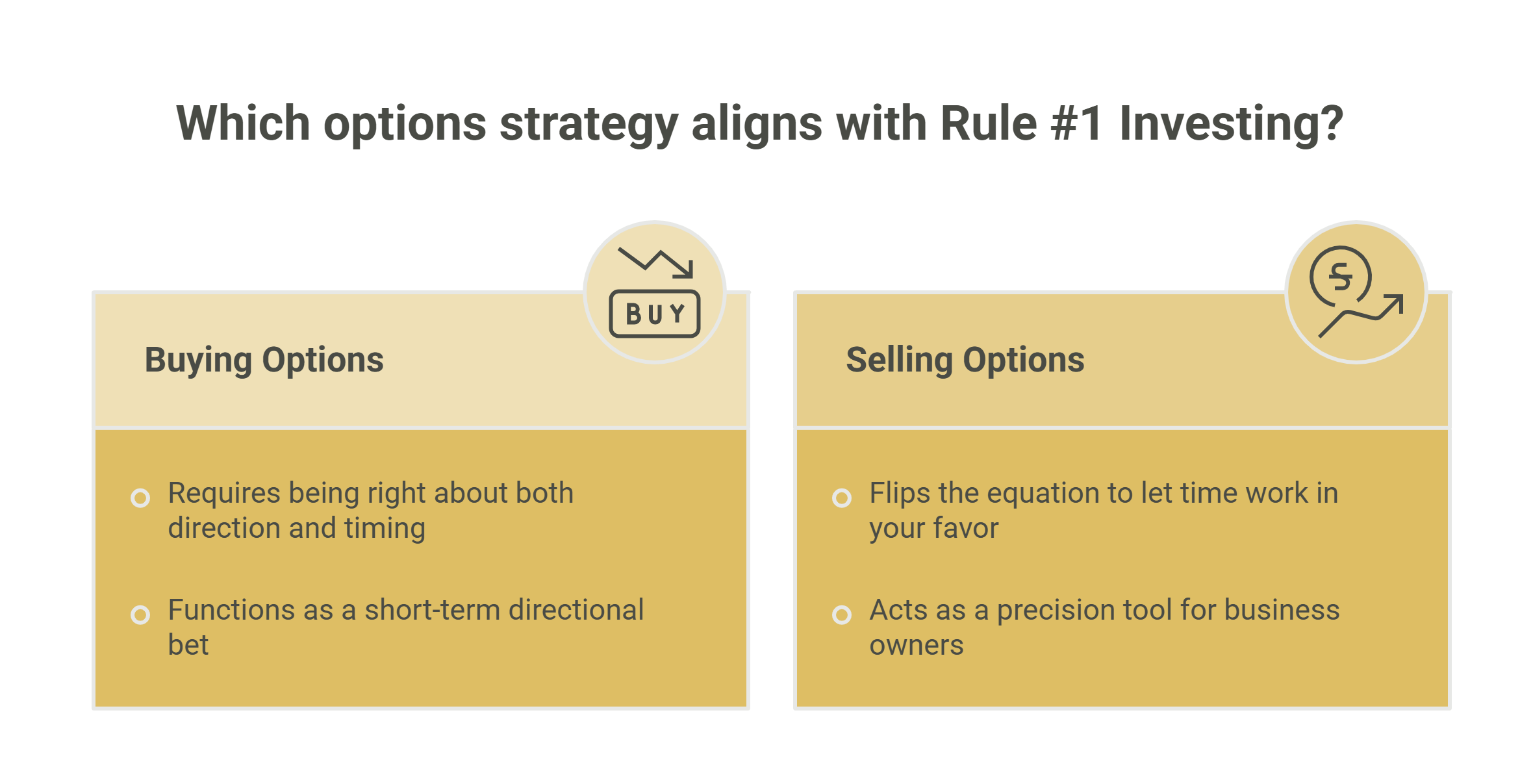
Most options content is written for traders placing short-term directional bets. Rule #1 investors are not traders. We are business owners who use options as a precision tool after the analytical work is already done.
An option is a contract that gives the buyer the right, but not the obligation, to buy or sell shares at a set price by a set date. The buyer pays a premium for that right. The seller collects it and takes on the obligation.
The distinction that matters for Rule #1 investors is this: buying options requires being right about both direction and timing. This double requirement can make it very challenging to sustain successful returns when buying options. Selling options flips the equation. We collect premium upfront and let time work in our favor.
Phil Town addresses this directly in his book, Payback Time. Advanced strategies like options can enhance returns, but only after the Four Ms are solid.
Options are never the starting point. The business is. A well-prepared trading plan is a product of a well-researched business.
For the full mechanics of how options contracts work, read how stock options work and call options explained.
The Rule #1 Filter: Four Ms Before Any Options Trade
This is the most important section on this page. Before any option is considered, the business must pass the Four Ms: the evaluation framework Phil Town teaches across all his books and workshops.
Meaning is whether the business aligns with your interests, values, and if you understand the business well enough to want to own all of it. Moat is the durable competitive advantage that keeps competitors out over the long term. Management is honest, capable leadership acting in shareholders' interests. Margin of Safety is buying at a price well below what you believe the business is actually worth.
Your Margin of Safety price is calculated from the company's own fundamentals. That number, not a chart pattern or a gut feeling, determines the strike price on a cash-secured put. The Margin of Safety calculator walks you through that calculation. The Four Ms framework covers the full evaluation process.
Phil Town's teaching throughout Payback Time is consistent on this point. Options belong to investors who have already done the Four Ms work. They're not a mechanism for bypassing it.
The Four M's For Successful Investing
How to invest with certainty in the right business at the right price
Options for Income: Getting Paid While You Hold or Wait
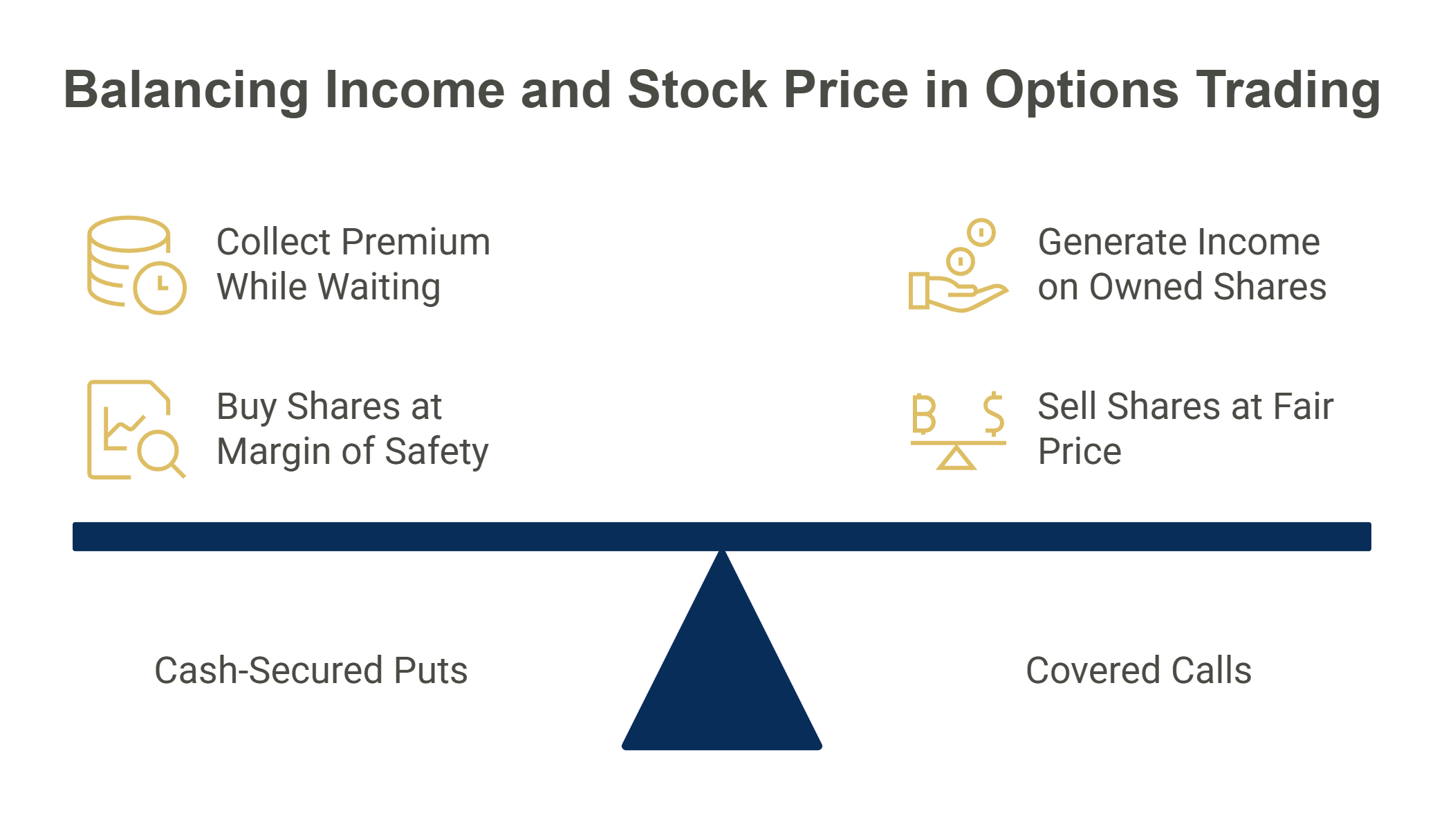
Once a business passes the Four Ms, Rule #1 has numerous strategies designed to allow investors to generate income from that conviction. Two commonly used strategies are cash-secured puts and covered calls.
Cash-secured puts let you set a target price for a wonderful company, collect a premium while you wait, and potentially buy shares at your Margin of Safety price if the stock reaches it. If it doesn't, you keep the premium and repeat. Either outcome is acceptable because the business analysis determined the price, not market timing.
Covered calls let you generate income on shares you already own by selling someone the right to buy them at a price above what you calculated the business is worth. If the shares get called away at that price, you sold a wonderful business at a price you already judged fair. If they don't, you keep the premium and still own the business.
The full Rule #1 approach to both strategies, including a real Sprouts Farmers Market example with actual numbers, is in options trading for income: the Rule #1 way. For a deeper look at how selling options generates income and reduces risk, read smart options trading and how Rule #1 options trading can maximize returns.
Options involve risk and are not suitable for all investors. This content is for educational purposes only.
Want to practice evaluating businesses with the Four Ms before applying any options strategy? That's exactly what we teach at the Rule #1 Virtual Investing Workshop, live and hands-on with real companies, and the opportunity to ask questions to real people using these very strategies in real life.
Options for Portfolio Protection: Managing Risk the Rule #1 Way
Options were not invented for speculation. They were invented to manage risk. Understanding that changes how you think about every strategy on this page.
At Rule #1, our options trades focus on much more than strictly producing cash flow. Every strategy we deploy aims to mitigate risk to the overall portfolio. When distracted by receiving premiums, one can incur more risk even with the best of intentions. A protective put is one way of managing risk.
A protective put acts like insurance on a stock you already own. It gives you the right to sell at a set price no matter how far the market falls. A collar combines a protective put with a covered call to limit your downside while capping your upside, sometimes at little or no net cost depending on the strikes you choose.
Rule #1 investors use protective puts selectively, typically when a position has grown to full value and a near-term event creates meaningful risk worth protecting against. For most situations, buying at a genuine Margin of Safety already provides the cushion.
Phil and Danielle Town walk through the collar strategy with a real example in how to protect your investments with put and call options. For a deeper look at when protective puts make sense, read protective put options.
Advanced Strategies: Credit Spreads
With cash-secured puts and covered calls as the foundation, credit spreads could be viewed as the next level up. A more advanced strategy, but also a great way to get started with a smaller amount of capital. Practicing first with paper trading helps to develop competence and confidence with credit spread trades.
A vertical spread uses two options of the same type and expiration at different strike prices, one sold and one bought, so your maximum loss is fixed before you place the trade. That defined risk is what makes spreads worth considering. You know exactly how much you stand to win and what you can lose before a single dollar is committed.
The bull put spread and bear call spread are the most common versions. Both are advanced strategies and we treat them as a complement to owning wonderful businesses, not a replacement for that foundation.
The full mechanics are in understanding vertical spreads.
Rule #1 Options Trading Guide
Learn the Fundamentals of Stock Options - The Rule #1 Way
Warren Buffett Uses Options Too, and Not to Gamble
One of the most celebrated value investors in history has used options for decades, and not to speculate. Warren Buffett, executive chairman of Berkshire Hathaway, has documented his put-selling in Berkshire's annual letters.
In 1993 he sold puts on Coca-Cola, collecting premium while he waited for a price he had already decided was attractive. Between 2004 and 2008 Berkshire sold long-dated puts on major stock indexes, detailed in the company's annual letters. In both cases the logic was identical. Name a price you'd happily own the asset at, get paid to wait, and either buy at your price or keep the income.
Phil Town documents this same approach in Payback Time through the Burlington Northern Santa Fe Railroad example. Buffett sold puts on BNI not because he was making a directional bet, but because he had done the Four Ms work and knew exactly what the business was worth to him.
The full story of what Buffett actually did with options, and why it wasn't speculation, is in does Warren Buffett trade options?
The Most Common Mistake Options Traders Make
The biggest mistake is selling options on businesses you haven't evaluated. Without the Four Ms foundation, options become speculation with extra steps, and speculation is exactly what Rule #1 is designed to avoid.
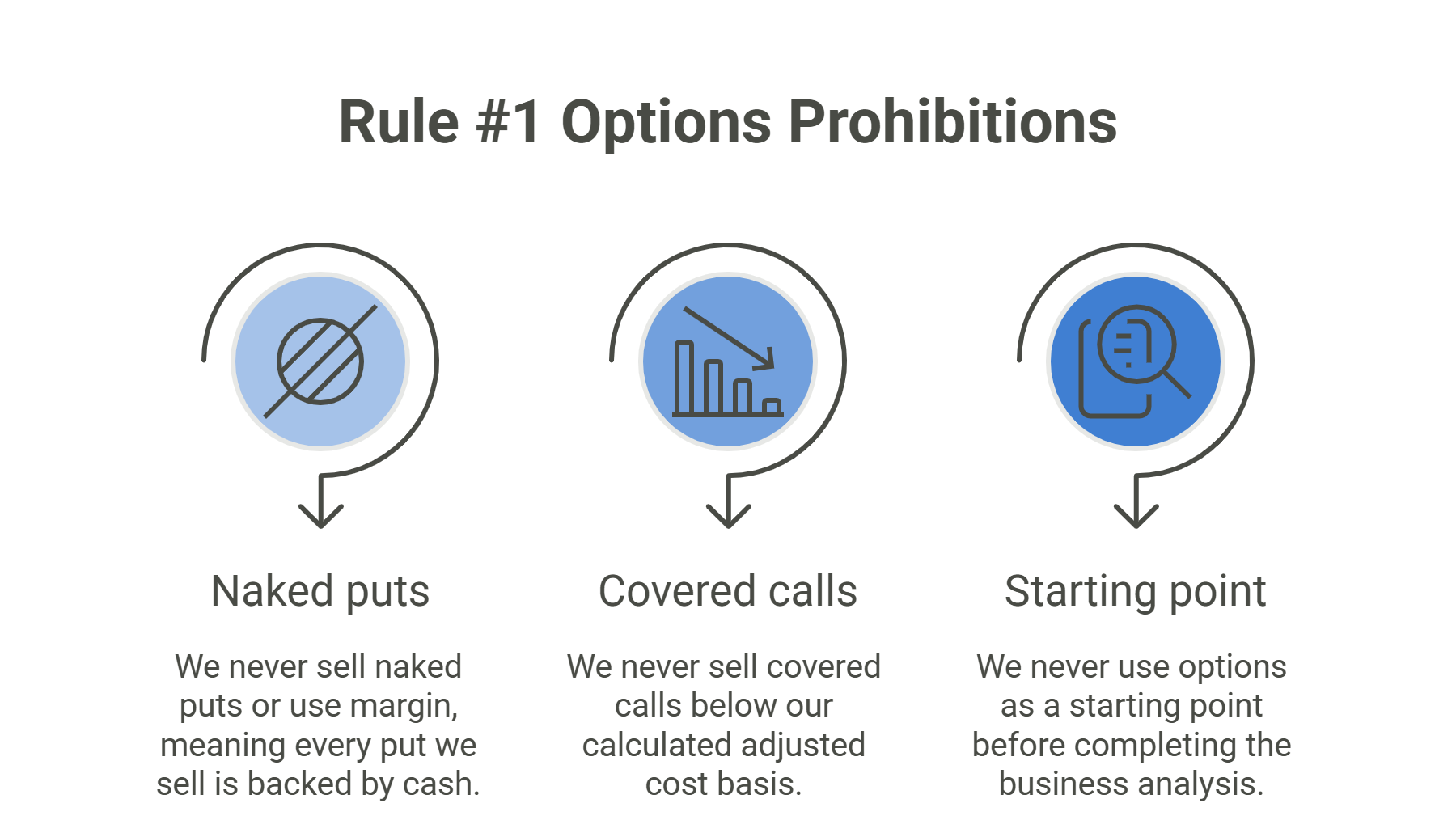
There are three things Rule #1 never does with options. We never sell naked puts or use margin, meaning every put we sell is backed by cash set aside to buy the shares if assigned. If cash isn't available, we simply sit and observe. We never sell covered calls below our calculated adjusted cost basis. And we never use options as a starting point before completing the business analysis.
These aren't arbitrary rules. They're what keeps options aligned with Rule #1's foundational principle: don't lose money.
How Options Fit Into a Rule #1 Wealth Plan
Options are a tool. They support the plan but aren't the plan itself. Building wealth the Rule #1 way still comes down to buying wonderful businesses at attractive prices and holding them for the long term. Everything else is in service of that core.
Cash-secured puts get you paid while you wait for your Margin of Safety price. Covered calls get you paid while you hold a business you evaluated and chose to own. Neither strategy changes what Rule #1 is about. They just make the waiting more productive.
When options become the strategy rather than a tool within one, the business evaluation stops mattering. That's when things go wrong. Used the right way, options make a disciplined long-term plan work harder without adding speculation.
Your Rule #1 Options Learning Path
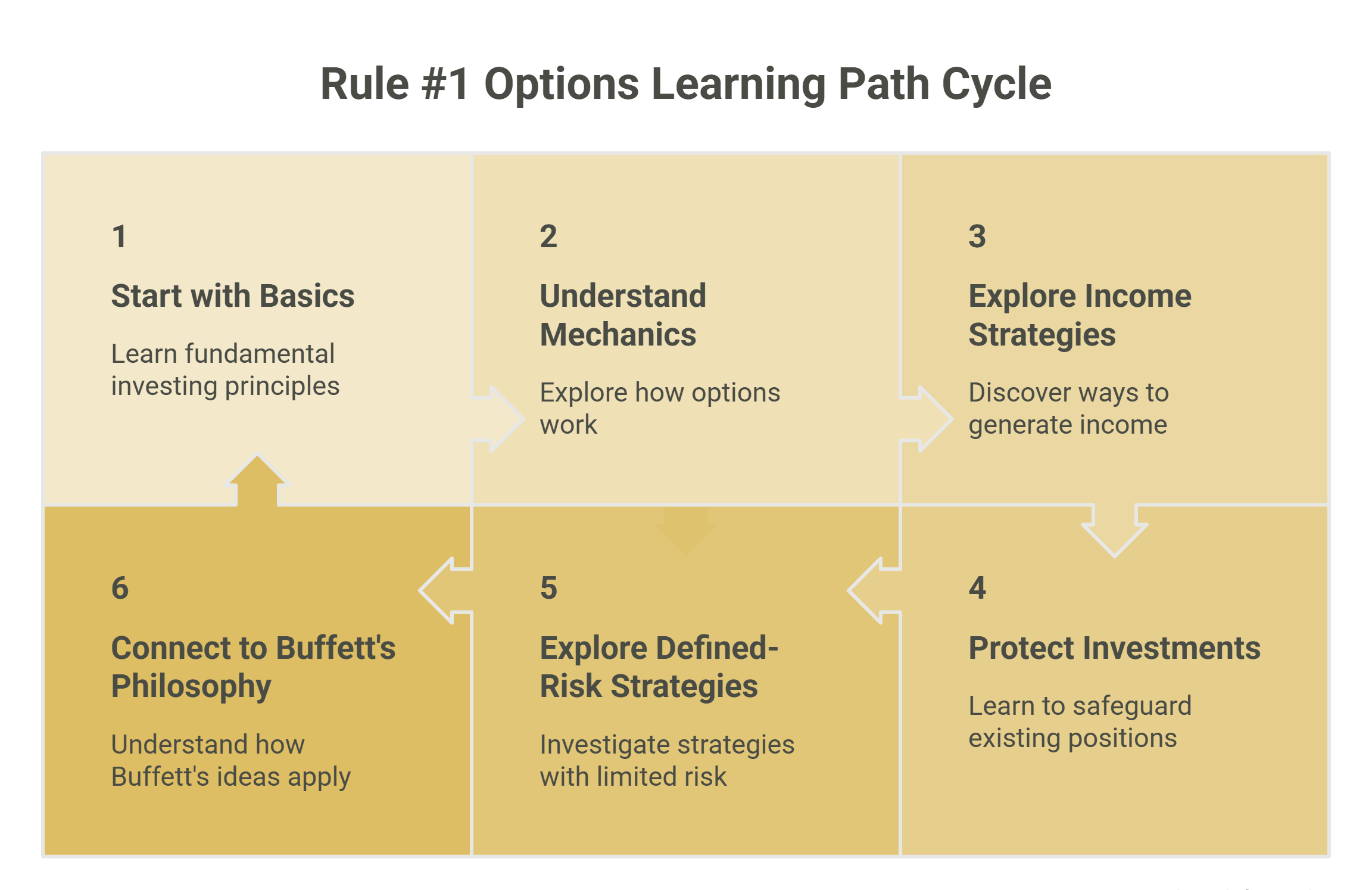
The sequencing matters as much as the strategies. Options are a later-stage tool, not where you start. Here's the right order.
Step 1 — If you're new to investing altogether, start with the beginner investing guide before anything else.
Step 2 — If you understand investing basics and want to learn how options work mechanically, read how stock options work and call options explained.
Step 3 — If you've evaluated a business with the Four Ms and are ready to explore income strategies, go to options trading for income: the Rule #1 way.
Step 4 — If you want to protect a position you already own, read how to protect your investments with put and call options and protective put options.
Step 5 — If you're comfortable with cash-secured puts and covered calls and want to explore a defined-risk strategy that also works well for smaller amounts of capital, explore understanding vertical spreads.
Step 6 — To see how Buffett's philosophy connects to everything above, read does Warren Buffett trade options?
Frequently Asked Questions About Options Trading for Value Investors
What is options trading for value investors?
Using options as a disciplined tool after completing business analysis, not as a speculative bet on price direction. At Rule #1 that means selling cash-secured puts to potentially buy wonderful businesses at a Margin of Safety price, and selling covered calls to generate income on businesses already owned. The business evaluation always comes first. The option is the mechanism, not the starting point.
What is the difference between a call and a put option?
A call gives the buyer the right to purchase shares at a set price by a set date. A put gives the buyer the right to sell shares at a set price by a set date. At Rule #1 we focus on the seller side, selling cash-secured puts and covered calls, because that's where premium is collected and where Buffett-style value investing intersects with options in a disciplined way.
Is options trading risky?
All investing carries risk and options are no exception. Selling naked puts, meaning puts without the cash to back them, can expose you to losses far exceeding your initial investment. Rule #1 never does this. With cash-secured puts and covered calls, the risk is bounded and understood before any trade is placed. The business analysis is what keeps the risk disciplined.
What options strategies do Rule #1 investors use?
We use numerous options strategies to accomplish our objectives. Some which are basic in nature and some which are more advanced. Some with higher frequency and some that are more situational based. Two of our commonly used and foundational strategies are selling cash-secured puts to potentially acquire wonderful businesses at a Margin of Safety price, and selling covered calls to generate income from businesses already owned. All of them require completing the Four Ms before any trade is placed and designed to complement the overall long-term investment plan.
Did Warren Buffett really trade options?
Yes. His documented put-selling on Coca-Cola in 1993 and equity index puts between 2004 and 2008 are detailed in Berkshire Hathaway annual letters. In both cases he had already done the business analysis and set a price he was happy to pay. He used options to get paid while he waited for the market to reach his price. The full story is in does Warren Buffett trade options?
Do I need to understand value investing before trading options?
We believe you do. The entire Rule #1 approach to options depends on knowing what a business is worth and what price you're willing to pay for it. Without that foundation, options become speculation. The Four Ms and the Margin of Safety price are what make disciplined options use possible.
Where Should a Beginner Start with Rule #1 Options?
Options are one piece of the Rule #1 framework. The complete picture, from evaluating wonderful businesses to knowing exactly when and how options fit in, is what we teach at the Rule #1 Virtual Investing Workshop. Join us.
Rule #1 Investing provides investment education and training only. We do not provide personalized investment advice, manage client assets, or guarantee investment returns. All content is for informational purposes. Consult a qualified financial professional before investing. Past performance does not guarantee future results. Individual results vary. Trading options involves risk and can result in the loss of more than the original amount invested.

About Phil Town
Phil Town is an investment advisor, hedge fund manager, 3x NY Times Best-Selling Author, ex-Grand Canyon river guide, and former Lieutenant in the US Army Special Forces.
He and his wife, Melissa, share a passion for horses, polo, and eventing. Phil's goal is to help you learn how to invest and achieve financial independence.
Get Phil's Free Guide