









SpaceX Stock Analysis: What the Lockup Expiration Actually Revealed
 Austin Bowen
 In This Article
- The Biggest IPO in History, and the Part Almost Nobody Explained
- Why You're Reading This Right Now
- One Thing About Price That Most People Have Backwards
- Picture a Neighborhood With 100 Identical Houses
- Why the Float Made the Surge Almost Inevitable
- What the SpaceX Lockup Expiration Actually Did to the Price
- Price and Value Aren't the Same Thing
- The Four M's I Run Before I Buy Anything
- You Can Love the Rockets and Still Not Buy Today
- Why I Could See This Coming
- Frequently Asked Questions
- Understand What You Own
On June 12, 2026, SpaceX priced at $135 per share and went public at a valuation of $1.77 trillion. It was the largest stock listing in history. Four days later the shares touched $225.64 and the market cap neared $3 trillion, briefly passing both Amazon and Microsoft to become the fourth most valuable company in the world.
Almost every article I read explained why the company deserved every penny of it. I want to explain something different. I want to show you the machinery underneath that price, because the machinery is what decided where the stock went next.

The Biggest IPO in History, and the Part Almost Nobody Explained
I want to be clear about where I stand on the company. I think Elon Musk is the best entrepreneur in history, and I think SpaceX is one of the most remarkable businesses any of us will ever watch get built. This isn't a hit piece, and I'm not telling anybody to short this stock.
What I am going to do is walk you through why the price moved the way it did. Rockets got the credit. Starlink got the credit. The actual reason was a lot simpler, and most of the coverage walked right past it.
Why You're Reading This Right Now
If you bought SPCX after the IPO, you're looking at a number today that doesn't resemble the one you paid. If you thought about buying and didn't, you're probably wondering whether you missed a window or dodged something.
Either way, the question you're really asking is whether SpaceX stock is a good buy, and I can't answer that for you. What I can do is show you the mechanics, because they're the part nobody explains and they show up again in every hot IPO that follows this one.
Learn to see this once and you'll recognize it the next time somebody tells you a company deserves whatever price the market is printing.
One Thing About Price That Most People Have Backwards
A stock price isn't a calculation of what a company is worth. It's the last price somebody paid for a share. That's the whole machine.
When more people want to buy than there are shares available, buyers have to outbid each other and the price climbs. When more people want to sell than there are buyers, sellers keep cutting until somebody bites.
Rockets, earnings, and tweets don't move a price directly. They move it by changing how badly people want to buy or sell right now. If you want the fuller version of that, Phil covers it in his breakdown of what makes stocks go up and down. I'm going to stay on the part specific to IPOs.
Picture a Neighborhood With 100 Identical Houses
Imagine the most desirable neighborhood in the world. A hundred identical houses, and for ten years nobody has been allowed to buy or sell a single one of them.
Then the rules change, but only partway. Five houses go up for sale. The other 95 owners are legally banned from listing, showing, or transferring anything.
Now put 30 buyers in that neighborhood who want in badly enough to fight for one of those five spots. Those five houses get bid into the stratosphere, because five is all anybody can buy.
Here's the part that matters. All 95 locked-up owners look at those sale prices and decide their house must be worth that too. They feel rich on paper. Some of them start spending like it.
So ask the question this whole thing turns on. What happens to prices in that neighborhood the day the selling ban lifts, and suddenly there are 50 people who want out and only 20 people who want in?
That neighborhood is the SpaceX IPO. With one important difference, which I'll get to.
Why the Float Made the Surge Almost Inevitable
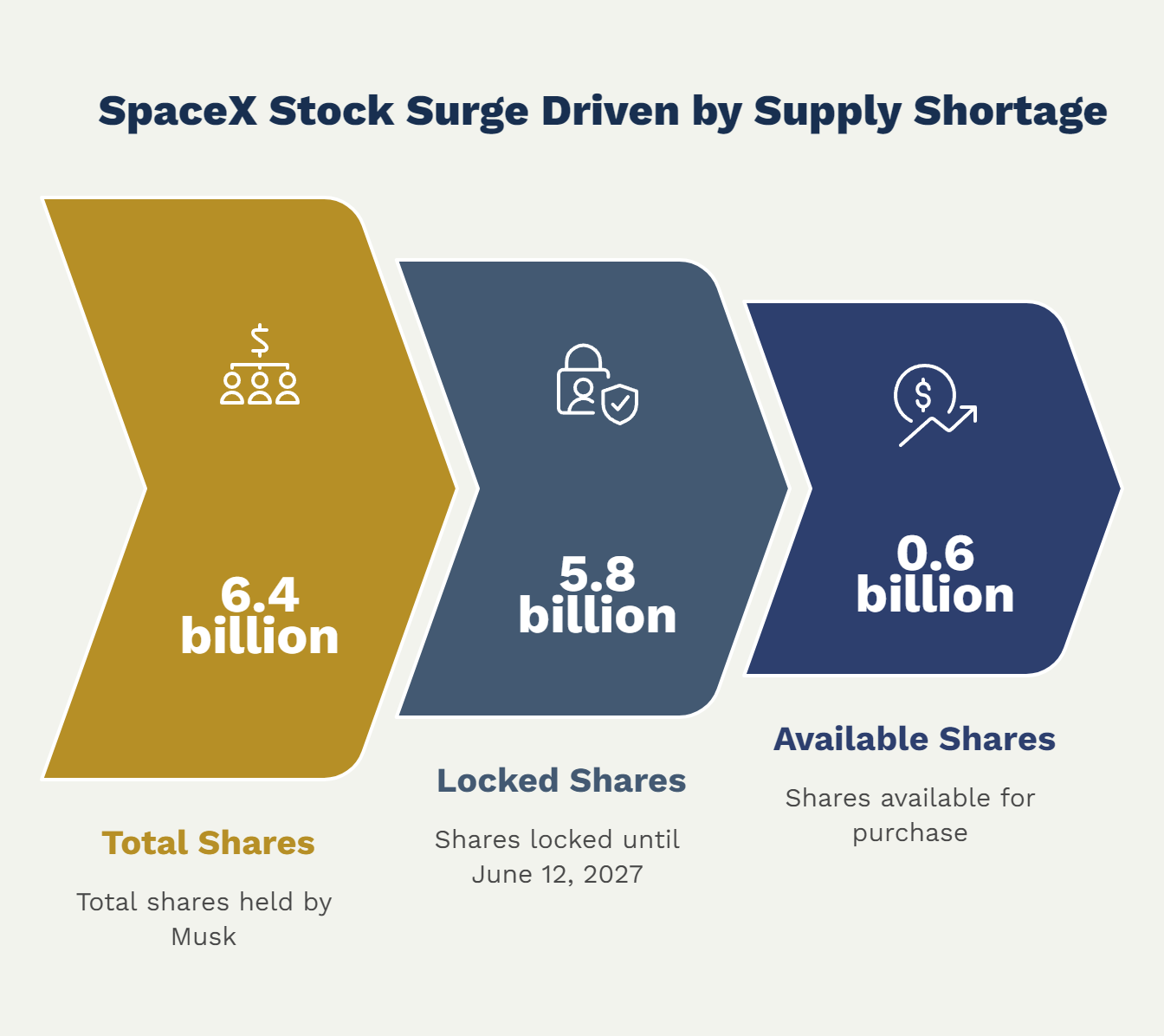
When SpaceX went public, only a thin slice of the company's total shares actually reached the open market. Everything else stayed locked with early investors, employees, and Musk himself. Legally untradeable.
At the time I was seeing reports of roughly $350 billion in orders chasing the stock that was actually for sale, which would put demand somewhere around four or five times the available supply. I can give you a cleaner data point than that, though.
That's what a supply shortage looks like from the inside. There simply weren't enough shares to go around.
So when the stock hit $225.64 on June 16, that number wasn't the market's careful estimate of what Starlink will earn over the next decade. It was too much money chasing too little stock.
Who Was Holding the Shares Nobody Could Sell
The locked-up shares sat with people who'd been waiting years for this exact moment. Employees who became millionaires on paper the day the stock opened. Venture capital and private equity firms that funded the early years and have their own investors asking when they get paid.
Musk's roughly 6.4 billion shares are locked until June 12, 2027, with no early-release provisions attached. Take his stake out of the picture entirely and you're still left with an enormous block of stock held by people with every financial reason to sell the moment they legally could.
What the SpaceX Lockup Expiration Actually Did to the Price
I recorded my original take on this in June, when the stock was still climbing. But it quickly reversed course.
SpaceX set August 4 as its first earnings report as a public company. That date also triggered the staggered lockup schedule, which gave insiders a path to sell some shares earlier than the standard 180-day block. The stock trading down below its IPO price was in my opinion, early investors taking profit before the first lockup arrived on August 6h
Now, why did the stock trade back up after the lockup? Because an early-release provision that could have freed an additional 455.8 million shares expired. It required the stock to trade at least 30% above the IPO price during five of the ten trading days before earnings. That never happened.
Price and Value Aren't the Same Thing
This is where all of it lands, and it's the reason I bothered writing any of it down.
Price is whatever the auction produces on a given day. It runs on emotion, on hype, and on mechanical facts like a locked float and a line of sellers waiting for a date on a calendar. The $225.64 peak was a price. The $108.27 close was a price. Neither one told you what the business is worth. In the short term, lots of factors that arent related to a business can cause the stock price to swing like SpaceX.
Value is derived from understanding what the business is worth today, based on what the business will be worth in the future. At Rule #1 We call our estimate of that number the Sticker Price, and we never pay it. We wait until the market offers the business at roughly half, and that gap is the Margin of Safety.
That's the discipline. If you know how to calculate the buy price of a stock and the stocks current price is at or below it, you have a Margin of Safety.
Calculating a Sticker Price is a learnable skill, not a talent. The Virtual Investing Workshop is where we teach it, on real companies with real numbers, with coaches working alongside you.
The Four M's I Run Before I Buy Anything
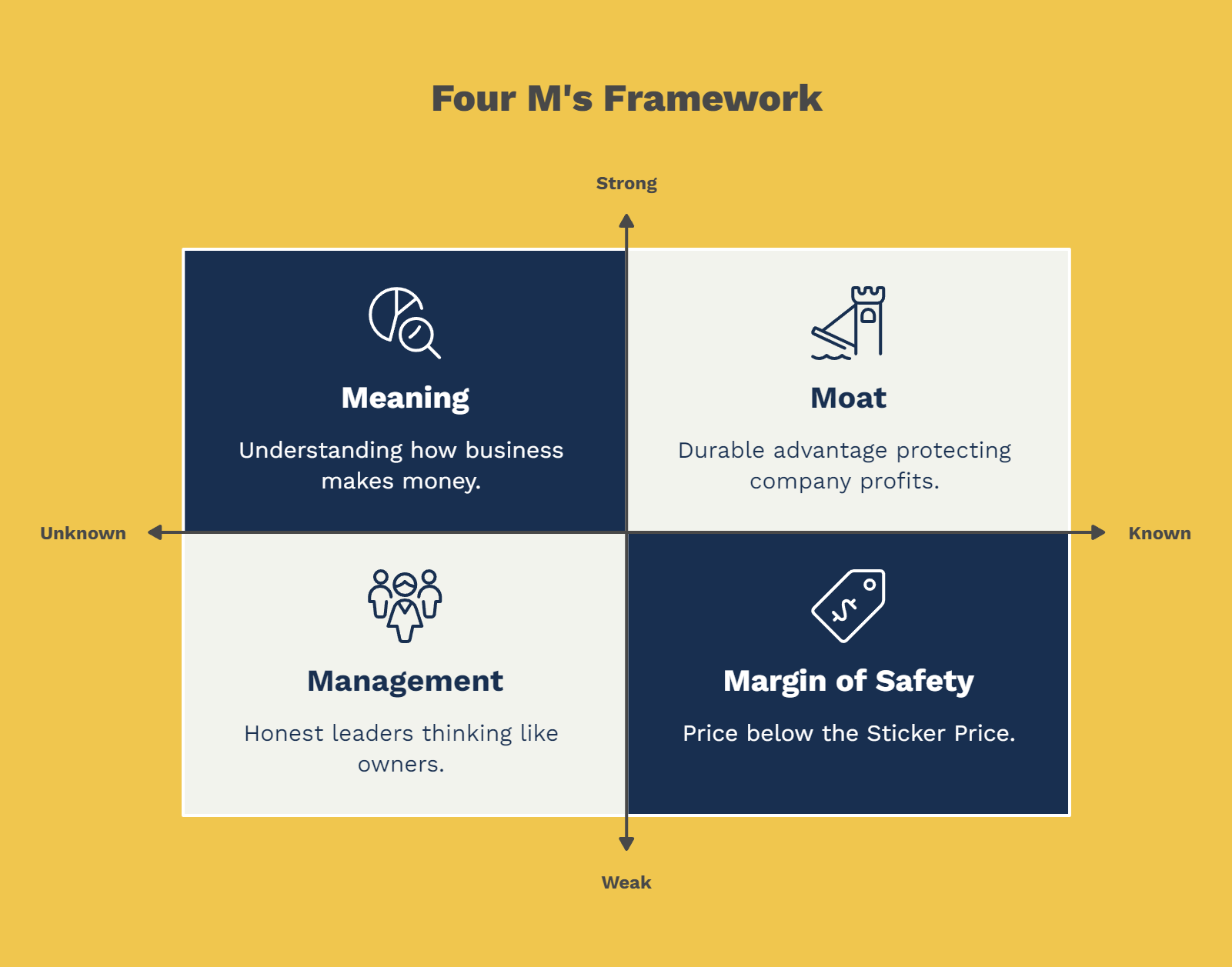
Every business gets the same four questions from me, at every price, in every market. We call them the Four M's.
Meaning comes first. Do I understand how this business actually makes money? SpaceX now spans rockets, Starlink satellite internet, and AI capability after the xAI acquisition closed in February 2026. That's three businesses in three industries, and whether they sit inside your Circle of Competence is a question only you can answer honestly. They don’t fall in mine.
Then Moat. Does the business have a durable advantage that keeps competitors from taking its profits? The Big Five Numbers are where you can see easy evidence of a Moat based on ten years of financial history. Companies like SpaceX lack this financial history, which means it's harder to understand the strength of the Moat
Then Management. Are the people running it honest, capable, and thinking like owners rather than operators chasing a quarter?
And then Margin of Safety, which is the one everybody skips. Is the price meaningfully below the Sticker Price? Is this company on sale.
You Can Love the Rockets and Still Not Buy Today
I'll say the position plainly, because I think people get this backwards.
I like this company. I still think Starlink could be by itself one of the worlds most valuable businesses, and if there was any CEO that could make it happen. Elon’s the CEO. But that doesn’t mean that buying it now, is going to result in a good return.
Those aren't contradictions. A great business can be a bad investment if you overpay for it. That's most of the game right there.
I'm not telling you to sell, I'm not telling you to short it, and I'm not telling you what to do with your money. I'm showing you the machinery underneath the price so you can decide with more than a headline.
Why I Could See This Coming
How did I know the stock was very likely to shoot up and come right back down? I was trained to look for exactly this kind of risk, the kind that hides underneath an exciting story.
Wall Street has no incentive to explain float mechanics to you. It's the same thing I see in options, where the language gets made deliberately complicated so you conclude you can't do it yourself. The complexity is often the product.
That training came from Rule #1. More than two million people have learned to invest using Rule #1 principles, and more than 25,000 have come through a workshop across 56 countries.
As Arthur Levitt, former Chairman of the SEC, put it: "Follow Town's simple, time-tested precepts, and even unsophisticated investors will leave most mutual fund managers in the dust."
Frequently Asked Questions
What happens when a stock lockup expires?
A lockup expiration is the first date insiders can sell, including employees, venture capital investors, and private equity backers. Before that date those shares can't trade, so the float is artificially small and a given amount of buying pushes the price further than it otherwise would. When the lockup lifts, supply increases, and if it outruns demand at current prices sellers have to come down to find takers.
What is a stock float and why does it matter?
A float is the number of shares genuinely available to trade. It leaves out anything locked up by insiders, employees, or early investors who aren't yet permitted to sell. A small float amplifies price movement in both directions, because the same amount of buying or selling hits a much smaller pool of shares.
Is SpaceX stock a good buy?
Anybody handing you a clean yes or no is skipping the work. The real question is whether today's price sits meaningfully below the Sticker Price, and answering that means understanding the business, its competitive position, and its management. We don't give buy or sell recommendations at Rule #1. What we teach is how to run that analysis yourself.
Understand What You Own
Go back to that neighborhood one last time. Those five sales were real. The 95 owners feeling rich were real people. August happened, and so did the stock rising on the day the first doors opened.
The point of learning this isn't to call the next unlock date or guess where the stock will go next. It's to stop being surprised by forces nobody showed you existed.
Once you understand that a price is the output of an auction rather than a calculation of worth, and that an example like a float and lockup schedule can quietly shape that auction, you can't unsee it. I’m offering you a choice of taking the blue pill or the red pill. Should you take the Blue pill, you wake up tomorrow and believe the illusion that Wallstreet is “all-knowing” and on your side. That price and value are always equal, and the market is efficient. But if you take the red pill. You stay with me in reality. A reality that shows you how Wallstreet’s incentive is to sell you. To do whatever is in their best interest first, and if you can benefit with them, then that is a nice side dish to their entree. The only way you can make sure your best interests come first is to take control of your own reality and learn how to do this yourself.
If you want to learn how to do this with any business, how to find the risk before it costs you, and how to tell a great company apart from a great price, come join us. That's the shift we walk you through step by step, on real businesses, at the Virtual Investing Workshop.
About the Author
Austin Bowen is a Senior Investment Analyst at Rule #1 Investing and a portfolio manager on the Rule One Fund. A former Air Force Combat Controller who completed two deployments to Afghanistan, he's spoken to more than 40,000 students on Rule #1 investing principles. He does not hold any shares of SpaceX at the time this article was written.
Rule One Investing provides investment education and training only. We do not provide personalized investment advice, manage client assets, or guarantee investment returns. All content is for informational purposes. Consult a qualified financial professional before investing. Past performance does not guarantee future results. Individual results vary.

About Austin Bowen
Phil Town is an investment advisor, hedge fund manager, 3x NY Times Best-Selling Author, ex-Grand Canyon river guide, and former Lieutenant in the US Army Special Forces.
He and his wife, Melissa, share a passion for horses, polo, and eventing. Phil's goal is to help you learn how to invest and achieve financial independence.
Get Phil's Free Guide