










Does Warren Buffett Trade Options? (And Does Phil Town?)
 Phil Town
 I get this question a lot. And I understand why.
On one hand, you've probably heard Warren Buffett call derivatives "weapons of mass destruction." On the other hand, you've seen the headlines about Berkshire Hathaway collecting nearly $5 billion selling put options. And somewhere in the middle of all that, someone told you that I teach options trading at Rule One.
So which is it?
The answer is: all of it is true. And once you understand why there's no contradiction, it changes everything about how you think about options.
Here's what I'll cover. What Buffett actually did with options and why it wasn't speculative. How I use the same approach in my own investing. And the one thing you need to have in place before any of this makes sense.
That last part matters more than people realize. So keep it in mind as we go.
The "Weapons of Mass Destruction" Quote, What Buffett Actually Meant
Let me clear this up right away.
In one of his shareholder letters, Buffett wrote that derivatives were "weapons of mass financial destruction." People have been quoting that line ever since to argue that he's anti-options. But that's not what he said. Not really.
What he was describing was a specific problem. Institutions were piling into complex derivative contracts with obligations they couldn't fully meet if things went wrong. Billions of dollars in exposure, layered on top of each other, with no real protection if the system cracked. He was warning about a risk to the entire financial system. And he was right. We saw exactly what he was talking about playing out in 2008.
That has nothing to do with a disciplined investor selling a put option on a business they've already researched and would be happy to own.
Think about it this way. A hammer can build a house or break a window. Buffett wasn't against hammers. He was against people swinging them blindly in a crowded room.
The distinction matters because it's the whole story. Buffett's objection was never to the instrument. It was reckless speculation without knowledge. Leverage without limits. Obligations without the means to meet them.
Keep that in mind as we look at what he actually did.
How Warren Buffett Actually Uses Options
So what did he actually do? Two trades tell the whole story.
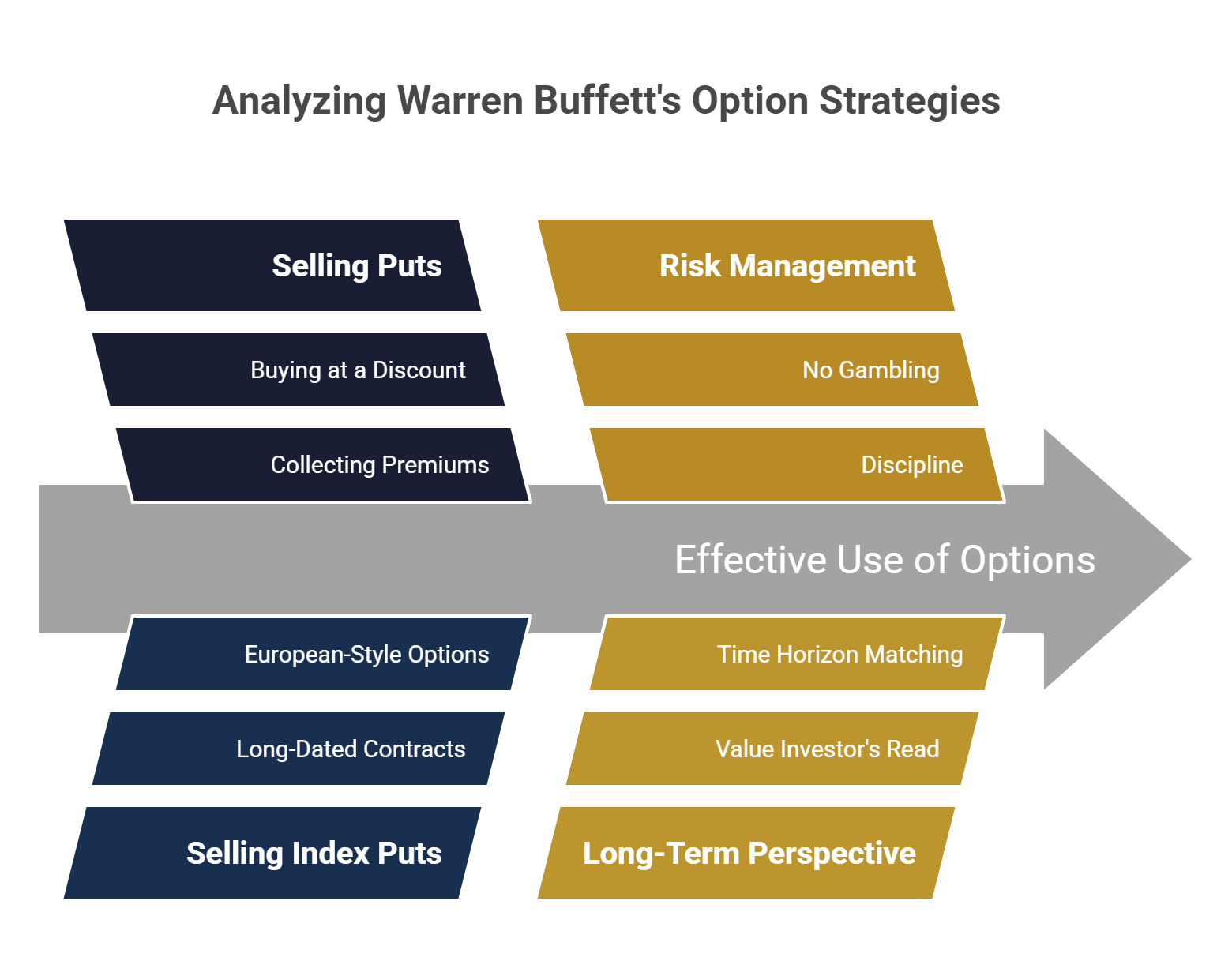
Selling Puts to Buy Great Companies at a Discount
In 1993, Buffett wanted to buy more shares of Coca-Cola. He already owned the stock. He already loved the business. He had already done the work to know what it was worth. The only question was price.
So instead of just putting in a buy order and waiting, he did something smarter. He sold a large number of out-of-the-money put contracts on Coca-Cola and collected millions in premiums upfront.
Here's what that meant in plain English. He made a promise to buy Coca-Cola shares at a set price if the stock dropped to that level. In exchange for making that promise, he got paid right away.
Two things could happen from there. If Coca-Cola dropped to the strike price, he would buy more shares of a wonderful business at a price he had already decided was attractive. That was a good outcome. If Coca-Cola stayed above the strike price, the options expired worthless and he kept the premiums as pure income. That was also a good outcome.
Both outcomes were acceptable. That's the key. He wasn't gambling on which way the stock would move. He was getting paid to wait for a price he already wanted.
That is not speculation. That is discipline with a premium attached.
Selling Index Puts During the 2008 Crisis
The second trade is bigger and gets misunderstood even more.
In the years leading up to the 2008 financial crisis, when fear was high and market volatility was spiking, Berkshire sold long-dated put options on several major global stock indices, including the S&P 500.
Berkshire collected more than $4 billion in upfront premiums. That money went straight to work as an investment float, capital Berkshire could deploy while the contracts ran their course.
Now here's the part most articles leave out. These were European-style contracts. That means the buyer could not exercise them early. The only price that mattered was the index level on the final expiration date. The contracts were structured to run 15 to 20 years out.
Think about what that structure means. Berkshire wasn't exposed to the day-to-day swings of the market during the financial crisis. A steep drop in 2008 was painful to watch. But it was completely irrelevant to these contracts. What mattered was where those indices stood a decade and a half later.
When the contracts eventually expired, Berkshire paid out nothing.
People say Buffett got lucky. I'd push back on that. He didn't bet that markets would recover. He made a judgment that over 15 to 20 years, the probability of a complete and permanent collapse of the world's major stock markets was negligible. That's not a speculative bet. That's a value investor's read on long-term business fundamentals applied at the index level.
He understood what he was betting on. He structured the contracts to match his time horizon. And he got paid more than $4 billion upfront to do it.
That's the pattern. And once you see it, you'll recognize it in everything I'm about to show you about how I use options in my own investing.
The Rule That Made These Trades Safe
Here's what nobody talks about.
Every article out there about Buffett and options focuses on what he did. The contracts. The premiums. The structure of the deals. But they all skip the part that actually made those trades safe.
He already knew what those businesses were worth.
Before Buffett sold a single put on Coca-Cola, he had done the work. He understood the moat. He trusted the management. He had figured out what the company was worth and what price represented a real bargain. The option came last. The valuation came first. That's not a small detail. That's the whole thing.
When you know what a business is worth, assignment isn't a risk. It's an opportunity
If the stock drops to your strike price, you're buying a wonderful business at a price you already calculated was attractive. If it doesn't, you keep the premium as income. Either way, you win. Both outcomes work because the homework was done before the trade was placed.
Without that foundation, selling puts is just speculation dressed up in respectable language.
I've said this to my students for years, and I wrote it in my book:
"Success in options comes first from being a solid Rule #1 investor."
That line isn't a disclaimer. It's the entire instruction manual.
Here's how it works in practice:
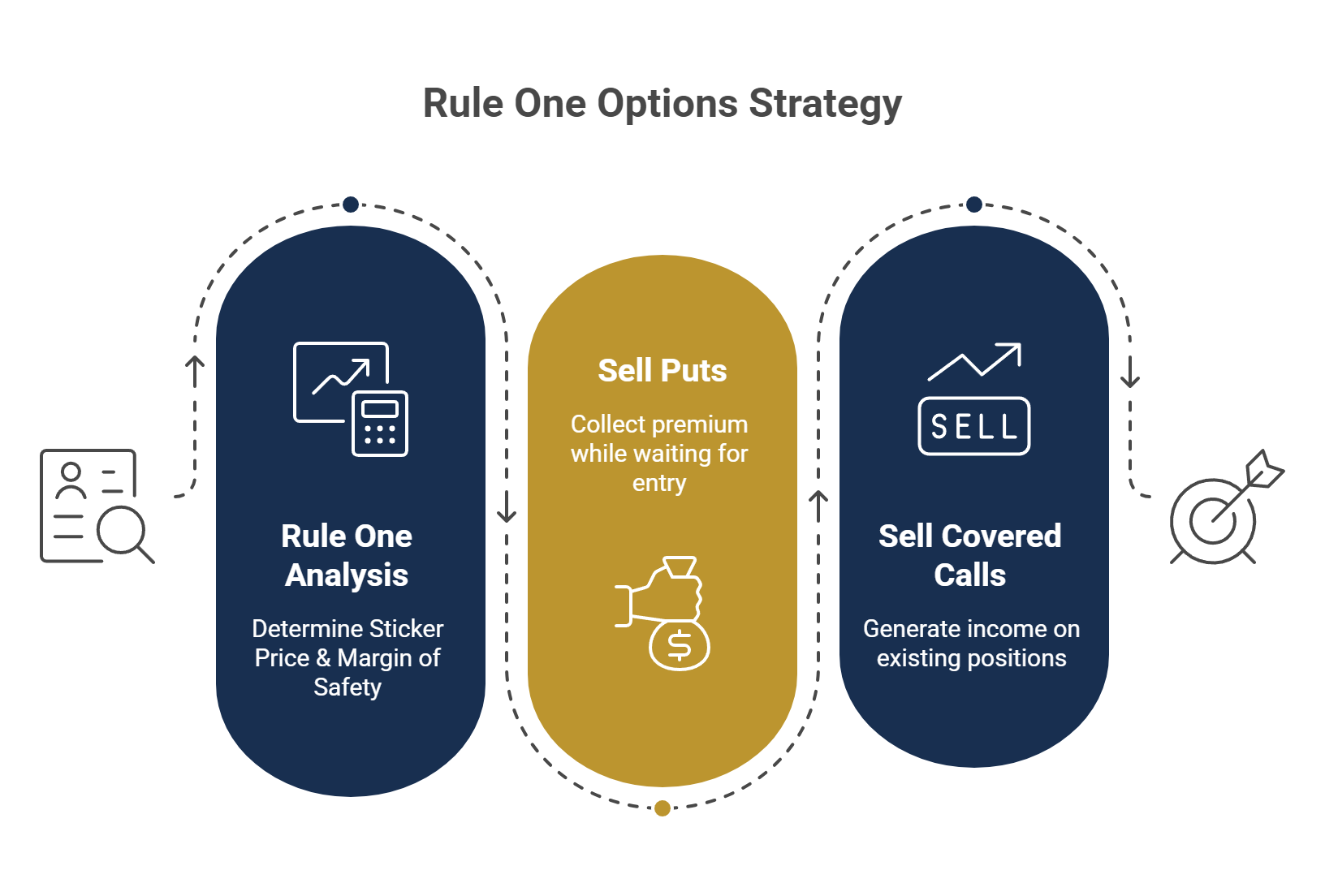
At Rule One, we teach you to calculate the Sticker Price first. That's the true value of the business. Then we cut it in half to find the Margin of Safety price. That's your buy target.
If you're going to sell a put, your strike price should sit at or below that Margin of Safety price. Only then are you operating the way Buffett operates. Only then is assignment an outcome you'd welcome rather than one you'd dread.
The options weren't Buffett's strategy.
Knowing what the business was worth was his strategy.
The options were just the instrument he used to get paid while he waited.
That distinction matters more than anything else in this article. Keep it in mind as I show you exactly how I use this same approach in my own investing.
How Phil Town Uses Options the Rule One Way
I don't just teach this. I do it.
The same logic Buffett uses is the same logic I use in my own portfolio. And it comes down to one simple rule: I only use options on companies I've already done the full Rule One analysis on. That means I know the Sticker Price. I know the Margin of Safety price. I know what I'd be happy to pay. The option comes after all of that. Never before.
Here's what that looks like in practice.
Selling Puts Below the Margin of Safety Price
Let me walk you through my process.
First, I find a wonderful company. One that passes all Four M's. A business I understand, with a durable competitive advantage, run by management I trust. Then I calculate the Sticker Price and cut it in half to get my Margin of Safety price. That's the price I'd be genuinely excited to buy at.
Now, here's where options come in.
If the stock isn't there yet, instead of sitting on my hands, I'll sell a put with a strike price at or below my Margin of Safety price. I collect the premium upfront. One important note: the cash to buy those shares has to be sitting in your account before you sell the put. That's not optional. If you're assigned, you need to be ready.
From there, one of two things happens.
If the stock drops to my strike price: I'm obligated to buy shares. But that's fine. That's actually what I wanted. I'm buying a wonderful business at a price I already calculated was a bargain.
If the stock stays above my strike price: The option expires worthless. I keep the premium and I keep looking for my entry.
Either way, I win. That's the structure of a Rule #1 put.
I've used this approach on companies I follow closely. Take Boeing as an example. At one point I was selling puts with strike prices well below my calculated intrinsic value for the business. If I got assigned, I was buying a wonderful company at what I believed was a genuine discount. If I didn't get assigned, I kept the premium and stayed patient.
That's not speculation. That's getting paid to wait for the price I already wanted.
Selling Covered Calls on Positions I Already Own
The second approach works the other way around.
Once I already own shares of a wonderful company at a good price, I'll sometimes sell covered calls against that position. That means I'm selling someone the right to buy my shares at a set price above where the stock is trading today.
Again, two outcomes. Both are acceptable.
If the stock rises to the strike price: My shares get called away. But I'm selling at a level I already decided was a profitable exit. That's a good outcome.
If the stock stays below the strike price: The call expires worthless. I keep the premium as additional income and I still own the position.
I've done this in positions in companies I know well, including in the technology and consumer sectors. In each case, the strike price I chose was at a level where I'd be perfectly comfortable with either outcome.
That's the pattern. Same logic every time. Calculate the value first. Set your price. Use the option to generate income while you wait. And never sell an option on a business you wouldn't want to own outright.
The Four M's Filter, Why Rule One Options Are Different
People ask me all the time: what makes Rule One options different from what everyone else is doing?
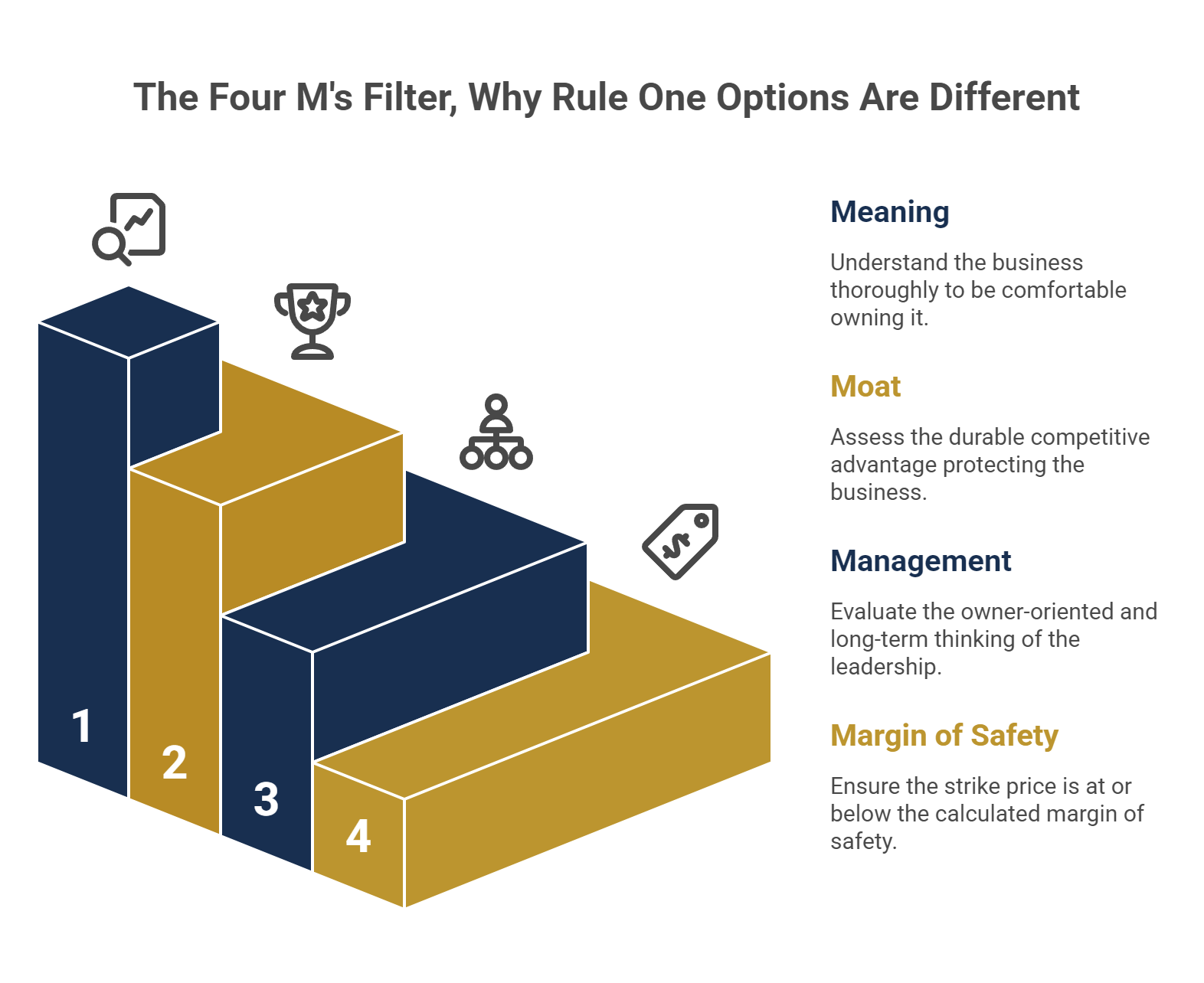
The answer is the filter we run every company through before a single option is considered. We call them the Four M's. And they're the reason our approach to options as risk management looks nothing like the speculative trading most people associate with the word "options."
Here's what each one means in the context of selling a put.
Meaning
This one comes first for a reason. Before I do anything else, I have to understand the business well enough to be comfortable owning it. Not just comfortable holding the stock. Comfortable owning the whole company.
That matters for options because if I'm assigned, I'm a shareholder. If I don't understand the business, I have no idea what I'm getting into. Meaning is what separates a deliberate decision from a blind bet.
Moat
A moat is the durable competitive advantage that protects a business from its competitors. Think of it as the castle wall. The wider and deeper it is, the harder it is for anyone to take the business down.
For options, this matters more than most people realize. An option contract runs for weeks or months. During that time, I need confidence that the business isn't going to deteriorate. A wide moat gives me that confidence. It means the company's value is unlikely to collapse between now and expiration.
Management
I want to know that the people running this business are owner-oriented. That means they think like long-term owners, not short-term operators. They're building something. They're protecting the value of the business I might end up owning.
If I don't trust management, I don't sell the put. Simple as that.
Margin of Safety
This is where the options strategy connects directly to the valuation work. Once I have the Sticker Price, I cut it in half to get my Margin of Safety price. That's my buy target. And for a cash secured put, that's where my strike price needs to sit.
If the strike is at or below the Margin of Safety price, assignment is welcome. If it isn't, the trade has no business being placed.
You can read more about how I calculate the Margin of Safety price and why it's the foundation of every Rule One decision.
Run all four of those before you sell a put and something interesting happens. The trade stops being a gamble on price movement. It becomes a disciplined decision with two acceptable outcomes.
That's why I call this approach value investing options strategy, not options trading. The options are just the tool. The Four M's are the strategy.
Skip even one of them and you're speculating. Work through all four and you're investing.
If you want to go deeper on the Four M's and how I use them to evaluate a business, here's where to start.
Can You Use Options This Way Too?
Yes. But the sequence matters.
Before you ever look at an options chain, you need to be able to answer one question: do you know what the business is worth?
If you can calculate a Sticker Price and a Margin of Safety price with confidence, options become a legitimate tool. You know your target entry price. You know what an assignment looks like. Both outcomes work in your favor.
If you can't do that yet, no amount of conservatively structured trades will fix it. Options without valuation knowledge is speculation with extra steps.
Options are an addition to the Rule One strategy, not a replacement for patient, long-term ownership. The best investors in the world build wealth by buying wonderful companies and holding them. Options just give you something productive to do while you wait.
That's why the Rule One Virtual Investing Workshop starts with valuation, not options.
You'll learn to run a company through the Four M's. Calculate Sticker Prices and Margin of Safety prices on real businesses. Practice with live coaches so you leave knowing how to do this yourself. Options come after that foundation is in place. That's the right order.
Join us at the Virtual Investing Workshop.
Options trading involves risk and is not suitable for all investors. This article is for educational purposes only and does not constitute personalized investment advice. Publishing team: insert standard compliance language per the Marketing Compliance Guide before publication.

About Phil Town
Phil Town is an investment advisor, hedge fund manager, 3x NY Times Best-Selling Author, ex-Grand Canyon river guide, and former Lieutenant in the US Army Special Forces.
He and his wife, Melissa, share a passion for horses, polo, and eventing. Phil's goal is to help you learn how to invest and achieve financial independence.
Get Phil's Free Guide