








What are Call Options and How Do They Work? A Complete Guide
 Trent Pearce
 In This Article
- Why I Always Start with the Options Grid, Not Just Call Definitions
- What a Call Option Actually Is
- How Call Options Work for Both Buyers and Sellers
- Call Options vs Puts vs Just Buying Stock
- Where Call Options Fit in the Rule 1 Approach (The "Risky Biz" Reality)
- Your Next Steps in Understanding Options
When I first came across options trading, I did what most people do, I Googled it and immediately regretted it.
I'd spent years leading high-performing teams in technology and real estate, so I wasn't afraid of complexity. But the options content out there dropped you right into the deep end. Strike prices, Greeks, expiration chains, with zero context for how any of it fit together.
I've been teaching options for years, but it wasn't until I came to Rule One that I developed a framework that actually sticks. After working with students across Rule One's advanced programs, I've found one thing makes the biggest difference: you have to see the whole picture before any individual piece makes sense.
There are only two types of options in the world. Puts and calls. And only two things you can do with either one. Buy them or sell them. Four squares total.
The Complete Options Picture:
Buy a Put = You get the right to sell shares
Sell a Put = You take on the obligation to buy shares
Buy a Call = You get the right to buy shares
Sell a Call = You take on the obligation to sell shares
Call options live in just one of those squares. Once you see where they fit in the complete picture, they stop being mysterious.
That's where we'll start.
Why I Always Start with the Options Grid, Not Just Call Definitions
Starting with isolated call option definitions creates confusion.
There are only two types of options: puts and calls. Only two things you can do: buy them or sell them. Four squares total.
The Complete Options Grid:
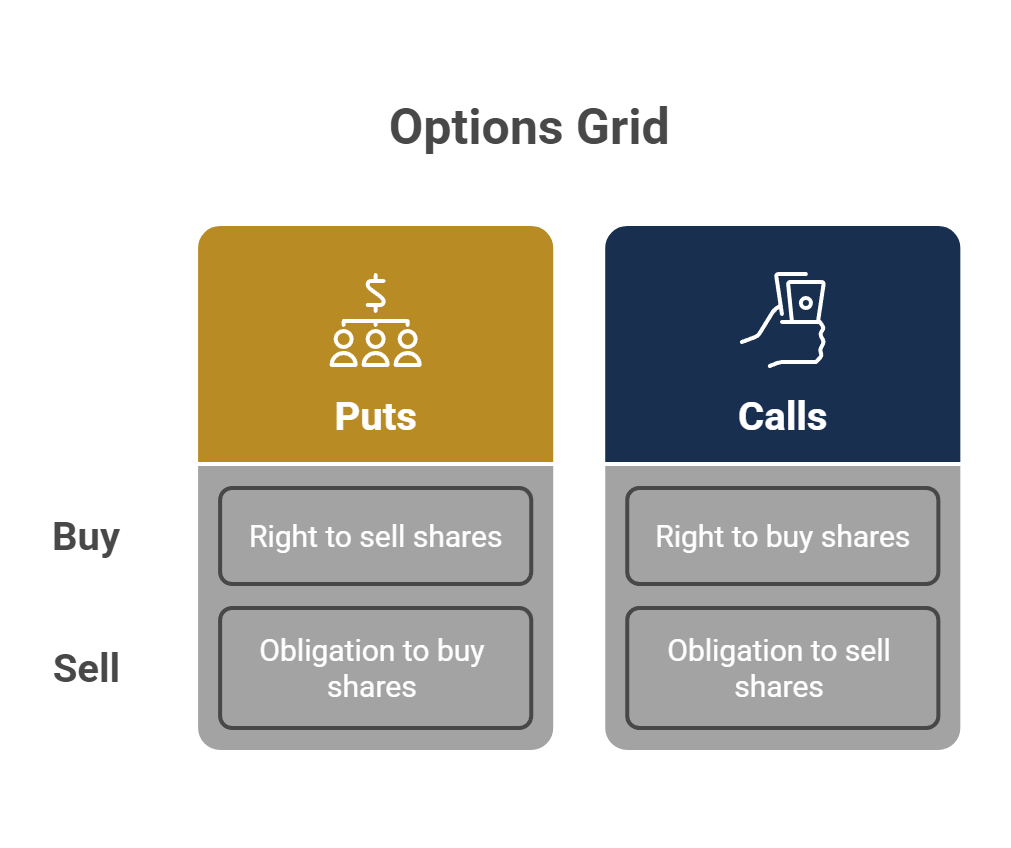
Buyers have rights. Sellers have obligations.
Buy any option? You get a right. Use it or don't. Sell any option? You take on an obligation. The buyer can force you to act. Call options occupy one square: "buy a call." You get the right to buy shares.
What a Call Option Actually Is
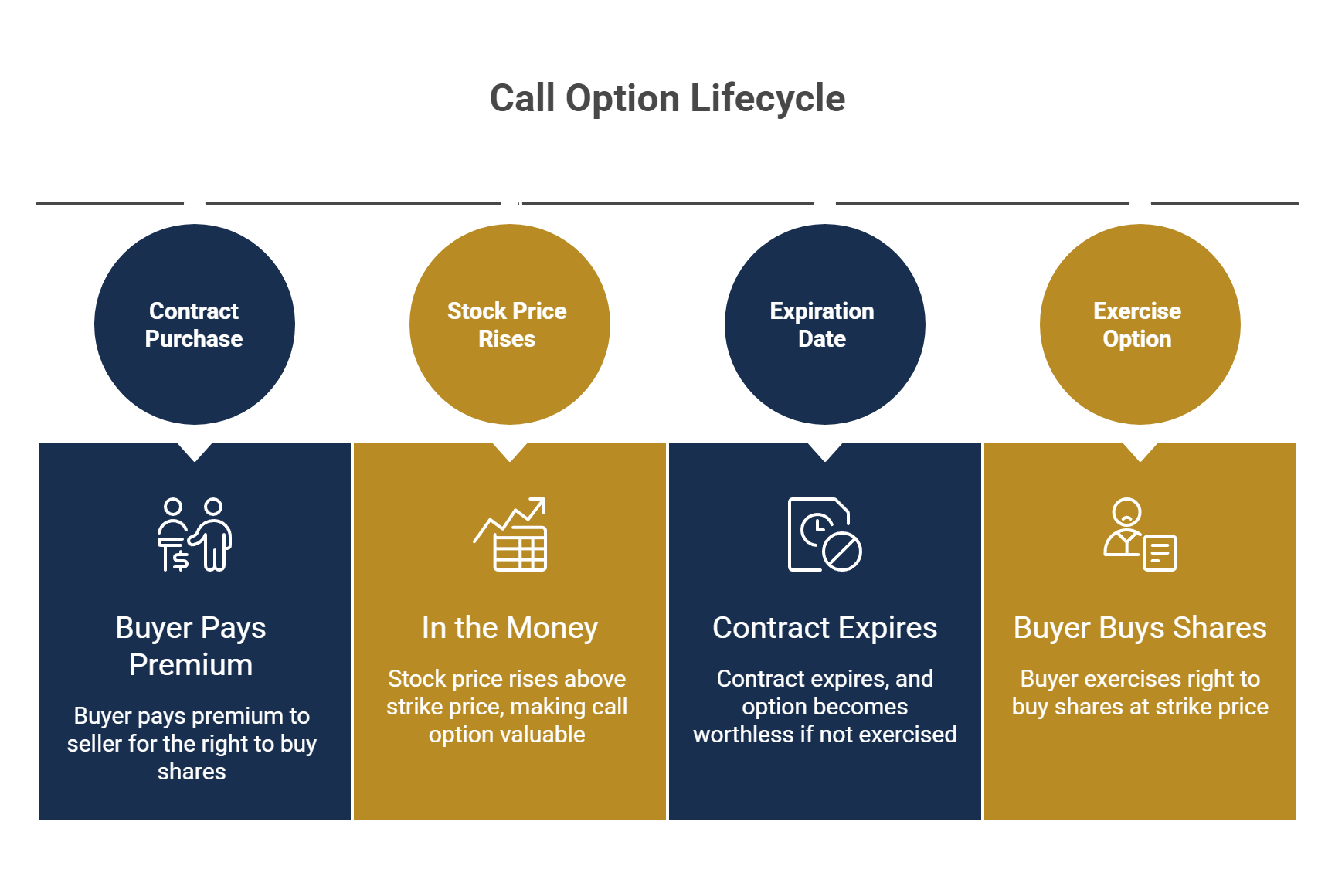
A call option is a contract that gives the buyer the right, but not the obligation to purchase 100 shares of a stock at a specific price (the strike price) before the contract expires.
The buyer pays a premium for that right. One contract always controls 100 shares.
Here's how it works, using standard options terminology:
Strike Price: The price where shares will change hands. If you buy a call at the $110 strike, you can buy 100 shares at $110 each.
Premium: The amount of money the buyer pays the seller to bind the contract. This is your cost and your maximum risk.
Expiration: When the contract expires and is no longer valid. Standard monthly expiration falls on the third Friday of each month.
Contract Size: One option contract controls 100 shares. Always.
In the Money: When the stock price rises above the strike price before expiration. The call has value because you can buy shares below market price.
Out of the Money: When the stock price stays below the strike price. The contract will likely expire worthless.
If the stock price goes up past your strike price, you can exercise your right to buy shares at the lower strike price, or sell the contract itself for a profit.
If the stock price never reaches the strike price, the contract expires worthless and you lose the premium you paid.
Remember: when you buy a call, you have a right to buy shares at that designated price. You don't have to exercise that right, but you can if you choose.
How Call Options Work for Both Buyers and Sellers
Most beginner content only covers the buyer's side of a call. But there's always someone on the other end of every trade. When you buy a call, someone else has sold it.
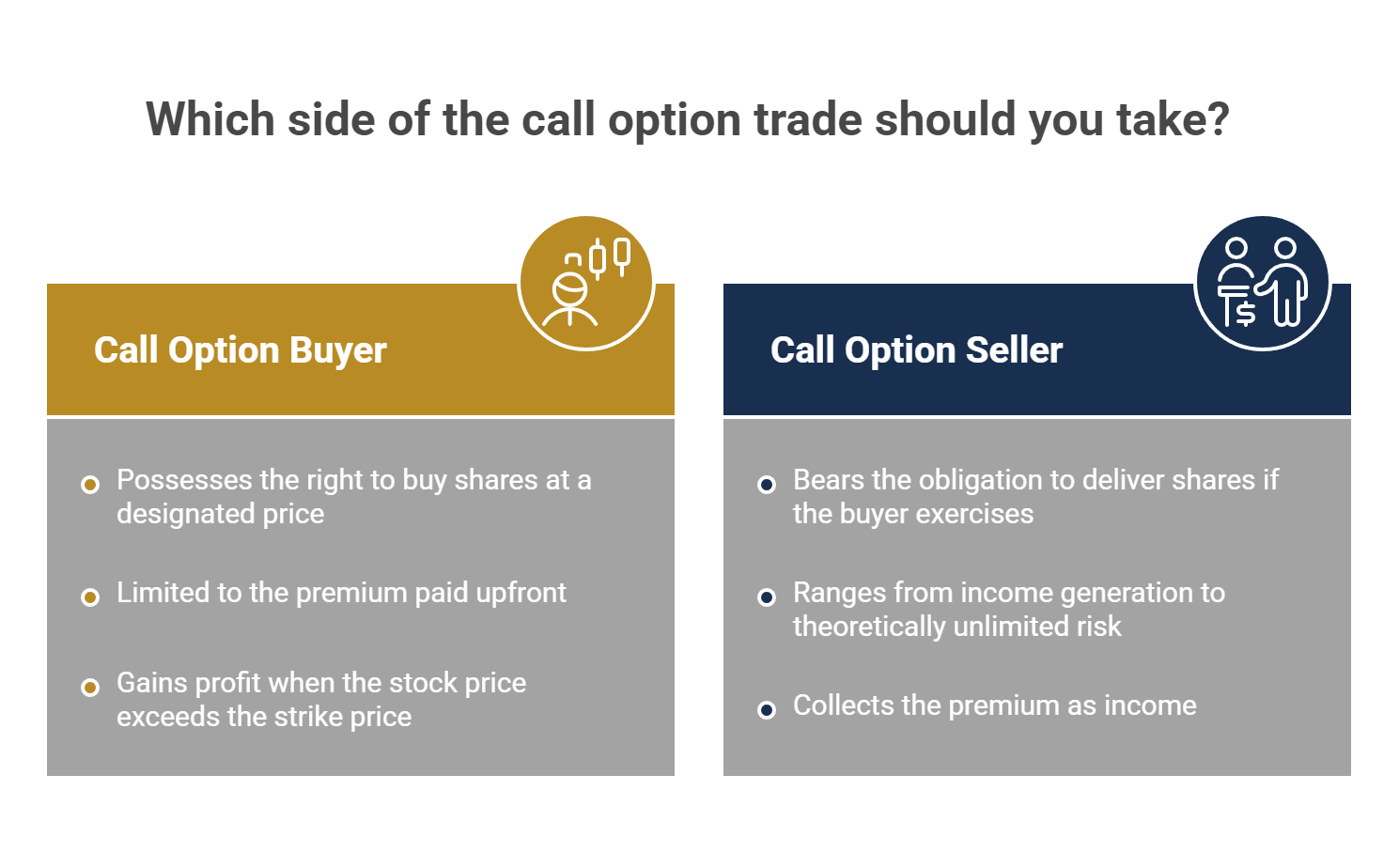
The Buyer's Side:
When you buy a call, you have a right to buy shares at that designated price. Buyers have rights to do something. They don't have to, but they can if they choose.
Your maximum loss equals the premium you paid. That's it. The stock could go to zero and you can only lose what you paid upfront.
If the stock price goes above your strike price, you profit. You can exercise your right to buy shares at the lower strike price, or sell the contract itself.
The Seller's Side:
Option sellers have obligations. They must do something if the buyer exercises their right.
That seller (the writer of the call) has an obligation: if the buyer exercises their right to purchase shares, the seller must deliver those shares at the agreed strike price.
This creates two different situations:
Covered Calls: Selling a call on shares you already own, a covered call is a common income strategy. You own 100 shares of ABC stock, you sell a call against those shares, you collect the premium. If the call gets exercised, you deliver your shares at the strike price.
Naked Calls: Selling a call without owning the underlying shares (a naked call) carries theoretically unlimited risk and is not something Rule One investors pursue. If the stock rockets higher and you get assigned, you have to buy shares at the high market price to deliver them at the lower strike price. The loss potential is unlimited.
Example with Real Numbers:
ABC stock trades at $100. You buy a $110 call for a $2 premium.
Stock goes to $120: Your call is worth at least $10 ($120-$110). Profit = $8 per share after premium.
Stock stays at $100: Call expires worthless. Loss = $2 premium paid.
Someone sold you that call. If they owned the shares (covered), they collect the $2 premium and deliver shares at $110 if assigned. If they didn't own shares (naked), they face unlimited risk as the stock climbs.
Remember: buyers have rights, sellers have obligations. Every option contract connects two people with opposite positions.
Call Options vs Puts vs Just Buying Stock
Understanding the differences helps you choose the right tool for your situation.
Calls vs Puts: The Basic Difference
From our options grid, you know calls and puts are opposites:
Buy a call = Right to buy shares (bullish bet - you profit when prices go up)
Buy a put = Right to sell shares (bearish bet - you profit when prices go down)
Both work the same way mechanically. You pay a premium upfront. One contract controls 100 shares. Both expire worthless if they don't move in your direction.
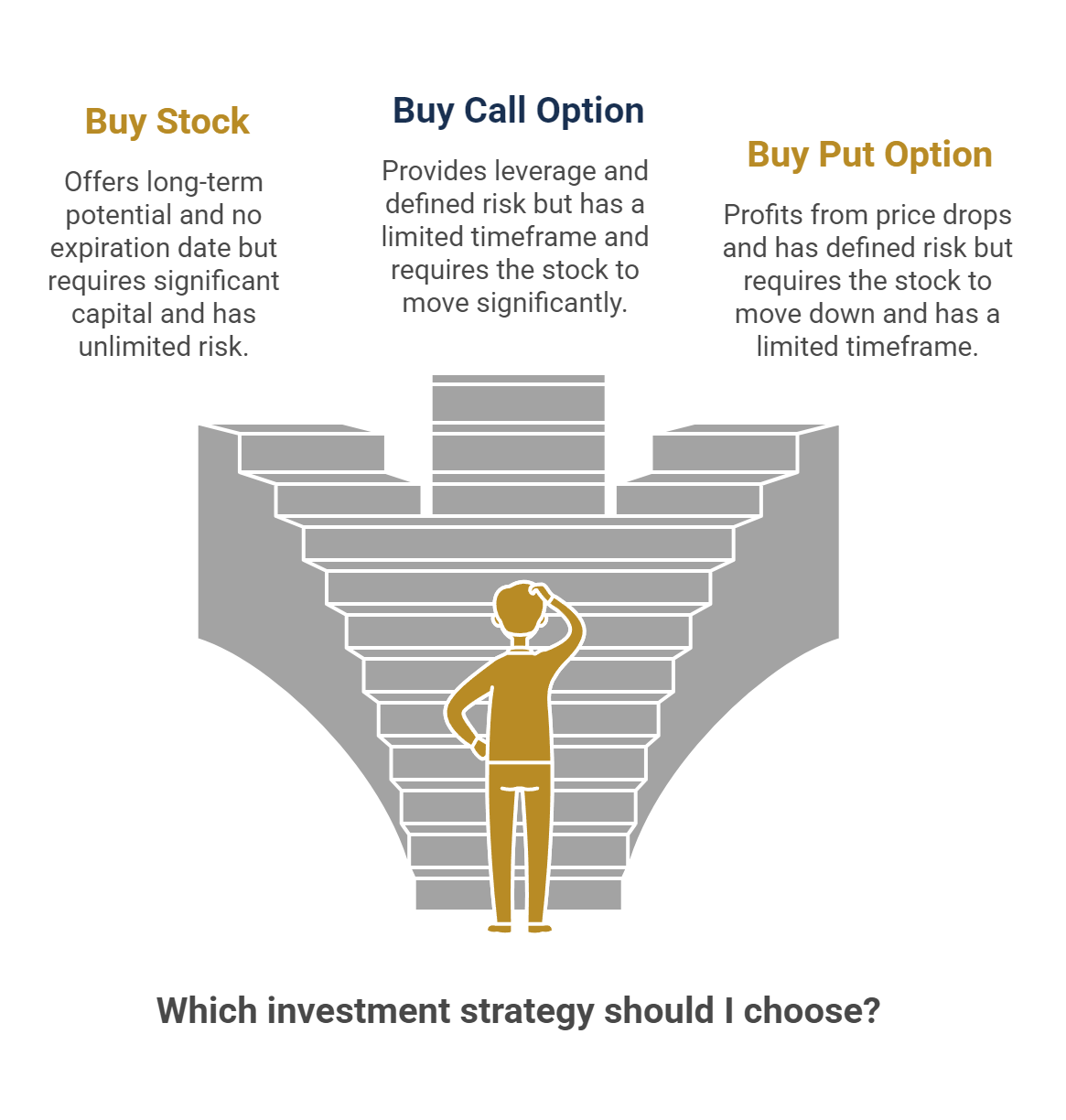
Calls vs Just Buying Stock
Why would someone buy a call instead of just buying the stock? Two main reasons:
Leverage:
A call option controls 100 shares for a fraction of the cost of buying those shares outright. If ABC stock trades at $100, buying 100 shares costs $10,000. A call option on those same shares might cost $200-500 depending on the strike price and time to expiration.
Defined Risk: Maximum loss on a bought call is the premium paid, versus buying stock where you could theoretically lose the full price per share. If ABC stock goes to zero, you lose $10,000 on the shares but only the premium on the call.
But Here's the Trade-off:
The stock has to move in the right direction within a specific timeframe, or the option expires worthless. Time is always working against the buyer of a call.
Real Example:
ABC stock trades at $100.
Buy 100 shares: Costs $10,000. If stock goes to $110, you make $1,000. If it goes to $90, you lose $1,000.
Buy 1 call at $105 strike for $2: Costs $200. If stock goes to $110, call is worth $500 (minimum $5 intrinsic value). Profit = $300. If stock stays at $100, call expires worthless. Loss = $200.
The Key Insight:
With stocks, you have time. Stocks can be held forever. With calls, you're racing against expiration. The stock has to move up past your strike price plus the premium you paid, and it has to do it before time runs out.
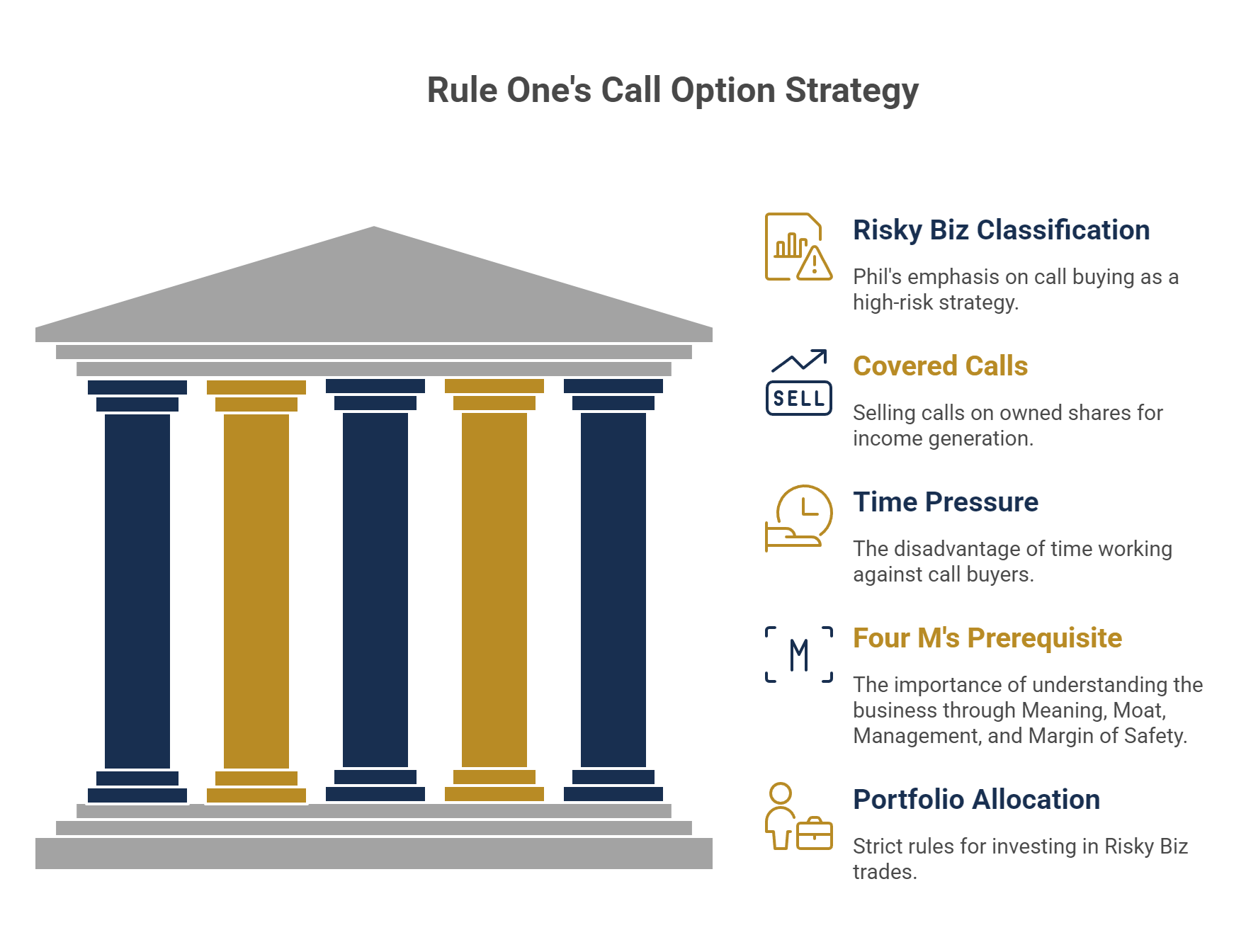
Phil is direct about this in his book. He specifically categorizes call options as "Risky Biz." Once you leverage a call option, lots of bad things can happen too quickly.
Where Call Options Fit in the Rule 1 Approach (The "Risky Biz" Reality)
In his book Rule #1, Phil emphasized that call buying is specifically categorized as "Risky Biz." Here's the exact framing: "call options, which is a trading technique, automatically makes it a Risky Biz no matter how predictable the business is or how well you understand it."
But here's the critical context: Phil is talking about buying calls, not selling them.
How We Actually Use Call Options at Rule One:
We use call options regularly, but as covered calls, selling calls on shares we already own at the price we want to sell the company at. This is income generation, not speculation.
That's not a throwaway comment. It's a fundamental classification that changes everything about how you should think about calls.
Why Call Options Are "Risky Biz"
Buying call options introduces leverage and time pressure that don't exist in straight Rule One Investing. When you buy stock in a wonderful company, time works for you. The company keeps growing, earning money, building its moat. You can hold forever.
With call options, time works against you. Once you leverage up with a call option, lots of bad things can happen too quickly to avoid breaking The Rule. The stock has to move in your direction before the clock runs out, or you lose your premium entirely.
The Four M's Prerequisite
Whether you're selling covered calls for income or (rarely) buying calls in your Risky Biz allocation, the Rule One prerequisite always applies: you must deeply understand the underlying company through the Four M's.
Meaning: You better understand the business inside and out
Moat: It better have durable competitive advantages
Management: Leadership better be honest and owner-oriented
Margin of Safety: Even with all that, you're adding leverage and time risk
My Portfolio Allocation Rules
Phil established strict rules for any Risky Biz trades, and I reinforce these with every student I work with:
You have at least $50,000 in the stock market
You only invest 10% of your total portfolio in Risky Biz trades
You actually believe you understand the business
You watch the indicators like a hawk
The Bottom Line:
Most of our focus at Rule One is on selling puts (Rule One Puts) to buy wonderful companies at our target prices. When we use calls, it's typically selling covered calls for income as we approach our sell targets - not buying naked calls for speculation.
I've seen students at both extremes, those who respect these guardrails and those who don't. The ones who take this framework seriously use it as a precision tool. The ones who don't learn the hard way.
I'm not trying to scare you away from calls. I'm trying to make sure you understand what you're getting into. Because once you add that time pressure and leverage, you're playing a different game entirely.
Your Next Steps in Understanding Options
This article is an entry point, not an endpoint.
You now know what call options are, understand both sides of the contract, and have the vocabulary to navigate options content. You've got the grid framework, the leverage trade-offs, and where calls fit in Rule One.
Join the Rule One Virtual Investing Workshop
Watch our instructors evaluate companies in real time and show you exactly when options make sense.
Keep Learning:
Vertical Spreads Explained: Managing Risk While Trading Options
How Warren Buffett Really Uses Options (And What Phil Town Learned From Him)
Start with the fundamentals. Build systematically. Options can fit into a disciplined approach when you understand the risks.

About Trent Pearce
Phil Town is an investment advisor, hedge fund manager, 3x NY Times Best-Selling Author, ex-Grand Canyon river guide, and former Lieutenant in the US Army Special Forces.
He and his wife, Melissa, share a passion for horses, polo, and eventing. Phil's goal is to help you learn how to invest and achieve financial independence.
Get Phil's Free Guide