







Why Did Buffett Sell Apple? What the Numbers Actually Tell You
 Phil Town
In This Article
- The Short Answer: Berkshire Sold Apple Because of the Price
- Berkshire Bought Apple at $25. Here's What Happened Next.
- The Earnings vs. Price Gap: What Really Drove the 13x Return
- Apple Through the Four M's
- When to Sell a Stock: Three Options When a Winner Gets Expensive
- Covered Call Strategy: The Option Berkshire Can't Use
- What Covered Calls Won't Do for You
- What This Means for Your Portfolio
- Was Berkshire Right to Sell Three-Quarters of Apple?
So why did Buffett sell Apple? The short version is that the price got ahead of the business.
I've spent my career investing and teaching people to invest this way, and this is one of the clearest lessons in price and value you'll ever see. Berkshire sold about three-quarters of its biggest stock position, kept the rest, and both moves make sense. Let me show you why, and what your options are if you're ever holding a winner that's gotten expensive.
This article discusses Apple and Berkshire Hathaway for educational purposes only. It's not a recommendation to buy, sell, or hold any security.

The Short Answer: Berkshire Sold Apple Because of the Price
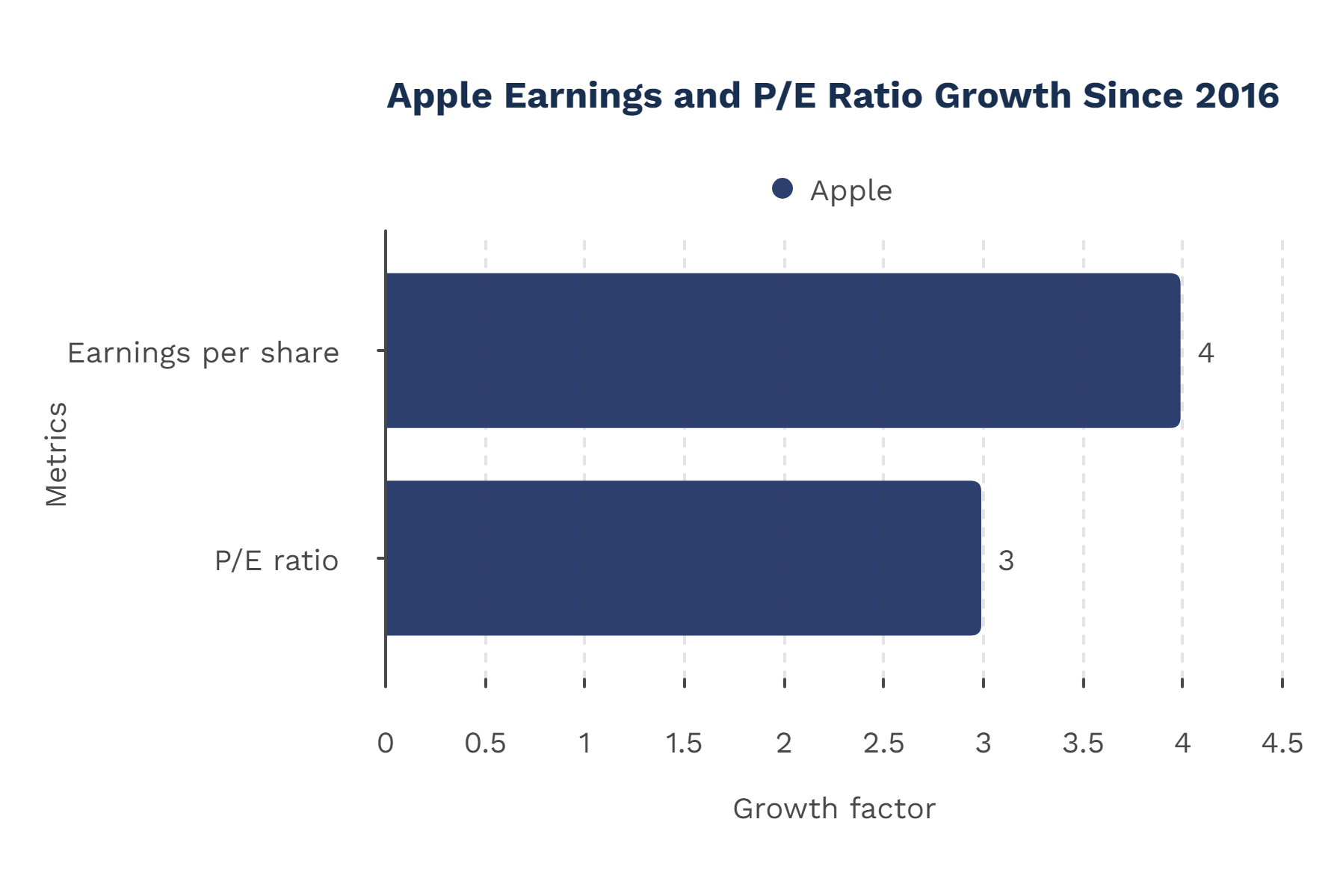
Berkshire sold most of its Apple stake because the price ran far ahead of the business. Apple's earnings per share roughly quadrupled after Berkshire started buying in 2016, but the stock rose about 13x as investors went from paying about 12 times earnings to about 37 times. Buffett has also pointed to taxes as part of the reason.
Berkshire Bought Apple at $25. Here's What Happened Next.
Berkshire started buying Apple in 2016 at around $25 a share, split-adjusted. The position grew fast and peaked at roughly 900 million shares. By my math, it's made Berkshire well over $100 billion, and it may be the single greatest investment of Buffett's career.
Then the selling started. As of the June 2026 quarter, Berkshire Hathaway's Apple stake is down to about 228 million shares. It's still the biggest holding in the portfolio at roughly 22%, and Berkshire hasn't sold a share since the end of 2025.
Most people look at that and ask whether Buffett made a mistake. Buffett has written plenty about the errors he works to avoid, and I covered several in investing mistakes Warren Buffett warns about.
I think the better question is one almost nobody asks. What actually created that 13x return?
The Earnings vs. Price Gap: What Really Drove the 13x Return
Two engines drove that return. The first was the business. Apple's earnings per share grew about 4x since 2016, which is real profit from a real company.
The second engine was Mr. Market, the crowd of investors who set prices every day, and that crowd can get very emotional. Apple's P/E ratio, the price you pay for each dollar of yearly profit, went from about 12 to about 37.
Multiply the two together, about 4x more earnings times about 3x more paid per dollar of earnings, and you land near 13x. Here's what that means in real dollars. When I recorded this, Apple was around $325 a share with roughly $8.70 in yearly earnings per share, so you're handing over about $37 for every $1 of profit Apple makes.
And you guys, if you own an index fund or a mutual fund, you're probably buying Apple at that price right now. You just don't see it.
Apple’s business did real work, but most of what a buyer pays today is Mr. Market’s optimism stacked on top of it.
What a 37x Multiple Means for Future Returns
At 37 times earnings, the price already includes years of future profit. Whoever buys today is paying now for cash the business may not produce for a decade. For that to work out, Apple has to keep growing fast for a long time.
If the multiple drifts back toward where it's been historically, the stock could be dead money for years. That wouldn't mean Apple failed. It would mean the price got ahead of the value, which is why I teach people to start with estimating a company's growth rate before they ever look at a price.
The Microsoft 1999 Lesson: A Great Business Isn't Always a Great Investment
Microsoft was a fantastic business in 1999, and it stayed one. But people who bought near the top of the dot-com bubble waited about 15 years to break even, even counting dividends. On price alone, it took about 17.
That's what overvalued stocks do to you. As Buffett put it, borrowing a line from his teacher Ben Graham, price is what you pay, value is what you get.
Apple Through the Four M's
Every business I look at goes through the Four M's: Meaning, Moat, Management, and Margin of Safety. Apple's a great case study, because it shows which M's can stay strong while one breaks.
Meaning asks whether you understand how the business makes money well enough to want to own the whole thing. Using an iPhone every day is a start, but understanding how Apple earns its money is the real test. Back in 2000, Apple was too hard for me to understand well enough to value, so this M takes real work.
Moat is where Apple shines. It has one of the widest moats on the planet, with over a billion people who aren't going to switch.
The Big Five Numbers are how I check whether a moat is holding up, and they’re worth running on any business you own. Management deserves its own look too, starting with how the company uses the cash the business throws off.
Margin of Safety is what changed. I want to buy a wonderful business at an attractive price, meaning well below its Sticker Price, or what the business is actually worth. At 37 times earnings, that cushion is gone, and you can see how I work out Sticker Price and Margin of Safety step by step.
When to Sell a Stock: Three Options When a Winner Gets Expensive
So here's the real question about when to sell a stock that's been a big winner. You only get to ask it if you were right when you bought. You found a wonderful business, paid a fair price, held it for years, and now it's priced to the moon.
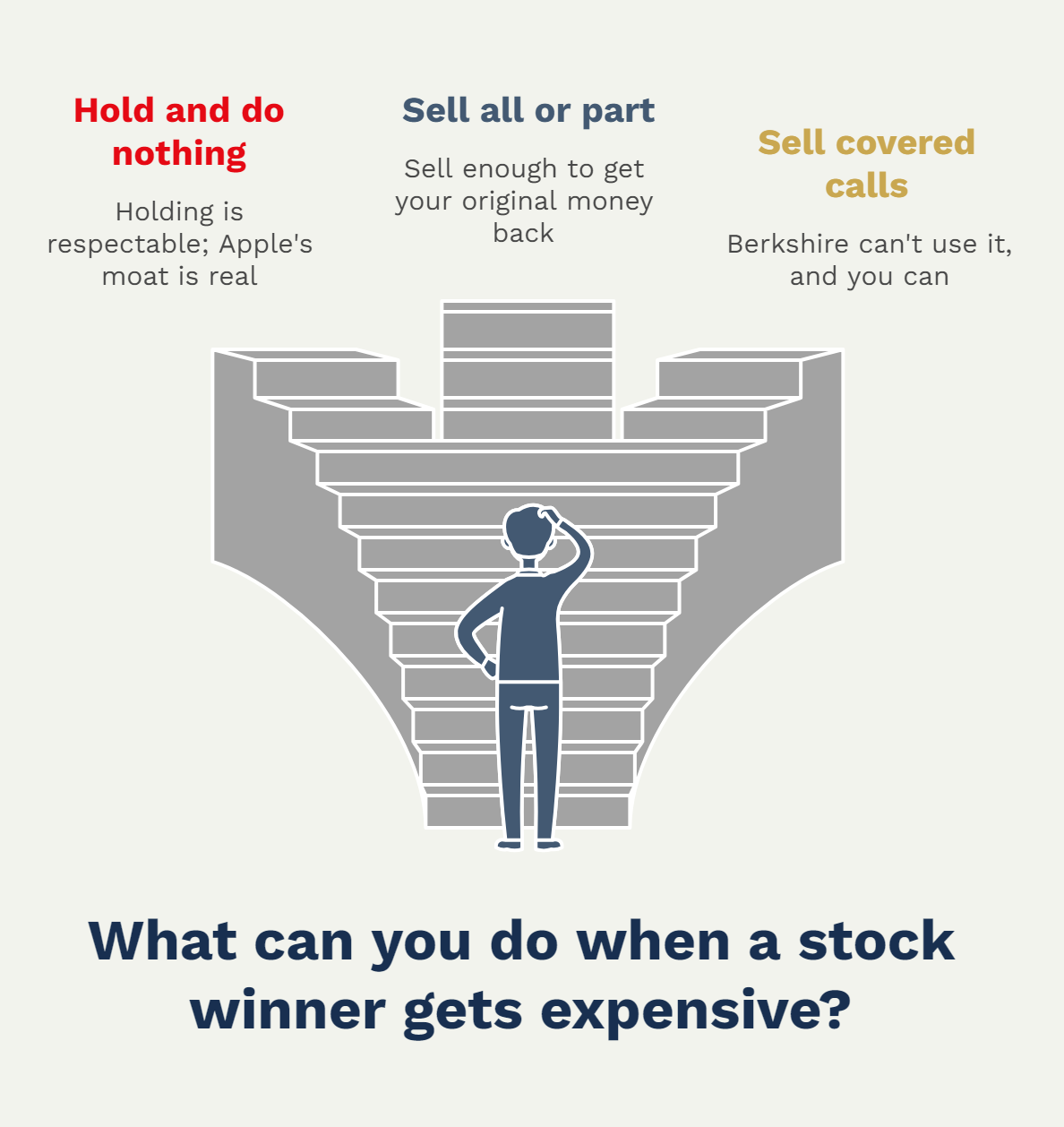
When that happens, you've got three choices:
Hold and do nothing.
Sell all or part of it.
Sell covered calls.
Berkshire can use the first two. The third gets its own section below, because Berkshire can't use it, and you can.
Option One: Hold and Hope the Multiple Doesn't Shrink
Holding is respectable. It's also the lazy answer.
There are good reasons to do it. Apple's moat is real, and selling a position bought in 2016 triggers a big tax bill you can never get back. Then you have to be right twice, once about selling and again about where the money goes next.
Doing nothing is also what Wall Street wants you to do, because they keep collecting fees on your money either way. I'd rather you make that choice on purpose than by default.
Option Two: Sell All or Part and Take Profits
This is what Berkshire did. It sold about three-quarters and kept about a quarter.
Here's how I think about taking profits on a stock like this. Sell enough to get your original money back, and you're playing the rest with house money. Those remaining shares can still fall, but your starting capital is back in your pocket.
Buffett’s Rule No. 1 is don’t lose money. Trimming a position when the price gets stretched is one of the cleanest ways to follow that rule, and the Rule One investment checklist walks you through the full decision.
Covered Call Strategy: The Option Berkshire Can't Use
Selling isn’t your only way out. If you’re not sure yet, you can get paid while you decide.
That's the covered call strategy, and the name makes it sound harder than it is.
You own 100 shares of a stock. You sell someone else the right to buy those shares from you at a higher price within a set time, and they pay you cash today for that right. That cash is yours no matter what happens next.
You’ll need your broker’s approval to trade options, and you’ll want to learn the mechanics first. I explain how options fit a value investor’s toolkit in options trading for value investors.
How Covered Calls Work: A Hypothetical Example
This is a hypothetical example for teaching only. It's not a trade recommendation, a current market quote, or a typical result.
Say you bought Apple at $25 a share, and it's now around $325. You think it's likely to be dead money for a while, but you don't have a better place to put the cash. So you sell someone the right to buy your shares at $345 anytime in the next year, and they pay you $34 a share today.
That $34 works out to about 10.5% of today's $325 price. Measured against your original $25, it's about 136%.
From there, one of two things may happen:
Apple stays below $345. The option expires, and you keep your shares and the $34. You could then sell another call.
Apple goes above $345. The buyer takes your shares at $345, a price you already decided you'd be happy with, and you still keep the $34.
That's how covered calls work. Selling covered calls on stocks you own turns your "sell or hold" problem into cash flow. You're getting paid to be the house while somebody else bets on where the stock goes.
Why Berkshire Can't Do This (and Why That's Your Advantage)
Even after selling three-quarters, Berkshire still holds about 228 million Apple shares. At 100 shares per contract, that's more than 2 million option contracts. There's no options market on Earth deep enough to absorb that.
Berkshire's size is its superpower almost everywhere else. Here, it takes this strategy off the table. For once, being small is a real advantage.
What Covered Calls Won't Do for You
Here's the part most of the talking heads leave out, and I'm not going to.
A covered call won't protect you if Apple drops 30%. You keep the $34, but you could be sitting with a stock at $225 instead of $325. That $34 only covers a fraction of a $100 drop.
It also caps your upside. If Apple doubles, you don't get the double, you get $345.
And you're going to be annoyed about it. Ask me how I know.
You might also have done better just selling outright. And options aren't suitable for everybody. I'd genuinely rather you do nothing than do this badly.
If you want to learn the full Rule One process properly, before you put a dime at risk, that’s exactly what we teach at the Virtual Investing Workshop.
What This Means for Your Portfolio
Your job is never to guess where Apple goes next. It's to know what the business is worth.
You buy it when there's fear. You have an exit plan for the day when greed makes the price stop making sense.
If you own Apple through an index fund or mutual fund, know what you're holding and what you're paying for it. If you own it directly, you've now got three options to weigh. Use Berkshire as a clue, not a rulebook, because you have choices Berkshire doesn't.
Buying when others are scared matters just as much as knowing when to sell, and it’s what I cover in what causes stocks to go on sale. If you’re new to all of this, start with my Rule One strategy overview.
Was Berkshire Right to Sell Three-Quarters of Apple?
Berkshire sold three-quarters because of the price. It held the last quarter because of the business. My read is that both are right for Berkshire.
What do you think? Were they right to sell, right to hold, or both? And what would you do with a position that's up 13x?
If you want to learn how to find a wonderful business, figure out what it's worth, and decide when the price stops making sense, that's what we teach step by step.
Join us at the Virtual Investing Workshop
And if you’d rather watch, the full breakdown is on the Rule One YouTube channel, where you can drop your answer in the comments.
Rule One Investing provides investment education and training only. We don't provide personalized investment advice, manage client assets, or guarantee investment returns. All content is for informational purposes. Consult a qualified financial professional before investing. Past performance doesn't guarantee future results. Individual results vary.

About Phil Town
Phil Town is an investment advisor, hedge fund manager, 3x NY Times Best-Selling Author, ex-Grand Canyon river guide, and former Lieutenant in the US Army Special Forces.
He and his wife, Melissa, share a passion for horses, polo, and eventing. Phil's goal is to help you learn how to invest and achieve financial independence.
Get Phil's Free Guide