








Salesforce Stock Analysis: What Its Record Quarter Does and Doesn't Prove
 Austin Bowen
In This Article
- The Short Answer: What Salesforce's Q2 Earnings Tell Us
- Salesforce Earnings: The Q2 FY27 Numbers
- What This Quarter Doesn't Prove About Salesforce AI Disruption
- Meaning and Moat: Why Salesforce Customers Stay
- Management: Marc Benioff and the $50 Billion Salesforce Stock Buyback
- What to Watch: cRPO, Attrition, and Pricing Pressure
- Margin of Safety: Why a Great Quarter Doesn't Remove the Need for It
- The Bottom Line on This Salesforce Stock Analysis
- Frequently Asked Questions
- Learn to Run This Analysis Yourself
For about a year and a half, the story on Wall Street was that AI was coming for software companies, and Salesforce was the poster child. Then Salesforce reported on August 26, and it was the best second quarter in the company’s history. So which is it?
That's the question I want to work through in this Salesforce stock analysis. I'm less interested in where the stock goes next month than in what this quarter tells an owner about the business, what it doesn't, and how I'd think about it using the Four M's.
I broke the quarter down in the video below. We covered the broader software sell-off in a separate post, so this one stays on one company and one quarter.

My breakdown of Salesforce’s record quarter and what it means for the AI disruption story.
The Short Answer: What Salesforce's Q2 Earnings Tell Us
Salesforce delivered a record second quarter of fiscal 2027, with revenue up 11%, free cash flow up 81%, and growth in contracted future revenue speeding up to 14%. That's a real blow to the AI disruption bear case, but it isn't proof: acquisitions, a redefined AI metric, and investment gains all flattered the numbers.
Salesforce Earnings: The Q2 FY27 Numbers
Salesforce's fiscal year ends January 31, so the quarter that closed July 31, 2026, is the second quarter of fiscal 2027. Here's what the company reported in its Q2 FY27 earnings release.
Revenue came in at $11.35 billion, up 11% from a year ago. Subscription and support revenue, which is the recurring money customers pay to keep using the software, was $10.82 billion, up 12%.
Free cash flow was $1.1 billion, up 81%. Free cash flow growth is one of the Big Five Numbers I check in every business, because it’s the cash left over after the company pays to run and maintain itself. One quarter isn’t a trend, but this is the direction you want to see.
Management also raised its FY27 revenue guidance by $200 million as reported, or $300 million in constant currency, and now expects full-year revenue of $46.1 billion to $46.4 billion, up 11% to 12%. It left its full-year cash flow forecast unchanged, for a reason I’ll get to in the buyback section.
On the earnings call, management said customer attrition, the share of revenue lost when customers leave or cut back, was near its lowest level ever.
Why Salesforce cRPO Is the Number I'd Watch First
cRPO stands for current remaining performance obligation. In plain English, it's money customers have already signed contracts to pay Salesforce over the next 12 months. Think of it as the order book for the coming year.
This quarter, cRPO reached $33.5 billion, and its growth sped up to 14% in constant currency, which strips out swings in exchange rates. The bear case said growth was stalling. Customers committing to more future spending is hard to square with that.
What This Quarter Doesn't Prove About Salesforce AI Disruption
A record quarter can make you sloppy. Three things in this report need a closer look before anyone builds a case on them.
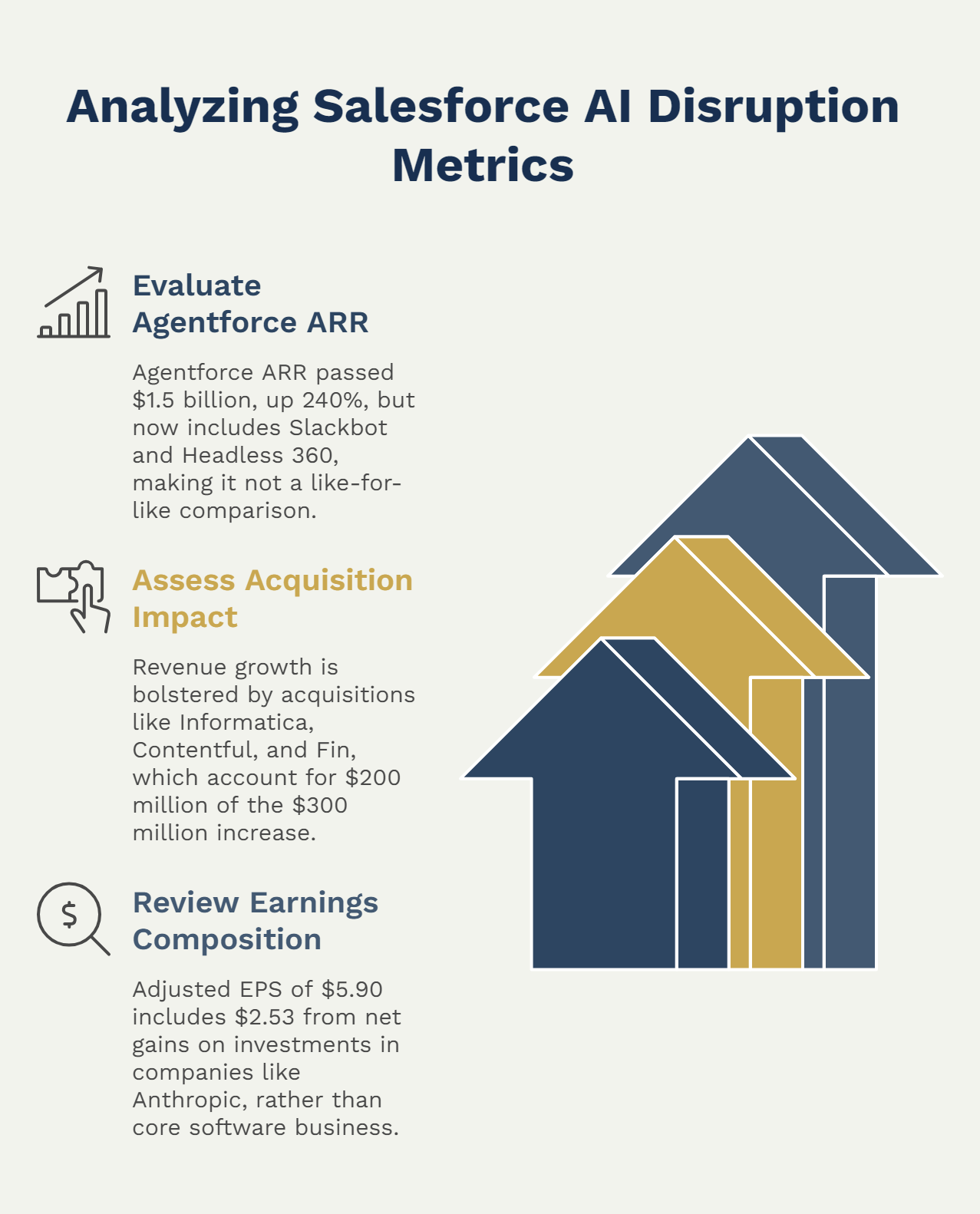
The first is Agentforce ARR. ARR means annual recurring revenue, and Agentforce is Salesforce's AI agent product. Agentforce ARR passed $1.5 billion, up more than 240%. Management also said it added 2,000 paying customers into production, and that accounts with agents in production grew 70% from the prior quarter.
Those are strong numbers, but starting this quarter, Agentforce ARR also counts Slackbot and Headless 360. That means the 240% isn't a like-for-like comparison with last year.
The second is acquisitions. Salesforce bought Informatica, a data management company, and that adds revenue the core business didn't grow on its own. The company says Informatica accounts for slightly more than 3 points of this year's guided revenue growth, and Salesforce doesn't break out how much of cRPO comes from Informatica, either.
Most of the raise comes from buying companies, too. Of the $300 million constant-currency increase, Salesforce said $200 million comes from the Contentful and Fin acquisitions and $100 million from organic growth.
The third is earnings. Adjusted earnings per share, the company's own version that leaves out certain costs, were $5.90. Earnings under standard accounting rules were $4.29.
Net income rose 87%, to $3.53 billion from $1.89 billion a year earlier. The company’s quarterly 10-Q filing explains why: Salesforce booked $2.6 billion in net gains on its investments in other companies, driven mostly by its stake in the AI company Anthropic.
Those gains added $2.53 to adjusted earnings per share. Take them out, and adjusted EPS was closer to $3.37, against $2.91 a year ago. That's still growth, but the gains aren't the software business, and they can swing the other way next quarter.
So here’s my honest read: this quarter weakens the bear case, but it’ll take several more quarters to know how AI really changes the business.
Meaning and Moat: Why Salesforce Customers Stay
What Salesforce Does, in Plain English
Salesforce is where a business keeps track of its customers. Every account, open deal, support ticket, and renewal date lives there, along with years of custom setup that whole departments depend on. I think of it as plumbing with 15 years of business logic welded into it.
That’s the first M, Meaning. If you can’t explain what a company does and why its customers need it, you can’t judge whether its problems are temporary. It’s the same test that made me pass on Adobe and ServiceNow, even though they were on sale too.
The Salesforce Moat: Security, Compliance, and Trust
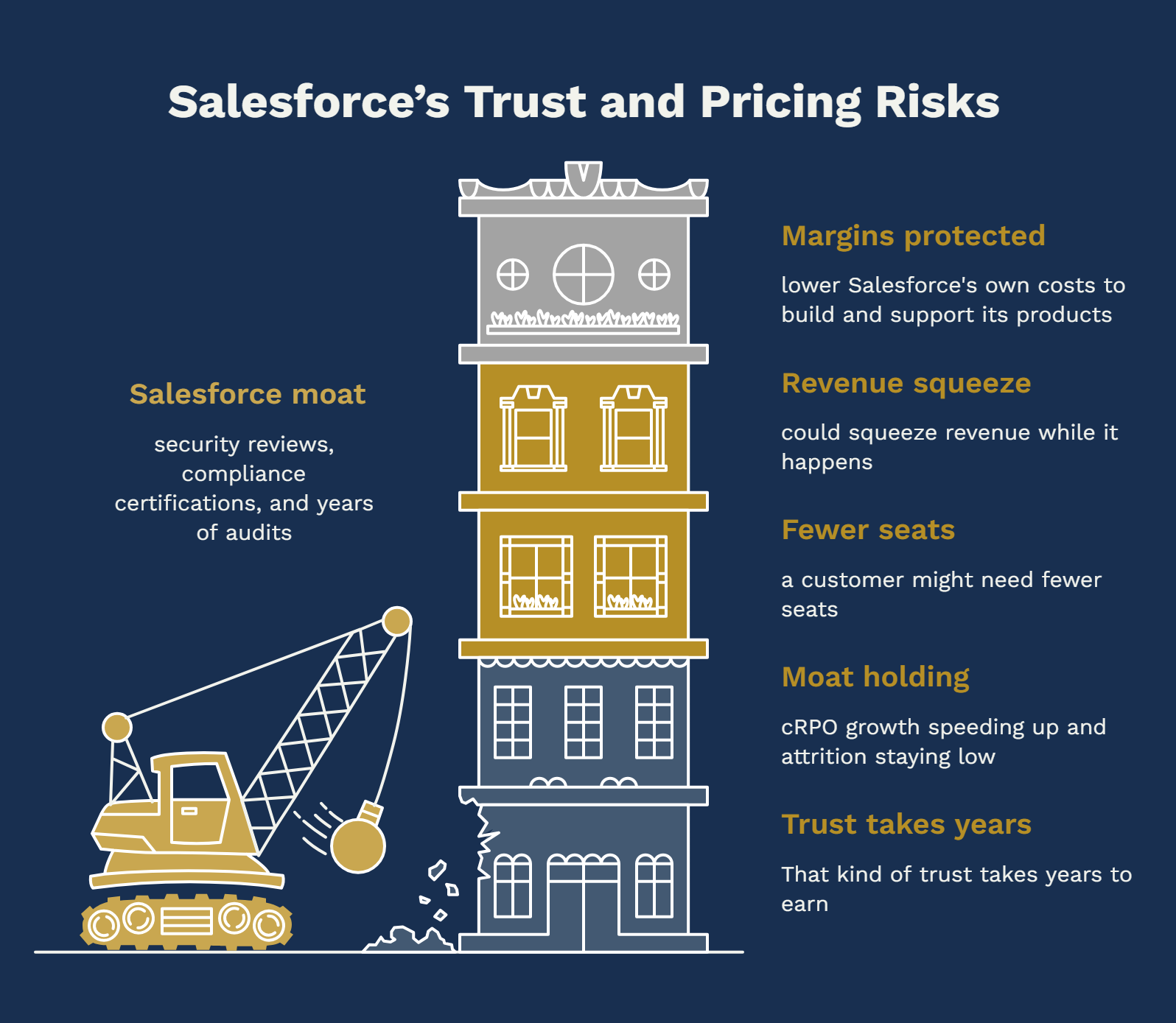
I covered switching costs in the sell-off post, so I won't repeat that here. What I want to add is the part of the Salesforce moat that's easy to overlook: the security reviews, compliance certifications, and years of audits that big customers demand before they'll trust anyone with their data.
Think about who actually buys Salesforce: a bank, a hospital system, a defense contractor, each with a procurement process, a security review, and lawyers who read every line of the contract.
In the 1980s, the saying in corporate IT was that nobody ever got fired for choosing IBM. Today the saying is that nobody ever got fired for choosing Salesforce. That kind of trust takes years to earn, and better code alone can't copy it.
The early evidence says the moat is holding, with cRPO growth speeding up and attrition staying low.
The Bigger Risk Is How Salesforce Gets Paid
The risk I’d actually lose sleep over is pricing. Salesforce has long charged per seat, meaning per person using the software. If AI agents start doing work people used to do, a customer might need fewer seats even while getting more value.
Salesforce is already moving part of its business toward charging for usage. Since 2025, customers can buy Agentforce through Flex Credits, which they purchase in packs and use up at about 10 cents for each action an agent takes. That change could go smoothly, or it could squeeze revenue while it happens, and nobody knows which yet.
AI cuts the other way, too. The same tools that threaten seat counts could lower Salesforce's own costs to build and support its products, which would help protect margins if revenue growth slows.
Management: Marc Benioff and the $50 Billion Salesforce Stock Buyback
Management is the third of the Four M's. I want a CEO who runs the company like an owner and treats shareholders' money like his own.
Marc Benioff co-founded Salesforce in 1999 after 13 years at Oracle, where he became the youngest vice president in that company's history. He helped prove that businesses would rent software over the internet instead of installing it, and the whole industry runs on that model now.
In February 2026, Salesforce’s board approved a $50 billion buyback, a clear signal that management thought the stock was worth more than the market was paying. A buyback is a company buying its own shares. When the price is below what the business is worth, every remaining owner ends up with a bigger slice of the business, and the company bought those shares at an attractive price.
Now the other side. Salesforce borrowed $25 billion to pay for a $25 billion share purchase in the first quarter of this fiscal year, and Moody's cut its credit rating to A2 over the new debt. That debt is also a big reason management expects full-year free cash flow growth of only about 4% to 5%.
Salesforce also pays employees heavily in stock, which creates new shares and works against the buyback. The company expects stock-based pay to equal about 9% of revenue this year.
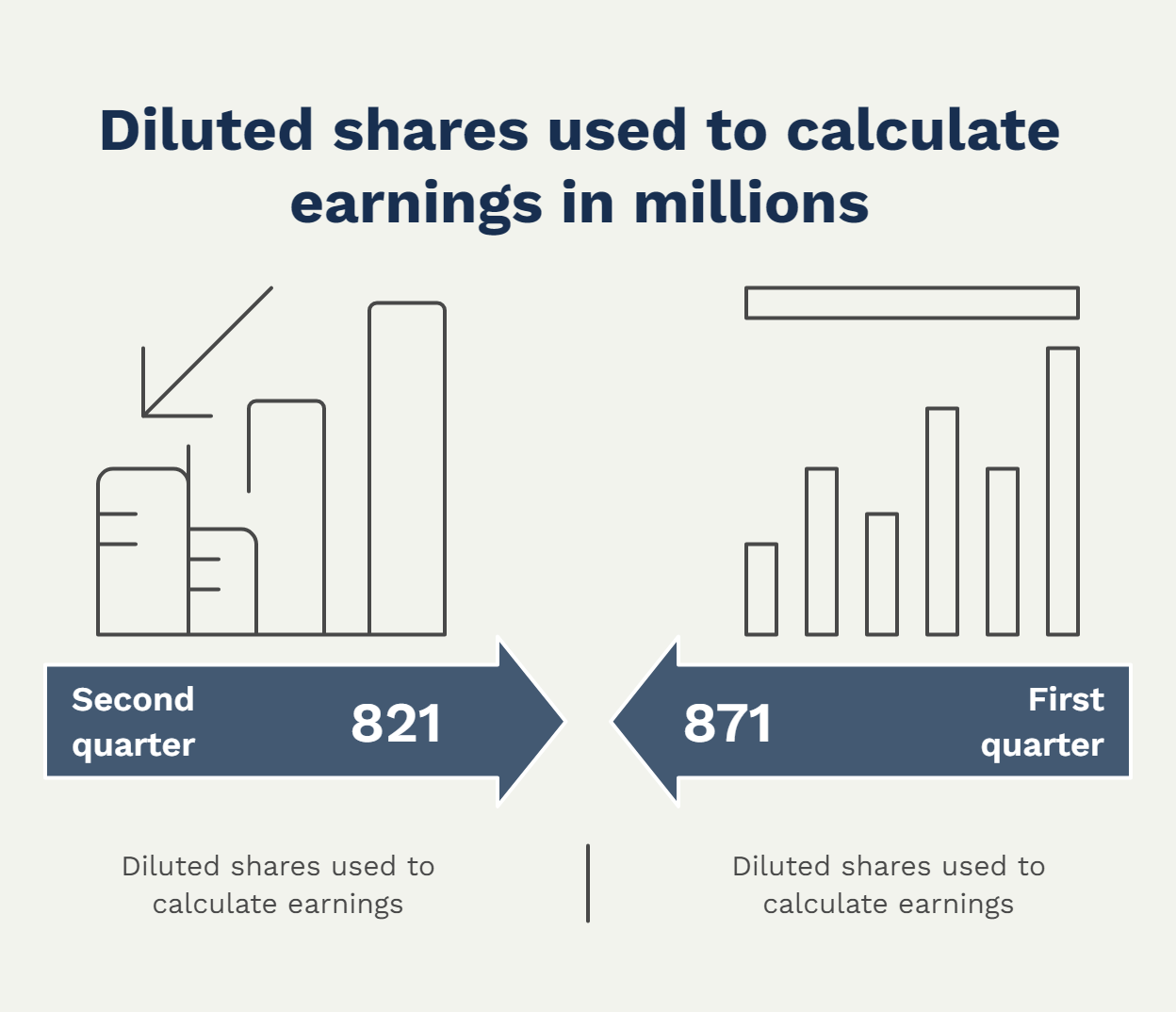
To be fair, the buyback is shrinking the share count. The diluted shares used to calculate earnings fell from 871 million in the first quarter to 821 million in the second.
So here’s how I’d think about the buyback as an owner. A buyback is only as good as the price paid, and debt and dilution are real costs that come out of your pocket.
What to Watch: cRPO, Attrition, and Pricing Pressure
There’s always a reason a stock goes on sale. When a problem looks like it’ll drag on for more than a year, big funds tend to sell instead of sitting through it, and that’s how a temporary problem can put a good business on sale. What I want to know is how long Salesforce’s problem is likely to last, because one to three years is a window I can work with.
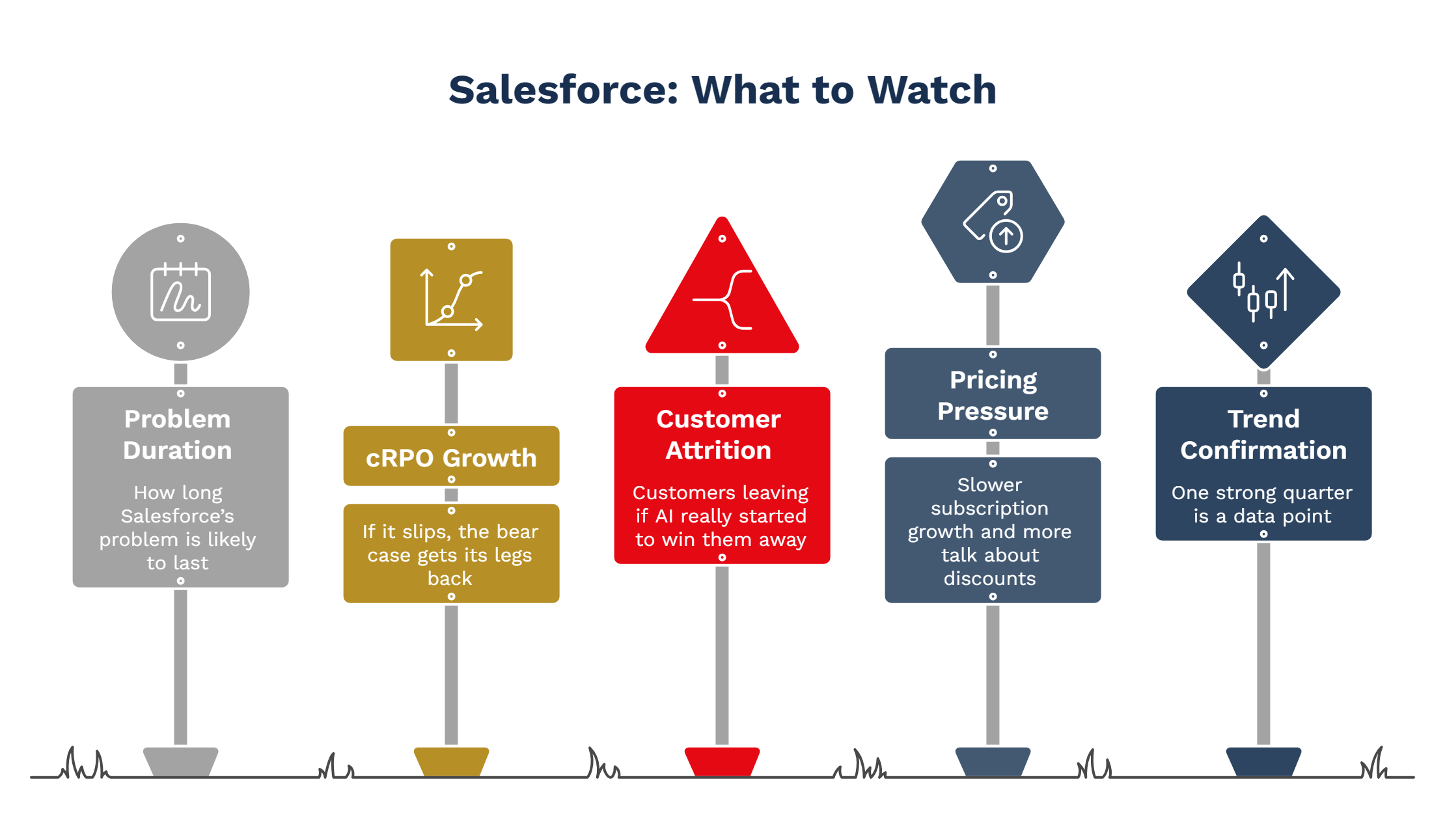
For Salesforce, three numbers will tell you which kind of problem this is. The first is cRPO. If its growth holds at or above 14% for the next few quarters, the demand is real, and if it slips, the bear case gets its legs back.
The second is attrition. It's low today, and it's the first place you'd see customers leaving if AI really started to win them away.
The third is pricing. If the move from seats to usage hurts revenue, you'll see it in slower subscription growth and more talk about discounts on earnings calls.
One strong quarter is a data point. Three or four in a row is a trend.
Margin of Safety: Why a Great Quarter Doesn't Remove the Need for It
Buffett’s Rule No. 1 is “Never lose money,” and Margin of Safety is how you follow it. It means buying a business for well below what it’s worth, so that if you’re wrong about something, you still don’t get hurt.
A great quarter doesn't change that. The definition change, the acquisitions, the investment gains, and the pricing shift are all reasons to want more room for error. Mr. Market gets as carried away after good news as he does after bad news.
I’m not putting a Sticker Price on Salesforce here. That’s work you should do yourself, and once you’ve worked out what the business is worth, you can run your own Margin of Safety numbers.
This post is for education only and isn't a recommendation to buy or sell Salesforce or any other security.
The Bottom Line on This Salesforce Stock Analysis
Salesforce had a record quarter, and the business looks a lot healthier than the "AI kills software" story suggested. The open questions are real, though: how much growth is organic, how clean the AI numbers are, and what a pricing shift does to revenue.
You don't need to answer all of those today. You need to know which numbers to watch and what price would give you a Margin of Safety. That's the Rule One approach, and it works on any business you can understand.
Frequently Asked Questions
Is Salesforce stock a buy?
We don’t give buy or sell recommendations at Rule One. The real question is whether today’s price sits well below a Sticker Price you calculate yourself, and whether you understand the business well enough to trust that number. Run it through the Four M’s and the Margin of Safety calculator.
What is Salesforce’s moat?
Salesforce’s moat combines switching costs with trust. Large customers keep years of data and workflows in it, and they favor vendors that have passed security reviews, compliance certifications, and audits. The bigger open question is pricing, since a shift from per-seat to usage-based charging could change how much Salesforce earns.
Did Salesforce’s latest earnings prove the SaaS sell-off wrong?
One quarter doesn’t settle it. Contracted revenue growth sped up to 14% and free cash flow rose 81%, which weakens the bear case. But Agentforce growth isn’t like-for-like after a definition change, and $2.6 billion of investment gains flattered earnings, so the long-term question is still open.
Learn to Run This Analysis Yourself
Everything I did in this post is something you can learn to do on your own. In the Virtual Investing Workshop, you practice the Four M’s on real companies, so you’re doing the work instead of just reading about it.
Disclosure: The Rule One Fund holds shares of Salesforce.
Rule One Investing provides investment education and training only. We do not provide personalized investment advice, manage client assets, or guarantee investment returns. All content is for informational purposes. Consult a qualified financial professional before investing. Past performance does not guarantee future results. Individual results vary.

About Austin Bowen
Austin is a former Air Force combat controller and now a dedicated faculty member and senior fund manager at Rule #1 Investing, where he empowers students to transform their financial futures through proven investing principles. Having guided his own family to financial independence and inspired countless others to achieve their "aha moment," he is passionate about making investing accessible for all.