











The SaaS Sell-Off: How to Tell If It's a Trap or Opportunity?
 Phil Town
 In This Article
- The Short Answer: Not All Sell-Offs Are the Same
- Three Types of Sell-Off, Three Completely Different Responses
- Why Industry Sell-Offs Create the Biggest Gap Between Price and Intrinsic Value
- The One Question That Separates a Value Trap from a Buying Opportunity
- How to Find Undervalued Stocks in a Sector Sell-Off: The Salesforce Case Study
- How to Invest Like Warren Buffett in an Industry Sell-Off: The Four Ms Framework
- Three Diagnostic Questions Before You Buy Any Stock in a Sector Sell-Off
- Value Investing During a Market Downturn Means Doing the Work, Not Just Watching the Price
- The Bottom Line: What to Do Right Now
- Learn to Apply This Framework Yourself
Value investing during a market downturn comes down to one question you answer before you touch a single falling stock: is this a business getting cheaper, or a business getting worse?
Right now the software sector is forcing that question on all of us. Salesforce has been cut in half. Adobe is down around 40% from its high. Workday, Snowflake, MongoDB, Okta, all of them bleeding. Five years ago these were the untouchable darlings nobody could afford. Today they are getting tossed to the side of the road, and Wall Street is convinced AI is about to finish the job.
When Mr. Market panics this loudly about this many companies at once, he is doing one of two things. He is either correctly pricing in a death sentence, or he is handing long-term investors the opportunity of a decade.
Here is the one question that tells them apart.

The Short Answer: Not All Sell-Offs Are the Same
Whether this software sell-off is a trap or an opportunity depends entirely on which of three sell-off types you're in. The SaaS sector is in an industry sell-off, the most misunderstood and potentially most rewarding category, where the market stops being precise and sells the best companies right alongside the worst.
Attend a Rule #1 Workshop
Learn how to conduct research, choose the right companies for you, and determine the best time to buy.
Three Types of Sell-Off, Three Completely Different Responses
It is easy to lose money in a panic, and it usually comes down to one mistake: treating three different situations as if they were the same.
Each one calls for a different response. Sell-offs like this have happened before, and the people who came out ahead were the ones who correctly named which type they were in.
Company-specific sell-off Management blows a decision, growth stalls, or fraud surfaces. The stock drops, and the drop is usually deserved, because the business really is worse than it was yesterday. That is a warning, not a buying opportunity.
Market-wide sell-off Rates spike, a bank fails, liquidity dries up, and everything gets repriced at once. The good, the bad, and the ugly go down together. These are the moments the legendary investor Warren Buffett lives for, because great companies go on sale next to the junk.
Industry sell-off Not one company, and not the whole market, but one entire sector gets repriced at once because the story around that industry has shifted. This is where SaaS sits right now.
Industry sell-offs are the most misunderstood events in investing. In the middle of one, nobody can yet tell who the winners and losers will be, so the market sells everything in the sector at the same discount. That lack of precision is where the opportunity lives for anyone willing to do the work.
Why Industry Sell-Offs Create the Biggest Gap Between Price and Intrinsic Value
Price and value are two different things, and in an industry sell-off they drift a long way apart. Start with what actually moves a stock's price.
Here is what is happening in software. AI has created a wave of existential fear across nearly every SaaS business. Investors are asking whether AI will replace these products, whether pricing will collapse, whether growth will flatline. Instead of answering those questions one company at a time, the market is just selling.
That is where the gap between price and value blows open. Mr. Market is smelling smoke in a theater that isn't on fire, and the Wall Street lemmings are sprinting for the exit. Your job is to check whether the theater is really burning before you follow them out.
The One Question That Separates a Value Trap from a Buying Opportunity
The single question that tells you whether a fallen software stock is a trap or a treasure: is this disruption structural, temporary, or irrational? Here is how I think about each one.
Structural disruption The long-term earning power of the business is permanently lower, the moat is broken, the product is going to be replaced. Think about Kodak when digital cameras arrived. That was not a dip. It was a funeral. Mr. Market is right to punish a stock like that, and a price that looks cheap today may look expensive a year from now as the business keeps declining. (Illustration of the concept, not a performance claim or recommendation.)
Temporary disruption The fear is real, but the moat is intact. Revenue takes a bruise, then recovers, often with weaker competitors gone. Think about Texas Roadhouse during COVID. Dining rooms closed, revenue fell off a cliff, and the stock dropped into the mid-30s from a 52-week high in the low 70s. The brand and its loyal customers were never in question, and as conditions normalized the stock went on to new highs near 200. (Historical illustration, not a performance claim or recommendation.)
Irrational repricing Mr. Market's fear is an emotional reaction to something new. Think about Netflix in 2019, when Disney and Apple launched streaming services. Wall Street decided the streaming wars would crush Netflix and sold it off hard. The disruption proved far less damaging than the headlines, the business kept growing, and the stock recovered. (Historical illustration, not a performance claim or recommendation.)
Your job as a Rule #1 investor in this AI moment is to sort each software company into one of those three buckets. Get that right and you don't need to predict AI. You just need to recognize a durable moat.
How to Find Undervalued Stocks in a Sector Sell-Off: The Salesforce Case Study
Let me walk you through one company in the wreckage, not as a recommendation but as an example of how to find undervalued stocks when a whole sector is on sale.
Salesforce is the system of record, the place where much of the developed world manages its customer relationships. Sales teams track deals in it, marketing teams run campaigns out of it, support teams live in it. If you work at a midsize or large business, your revenue engine probably runs through Salesforce.
The bear case is not crazy. Wall Street believes AI agents may eventually do what Salesforce does faster, better, and cheaper, or at least shrink the number of seat licenses companies need, which means lower revenue and squeezed earnings. Understand that argument well.
Munger refused to hold an opinion until he could argue the other side better than the people who held it. So let's give the bear case its due, then test it.
The Switching Cost Moat: Why Enterprise Software Is Harder to Replace Than It Looks
The switching costs competitive advantage in enterprise software is one of the most durable moats I know, and Salesforce has a deep one.
Picture yourself as a VP of Sales deciding whether to champion a switch off Salesforce to a new AI alternative. Your upside if it works is modestly lower software costs. Your downside if it fails is that you blow your quarter, your year, maybe the whole business, and you almost certainly get fired. That asymmetry is the moat.
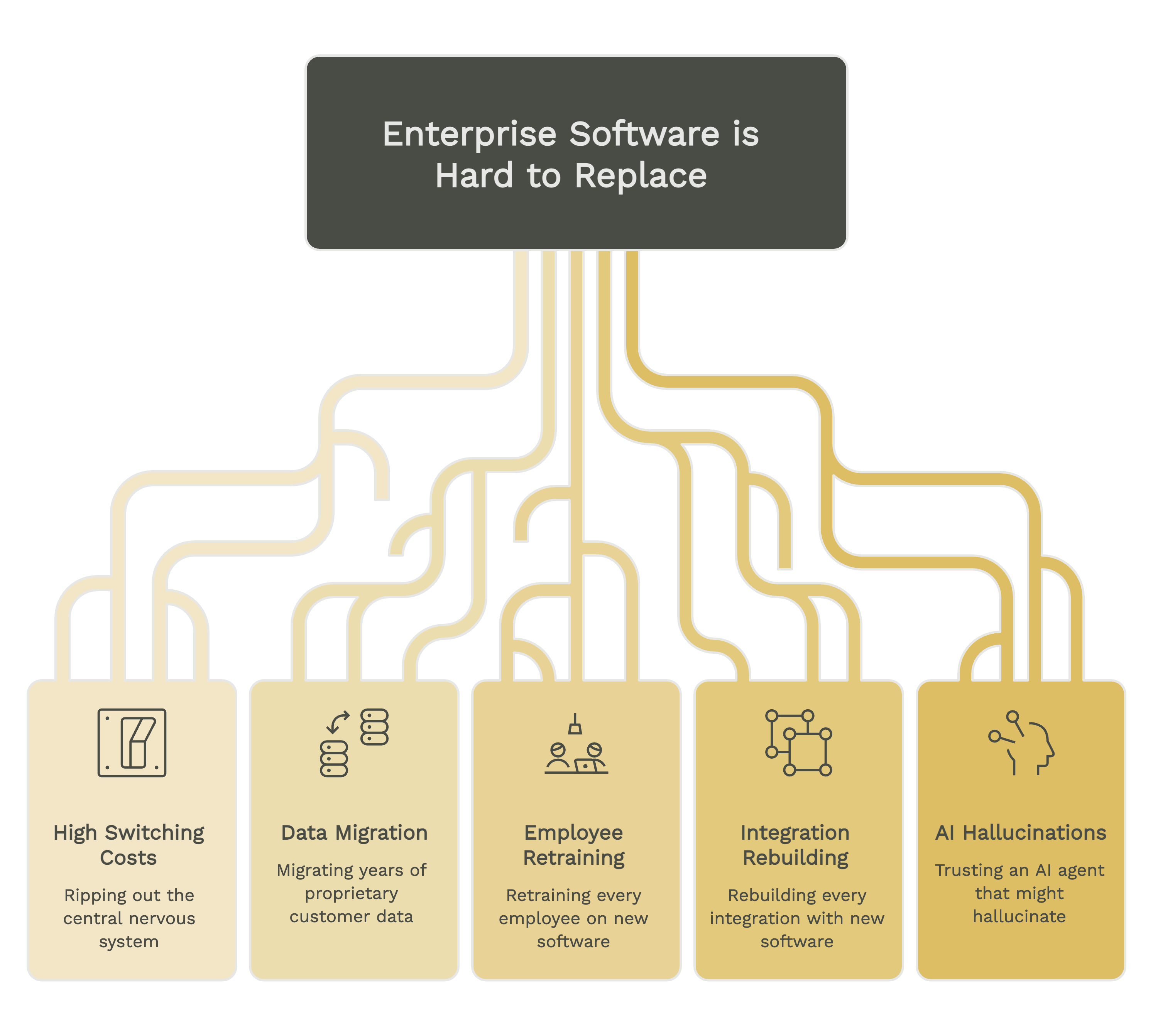
To leave, a company would have to rip out the central nervous system of its business: migrate years, sometimes close to two decades, of proprietary customer data, retrain every employee, rebuild every integration, and trust an AI agent that might hallucinate or drop a record to run the information its revenue depends on. That is not a subscription you cancel to save a few dollars.
Moats built on deeply embedded workflows do not crumble in twelve months because a new technology shows up. At worst, they erode over a decade, if at all.
Invert the Question: What Would It Actually Take to Kill This Business?
Munger's other habit was inversion: instead of asking how a business wins, ask what it would take for it to lose.
To kill Salesforce, the average enterprise would have to voluntarily tear out the system that manages its customer relationships and replace it with unproven technology to save a percentage on licensing. Who signs off on that? A VP whose career ends if it goes wrong. How long would the migration take even if the decision were made today? Years.
That reframes the AI fear from "possible" to "possible on what timeline." The market is pricing the worst case as if it lands next quarter. Salesforce's trailing price-to-earnings multiple has fallen to around 21, near its lowest in a decade and a fraction of the triple-digit average it carried over the prior five years, even as earnings have kept growing north of 20% a year.
That kind of multiple implies the market expects this business to barely grow, on a company growing far faster than that. That is a price-to-value gap in an industry sell-off.
I am not telling you to buy Salesforce. There are real questions about how AI reshapes the CRM industry over the next decade, and the bear case deserves serious weight.
How to Invest Like Warren Buffett in an Industry Sell-Off: The Four Ms Framework
This is the kind of moment the Four Ms of Rule #1 Investing were built for. They give you a structured way to separate a wonderful business from an impaired one when the market can no longer tell the difference.
Meaning. Do you understand this business well enough to own it through a hard stretch? If you can't explain why the moat holds, you don't have enough Meaning.
Moat. Does it have a durable competitive advantage, like switching costs, a brand, a network effect, or a patent, that protects pricing power when competitors attack?
Management. Are the people running it honest, owner-minded, and capable of steering through a disruption?
Margin of Safety. Is the price far enough below what the business is worth to protect you if your analysis is partly wrong? That is how you honor Rule #1: don't lose money.
The market's imprecision is your edge, but only if you can do that separating with discipline. And you hold an advantage Wall Street does not: you can think in five and ten year periods, even decades, while the big institutions are paid to think in quarters.
Three Diagnostic Questions Before You Buy Any Stock in a Sector Sell-Off
Here is the practical process for price vs. intrinsic value investing when a sector is in a panic.
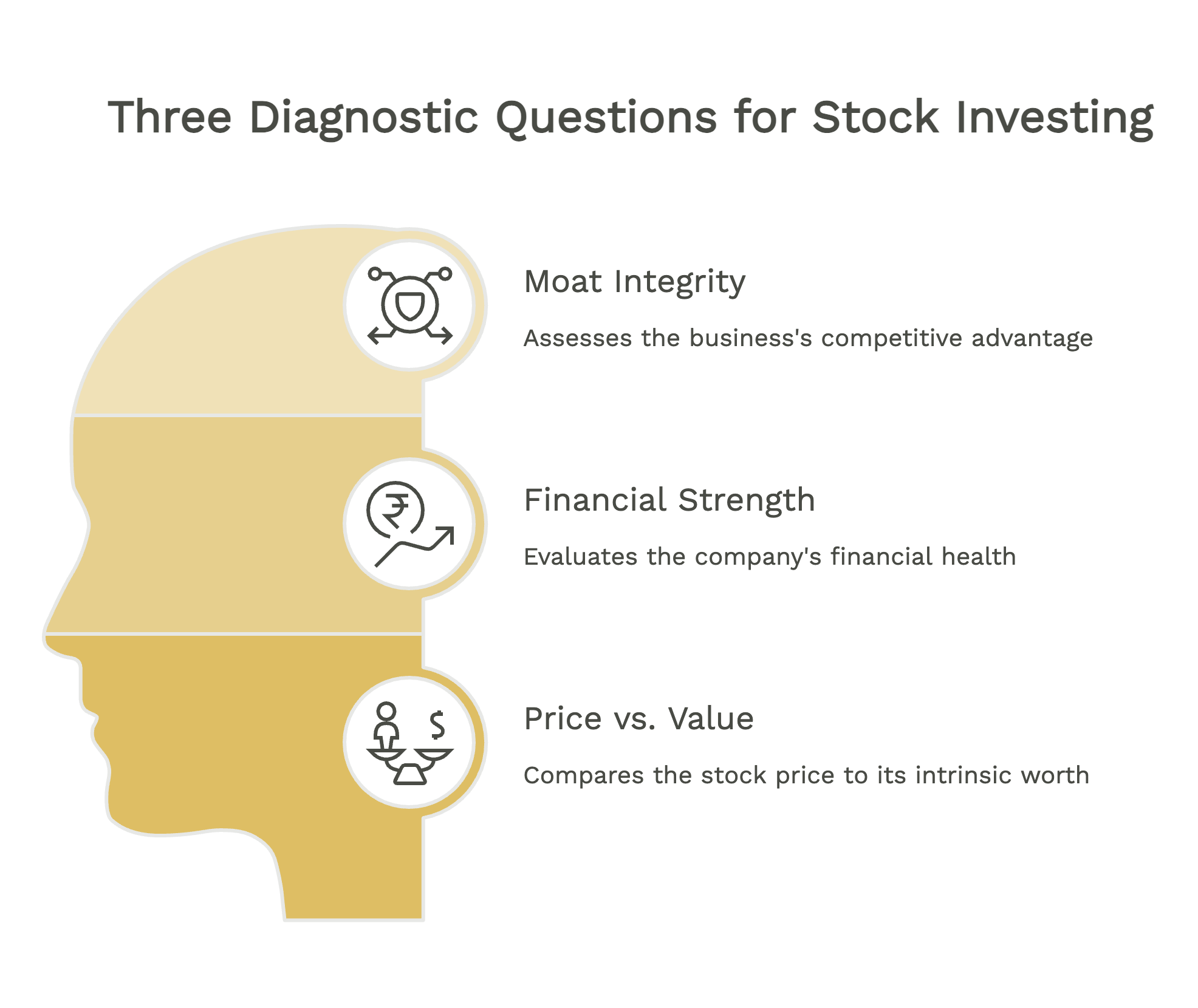
Is the moat intact or breaking? Apply the structural, temporary, or irrational test to this specific business, not the sector. Is the advantage still there, or is the disruption eating through it?
Are the financials strong or deteriorating? Look at the Big Five Numbers: Return on Invested Capital (ROIC), sales growth, earnings per share growth, equity or book value per share growth, and free cash flow growth. (Debt I check separately, after the Big Five.) A durable moat with strong, consistent Big Five is a different situation from a business whose numbers are already coming apart. Don't confuse a scary headline with a deteriorating business.
Is the price well below what the business is worth? Calculate what a business is actually worth, its Sticker Price, then compare today's price to it. From there you can run the Margin of Safety numbers yourself to see whether the discount is big enough to protect you if your assumptions are partly wrong.
If you can't answer all three with confidence, you don't have enough information to act. That is a reason to keep working, not to panic.
Value Investing During a Market Downturn Means Doing the Work, Not Just Watching the Price
A falling price is not evidence of value. It is an invitation to do the analysis.
Most of us are tempted to confuse activity with work. Watching a ticker drop is not analysis. Calculating what a business is worth, from its growth rate, its moat, and its current earning power, is analysis.
The danger in an industry sell-off is acting on the narrative instead of the numbers. The narrative says AI will destroy every SaaS business.
For some, that may prove true. For others, it may be wildly overblown. My honest view is that some of the most wonderful software businesses, the ones with intact switching-cost moats, are being priced like the worst.
The Bottom Line: What to Do Right Now
Don't buy a software stock because it is cheap. Buy a wonderful business at an attractive price: the moat intact, the financials supporting the story, and the price well below a Sticker Price you calculated yourself. If you can't answer those three with confidence, keep working.
The next step is to set your buy price with confidence before you commit a dollar. Industry sell-offs close. The window between Mr. Market's panic and the market remembering what these businesses are worth is finite, so use it.
Now go play.
Learn to Apply This Framework Yourself
If this resonates and you want to apply it to any company in any market, that is what we teach in the Virtual Investing Workshop.
In the workshop, my mentors and I walk you through how to read a moat, pressure-test a balance sheet, calculate what a business is worth, set your buy price, and use options to begin creating cash flow. Over 30,000 investors have been through it.
These are the skills that may help you act with confidence the next time an industry sell-off shows up, and there is always a next one.
Rule One Investing provides investment education and training only. We don't provide personalized investment advice, manage client assets, or guarantee investment returns. All content is for informational purposes. Consult a qualified financial professional before investing. Past performance does not guarantee future results. Individual results vary.
Attend a Rule #1 Workshop
Learn how to conduct research, choose the right companies for you, and determine the best time to buy.

About Phil Town
Phil Town is an investment advisor, hedge fund manager, 3x NY Times Best-Selling Author, ex-Grand Canyon river guide, and former Lieutenant in the US Army Special Forces.
He and his wife, Melissa, share a passion for horses, polo, and eventing. Phil's goal is to help you learn how to invest and achieve financial independence.
Get Phil's Free Guide