










Berkshire Hathaway's $380 Billion Cash Pile: What It Signals for Investors
 Phil Town
 In This Article
- What $380 Billion Actually Means in Plain English
- Buffett Has Done This Before: Three Historical Parallels Every Long-Term Investor Should Know
- Buffett Told Us Exactly What He Was Doing (and Most People Didn't Listen)
- The Three Signals That Explain Why Buffett Stopped Buying
- The Rule #1 Framework Is What Buffett Actually Uses for Long-Term Investing
- Three Action Steps for Rule #1 Investors Right Now
- Watch Greg Abel's 13F: The Signal to Act
- The Bottom Line on Berkshire Hathaway Stock and What It Signals for Your Portfolio
- Reserve Your Spot for the Next Virtual Investing Workshop
Warren Buffett spent 60 years running Berkshire Hathaway. His final strategic act before stepping into the Chairman role and handing the CEO keys to Greg Abel was not to buy anything. He left his successor a fortress of more than $380 billion in cash sitting in Treasuries, completely undeployed, and walked away.
Here's something worth knowing before we get started: I've spent four decades investing the Buffett way, and I've watched him build cash like this before. So when the greatest investor who ever lived makes a move this deliberate about where Berkshire Hathaway stock and long term investing stand, I pay attention. You should too.
This isn't a Berkshire earnings breakdown. It's a plain-English framework for exactly this moment, built around three questions:
What did Buffett see that made him build this pile instead of spending it?
What is Greg Abel supposed to do with it now?
What does all of this mean for your money?
I'm going to answer all three, because if you miss this signal, you'll regret it.

What $380 Billion Actually Means in Plain English
Let me put this number in perspective, because the dollar amount alone doesn't land until you understand the scale.
$380 billion is more than the GDP of Finland, more than the market cap of Walt Disney Corporation, and enough to buy Coca-Cola outright, which Berkshire already owns a big piece of, and still have a hundred billion dollars left over.
If you want the background on how this cash pile grew over time, start here: The Truth About Warren Buffett's Record Cash Pile.
That figure represented the pile at the late-2025 handover, roughly $382 billion. Under Greg Abel, it has since grown to approximately $397 billion, and it is still untouched.
But the raw number isn't what makes this historic. The ratio is what matters. Berkshire's cash as a percentage of its total assets is now at a level not seen in over 20 years.
The last time it looked like this was right before the Great Recession.
Buffett Has Done This Before: Three Historical Parallels Every Long-Term Investor Should Know
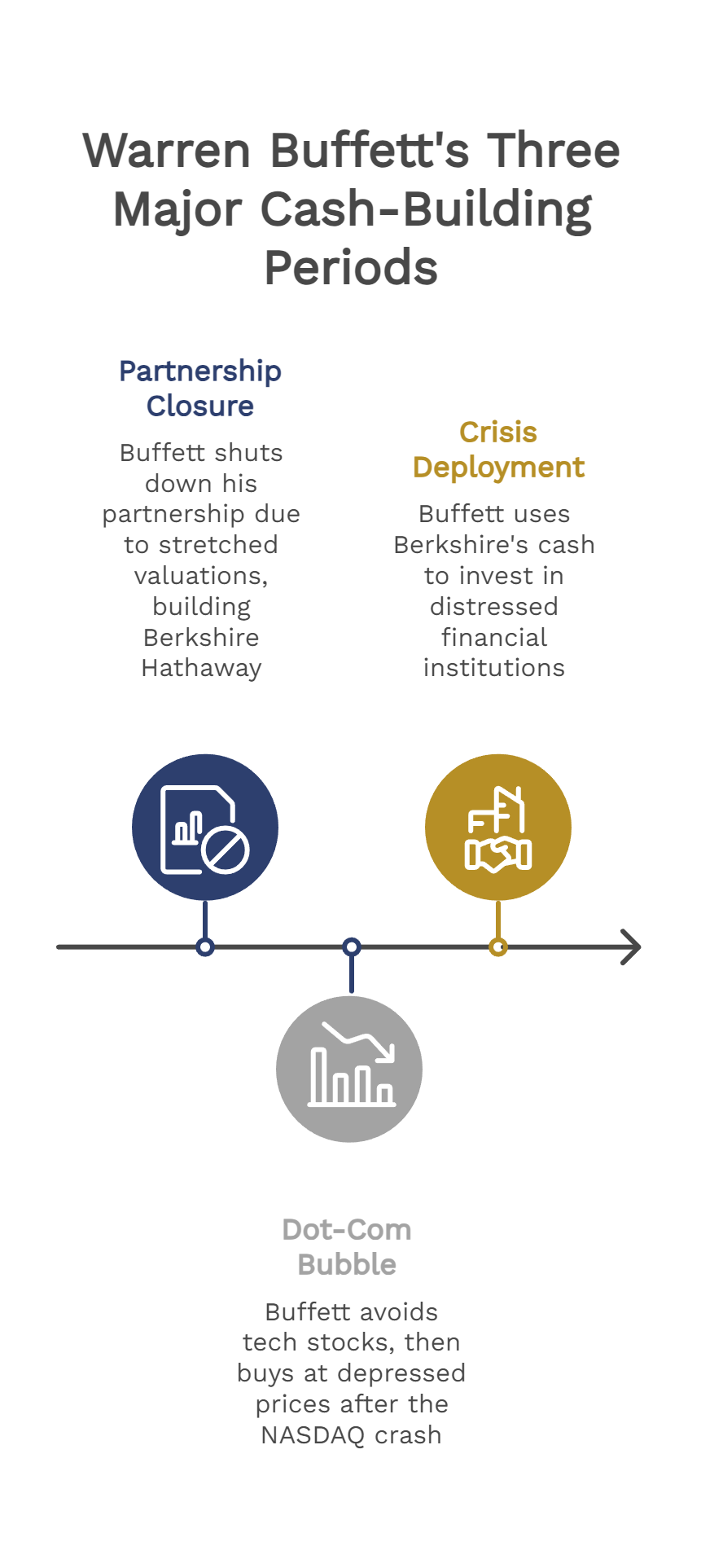
Buffett has done this exactly three times in 60 years.
First, the late 1960s
After World War II, the market ran hard and valuations got stretched. Buffett looked around, couldn't find anything worth buying at a good price, and made a decision most investors would consider unthinkable. He shut down his entire partnership. Closed the whole thing. The Dow sat near 1,000 and didn't decisively break above that level for the better part of two decades. Buffett spent that time building Berkshire Hathaway out of the wreckage of a long, grinding market. The investors who stayed fully deployed in overpriced stocks had a very rough stretch. This is essential Warren Buffett history, and most people skip right past it.
Second, 1999 and the dot-com bubble
Buffett famously refused to buy technology stocks. The entire financial industry declared he'd lost his edge, that he didn't understand the new economy, that he was simply too old to get it. Then the NASDAQ fell 78 percent. When prices collapsed, Buffett went shopping. The people who called him out of touch watched their portfolios get cut in half while he accumulated positions at prices that made him and his shareholders extraordinarily wealthy.
Third, the Great Financial Crisis
Berkshire ran into that crash holding a mountain of cash. Buffett deployed it into Goldman Sachs, Bank of America, and a long list of other great American businesses at prices that generated tens of billions of dollars in gains for Berkshire shareholders.
Three times in 60 years, Buffett built a fortress of cash instead of deploying it, and he was right all three times. Now, in what turned out to be his final year in charge, he built the largest pile of them all and handed it to Greg Abel on his way out. This is the fourth time.
Buffett Told Us Exactly What He Was Doing (and Most People Didn't Listen)
People act like Buffett's moves are mysterious. They're not. He broadcasts his thinking in plain sight, year after year, in his letters and at his meetings. The trouble is that hardly anyone reads it closely.
In his recent letters to shareholders, Buffett has made the point that there are very few deals left in America big enough to move the needle for Berkshire anymore.
Read that carefully. He wasn't saying he had stopped looking. He was actively hunting, with 60 years of relationships, a team that can buy entire companies on a single phone call, and more capital than almost any institution on earth. He looked, and he couldn't find enough wonderful businesses at great prices to justify putting the cash to work.
At the final annual meeting in Omaha, he went further. He said plainly that prices were high and he'd be happy to deploy the cash the moment the right opportunity appeared, but he wasn't going to swing just to swing. That framing matters. Wait for the fat pitch. Don't swing at everything they throw. That is Warren Buffett's advice on investing in its most direct form.
Here's the translation for the rest of us regular folks. He spent his final months in charge telling us, and telling Greg Abel, that the market wasn't offering him a fat pitch. And rather than force a bad decision on his way out, he did the single hardest thing in all of investing. He did nothing.
Now ask yourself this: if Warren Buffett with 60 years of relationships couldn't find anything worth buying at these prices, what are the odds that the guy on TikTok telling you to back up the truck on his favorite AI stock figured out something Buffett missed?
I'm going to leave that question right there. You may also want to read more about whether Buffett is predicting a stock market crash if you're trying to understand the full picture he was painting.
The Three Signals That Explain Why Buffett Stopped Buying
So what was Buffett actually watching? The signals that drove this decision are publicly known, and any one of you can track them right from home.
When I think about stock market valuation and stock market timing, these are the indicators I come back to. And here's the important reframe: Rule #1 isn't about predicting market tops and bottoms. It's about price relative to value and a margin of safety. These signals tell you when a margin of safety has become almost impossible to find anywhere you look. Here are the three that matter most right now:
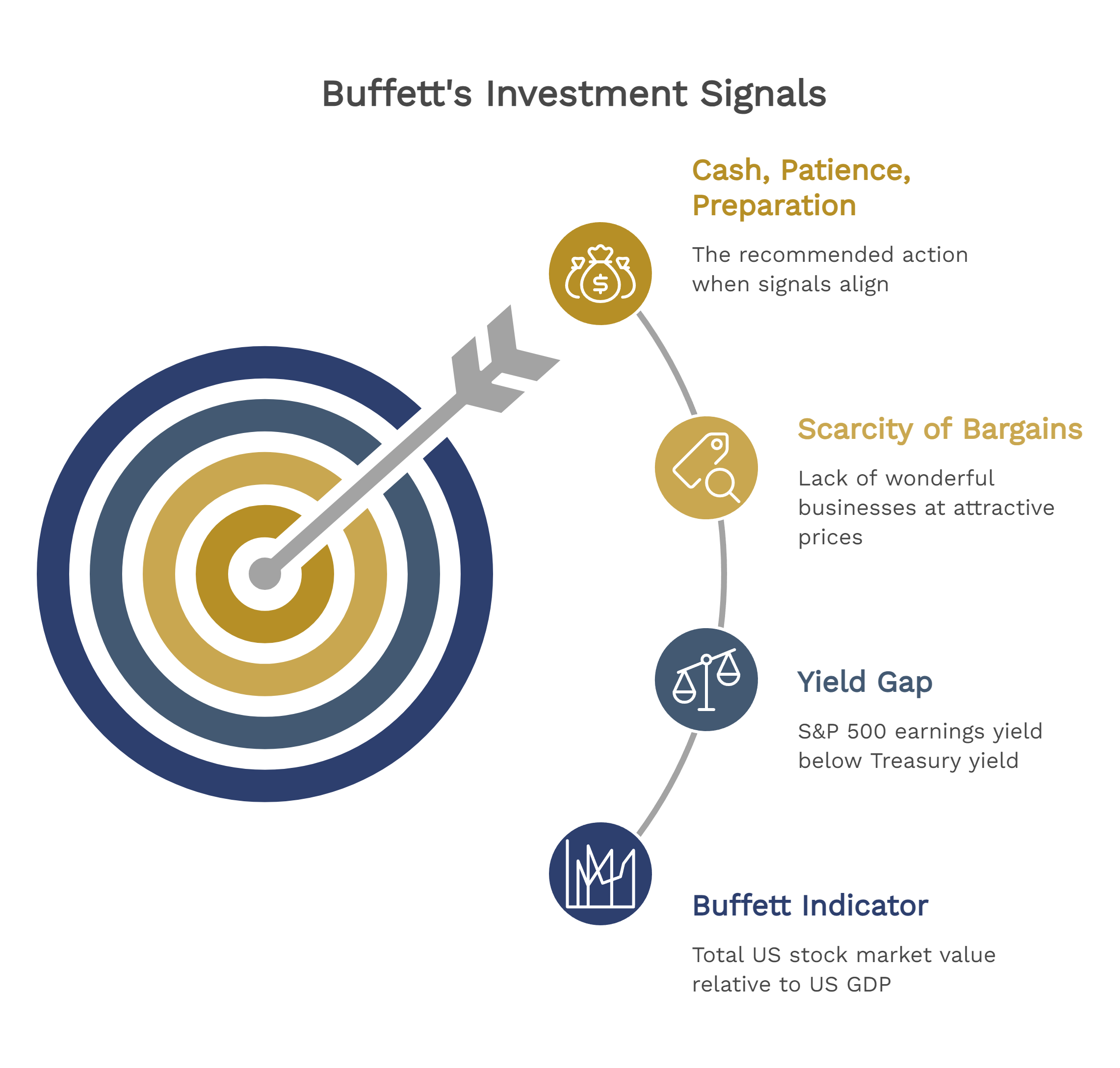
The Buffett Indicator: total US stock market value relative to US GDP
The yield gap: the spread between the S&P 500 earnings yield and the two-year Treasury yield
The scarcity of bargains: wonderful businesses at prices that offer a real margin of safety have nearly vanished
When all three flash at once, the correct move is cash, patience, and preparation.
Signal One: The Buffett Indicator Is at All-Time Highs
Back in 2001, Buffett wrote an article for Fortune magazine where he described the ratio of the total US stock market value to US GDP as probably the single best measure of where valuations stand at any given moment. That ratio became known as the Buffett Indicator.
As a rough guide:
Around 100 percent: the market is roughly fairly valued
Above about 120 percent: stocks are starting to get expensive
Approaching 200 percent: in Buffett's own words, you're playing with fire
When I recorded this analysis, the Buffett Indicator was hovering at all-time highs, higher than it was in 1999 before that crash, higher than almost any other point in American market history. This is signal one, and it isn't subtle.
Signal Two: Stocks Are Paying Less Than Treasuries
Here's the clearest plain-English version of this signal I know. When you can get around 5 percent on a completely safe two-year Treasury bond, stocks have to offer substantially more than that in forward earnings potential to justify the additional risk you're taking.
The earnings yield is simply the earnings of the S&P 500 divided by its price. It tells you what return you're getting from the earnings of the companies you're buying. When that number falls below what a risk-free Treasury pays, the math stops working in your favor.
At the time I looked at this, the S&P 500 earnings yield had fallen below the Treasury yield. Investors were being paid less to take stock risk than to take zero risk. That condition has appeared only a handful of times in the last 40 years, and each time it preceded a meaningful market drawdown. That is signal two.
Signal Three: Wonderful Businesses at Attractive Prices Have Disappeared
This is the signal I focus on most, because it's the one that actually determines whether Rule #1 investors can find something worth buying.
Buffett doesn't buy indexes. Neither will Greg Abel. They buy specific wonderful businesses when those businesses go on sale. That means:
Durable competitive advantages
Strong financial track records
Great management
A price that gives a real margin of safety
Right now, outside of a few isolated pockets, those opportunities are genuinely scarce. And that scarcity isn't a vague feeling. It's exactly what Buffett ran into when he went looking.
When you apply the Four M's framework, the lens Rule #1 investors use to decide whether a business is truly wonderful, the list of companies that pass all four filters at an attractive price is very short right now.
The Rule #1 Framework Is What Buffett Actually Uses for Long-Term Investing
Here's why all of this matters beyond the Berkshire story.
The framework Buffett has used his entire career isn't complicated. A wonderful business at an attractive price with a big margin of safety and patience. That is the whole system. And by Berkshire Hathaway's own long-term track record, that approach has produced roughly 20 percent annualized return over 60 years, and nothing else in public markets even comes close. That reflects Berkshire's documented historical performance, not a return any individual investor or Rule #1 student should expect. Past results don't guarantee future outcomes.
The $380 billion cash pile isn't separate from that framework. It is the product of that framework applied consistently over 60 years: when none of the businesses worth owning were trading at a fair price, Buffett simply didn't buy. Full stop.
Rule #1 investors already have the tools to apply this same logic. The real question is how to know what to pay for a stock at the individual company level, and the answer starts with calculating a Sticker Price and a margin of safety before you buy anything.
Three Action Steps for Rule #1 Investors Right Now
Here's what I'm actually telling Rule #1 investors to do in this environment. Not panic, not sell everything, and definitely not buy gold. Three things.
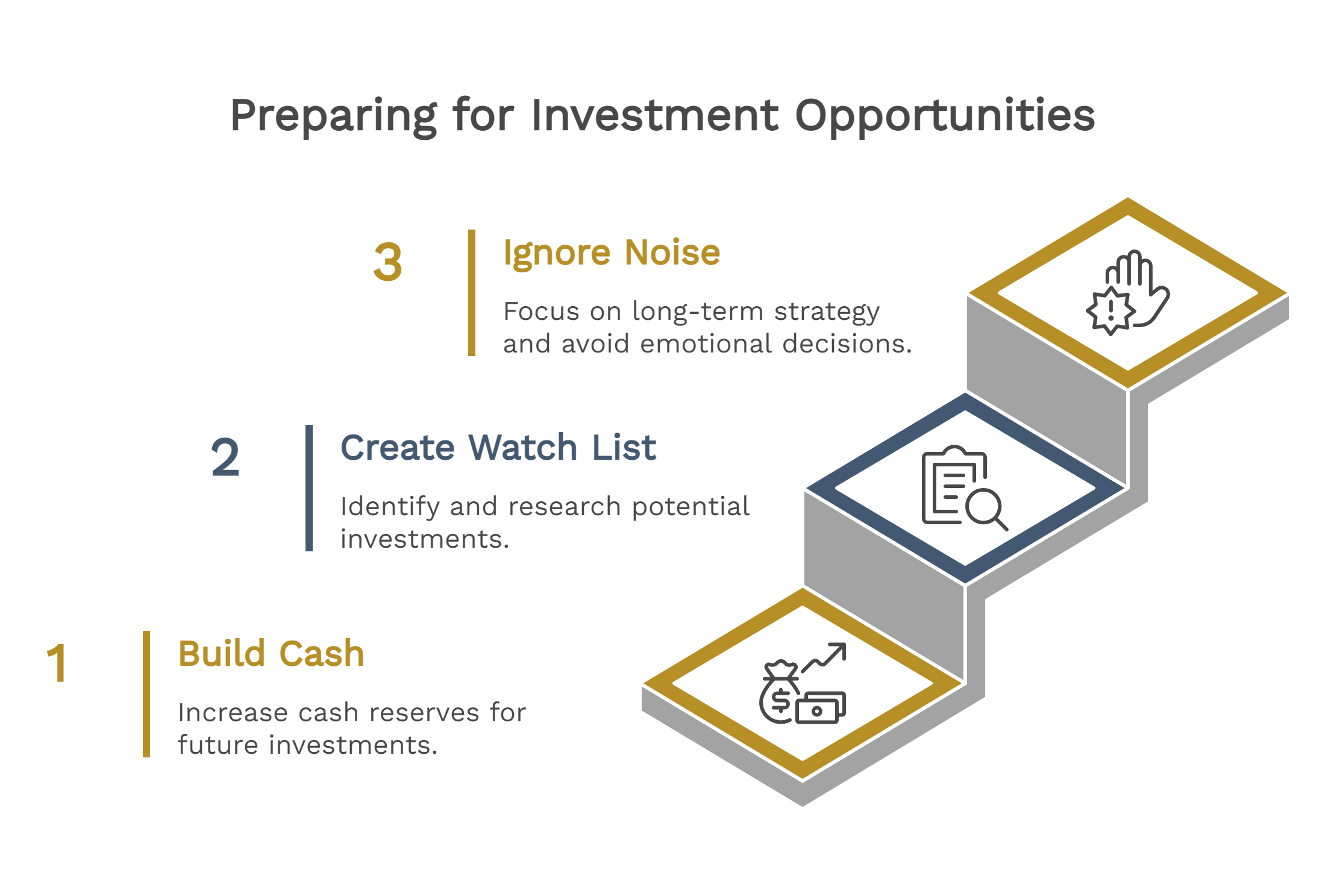
1. Build your cash position with intention
Cash isn't a failure position. Cash is optionality. As Buffett has long argued, cash matters most when it's paired with the courage to act in a crisis. You don't need $380 billion. You need enough dry powder to take advantage of the opportunities that historically follow periods exactly like this one. Building cash right now isn't fear. It's preparation.
2. Build your watch list right now, not later
This is the single most valuable thing you can do between today and the next real buying opportunity. Three steps:
Identify 5 to 15 wonderful businesses you'd love to own forever
Calculate what each one is actually worth
Set your buy price with a margin of safety calculator, the price that still gives you a real margin of safety even in a worst-case scenario
Here's why this can't wait: when the market finally panics, things move fast. History says Mr. Market will panic, and when he does, you won't have time to do the research. The people who get rich in those moments have already done the work, and they're ready to pull the trigger.
Here's where most people get stuck though.
And here's the part I love telling people: you already know more than you think. Start where you are, with the businesses you genuinely understand. That's your Circle of Competence. When I was starting out as a river guide, I understood the travel business because I lived in it every day, and that led me straight to companies I already knew. Begin with what you know, and let your curiosity grow the list from there.
3. Ignore the noise
CNBC will be screaming. TikTok geniuses will be dancing. Your neighbor will be absolutely certain the market is going to zero, and your other neighbor will be just as certain that AI is about to send it to 100,000. Neither of them knows.
Learning to recognize the stock market's emotional swings and why they shouldn't drive your decisions is one of the most practical investing skills you can build. Buffett didn't know the precise moment either, but he knew the framework, and he handed Greg Abel 380 billion reasons to keep following those rules.
Watch Greg Abel's 13F: The Signal to Act
A quick word on the mechanics here:
Berkshire's quarterly financial report shows the overall cash level
The 13F filing reveals the specific stocks Berkshire is buying and selling each quarter
Those are the two filings to watch. The moment Berkshire's 13F starts showing real deployment of that cash on hand, that will be one of the most important tells in financial markets this decade. It means Abel sees a fat pitch.
As of the most recent reports through early 2026, Abel has kept building cash rather than deploying it, pushing the pile to roughly $397 billion. That only proves the point: even the new CEO, with everything Berkshire has behind him, doesn't see a fat pitch yet.
When deployment starts, the signal shifts fast. That's why you build your watch list and position your cash now, so you're ready before that day, not scrambling after it.
The Bottom Line on Berkshire Hathaway Stock and What It Signals for Your Portfolio
Berkshire Hathaway's $380 billion cash position isn't an accident. It's a deliberate choice by the most disciplined investor we have. He didn't panic, and he didn't chase the crowd. He built his fortress, handed it to Greg Abel, and left with one unspoken directive: wait.
Buffett's own words capture it perfectly: "Cash combined with courage in a time of crisis is priceless." That phrase isn't a platitude. It's a working instruction from someone who deployed cash into Goldman Sachs and Bank of America while everyone else was running for the exits.
For anyone watching Berkshire Hathaway stock and trying to invest for the long term, the signal here is consistent with every other time Buffett has done this. The investors who copied his preparation did well every single time. The investors who ignored it and stayed fully deployed at peak valuations had very difficult years ahead of them.
The correct response isn't fear. It's readiness:
Build your cash
Build your watch list
Know your buy prices before Mr. Market blinks
When Greg Abel finally swings, you want to be ready to swing too. Do the work now, and when that fat pitch comes, it's time to go play.
Reserve Your Spot for the Next Virtual Investing Workshop
If you'd like to get better at exactly this, finding wonderful businesses, building your watch list, and knowing what to do when prices drop, that's precisely what we teach in our Virtual Investing Workshop.
My mentors and I walk you through the Rule #1 principles, live and entirely online.
Grab our stock investing guide as a starting point.
This content is for informational and educational purposes only. It doesn't constitute financial, investment, legal, or tax advice. Investing involves risk, including the possible loss of principal. Past performance does not guarantee future results. Always consult a qualified financial professional before making any investment decision.
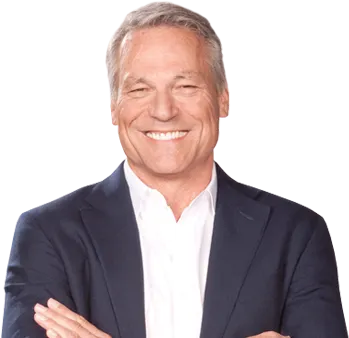
About Phil Town
Phil Town is an investment advisor, hedge fund manager, 3x NY Times Best-Selling Author, ex-Grand Canyon river guide, and former Lieutenant in the US Army Special Forces.
He and his wife, Melissa, share a passion for horses, polo, and eventing. Phil's goal is to help you learn how to invest and achieve financial independence.
Get Phil's Free Guide