











Circle of Competence: Why I Passed on Adobe and ServiceNow
 Austin Bowen
 Here's the thing about Adobe. From a purely financial standpoint it looks fantastic, and I mean that.
High margins. Sticky recurring revenue that customers don't cancel. Great return on capital, and a real moat around the business.
Smart money likes it too. Michael Burry, the investor from The Big Short, disclosed a position in it earlier this year.
I looked past the numbers, too. I asked our own YouTube editing team and our UI/UX team, people who open these products every day for work, whether they saw AI replacing Adobe for professional creatives.
Every one of them said no. Full stop.
So this should be a slam dunk. Financials are great, Burry's in it, the people who live in the software swear by it. So why am I not in it?

The Part the Numbers Can't Tell Me
I have no artistic talent. None. And anything that runs on artistic talent sits outside my circle of competence. That's the whole reason I can't own this business.
Adobe is built around creative professionals: designers, video editors, photographers, artists. People whose work I can admire and cannot evaluate.
What Owning Adobe Would Ask Me to Predict
Whether a designer who has spent 15 years inside Photoshop would ever seriously consider leaving it. Whether the next generation of creatives comes up on these tools at all, or on something that doesn't exist yet.
Whether the AI features Adobe keeps adding are the reason people stay, or the reason a cheaper competitor finally becomes good enough.
Whether an agency renewing its Creative Cloud seats next year is grumbling about the price or doesn't even think about it.
I can't answer any of that. Not from a filing, not from a chart, not from a screener.
Why Asking Someone Else Doesn't Fix It
My editing team can answer those questions. They live in it, which is why I asked them instead of guessing.
Their answer helped them more than it helped me. Someone inside that world has a feel for where it's going that I could study for a year and still not match.
I'd be borrowing their conviction and calling it my own. That's not analysis, that's hoping.
ServiceNow: A Different Area Code
Then a bunch of folks told me to look at ServiceNow. ServiceNow? I didn't even know what the company did.
So I went and read a description of the business. It said something close to this: ServiceNow sells software that structures and automates business processes through a subscription model, mostly for the IT function inside large enterprises, and it has pushed that workflow automation into areas beyond IT.
I'll be honest with you. I read that and came out the other side more confused than I went in.
There are people for whom that description means everything. IT professionals, enterprise folks, people who read it and light up.
They know the pain point it solves, they know the competition, they know where it's going. Happy for you. Genuinely.
It's inside their circle and it isn't inside mine. That distinction matters, because none of this is a judgment on either company.
Adobe is probably wonderful. ServiceNow is probably incredible. My circle is a fact about me, not a grade I'm handing out.
What Buffett Actually Meant
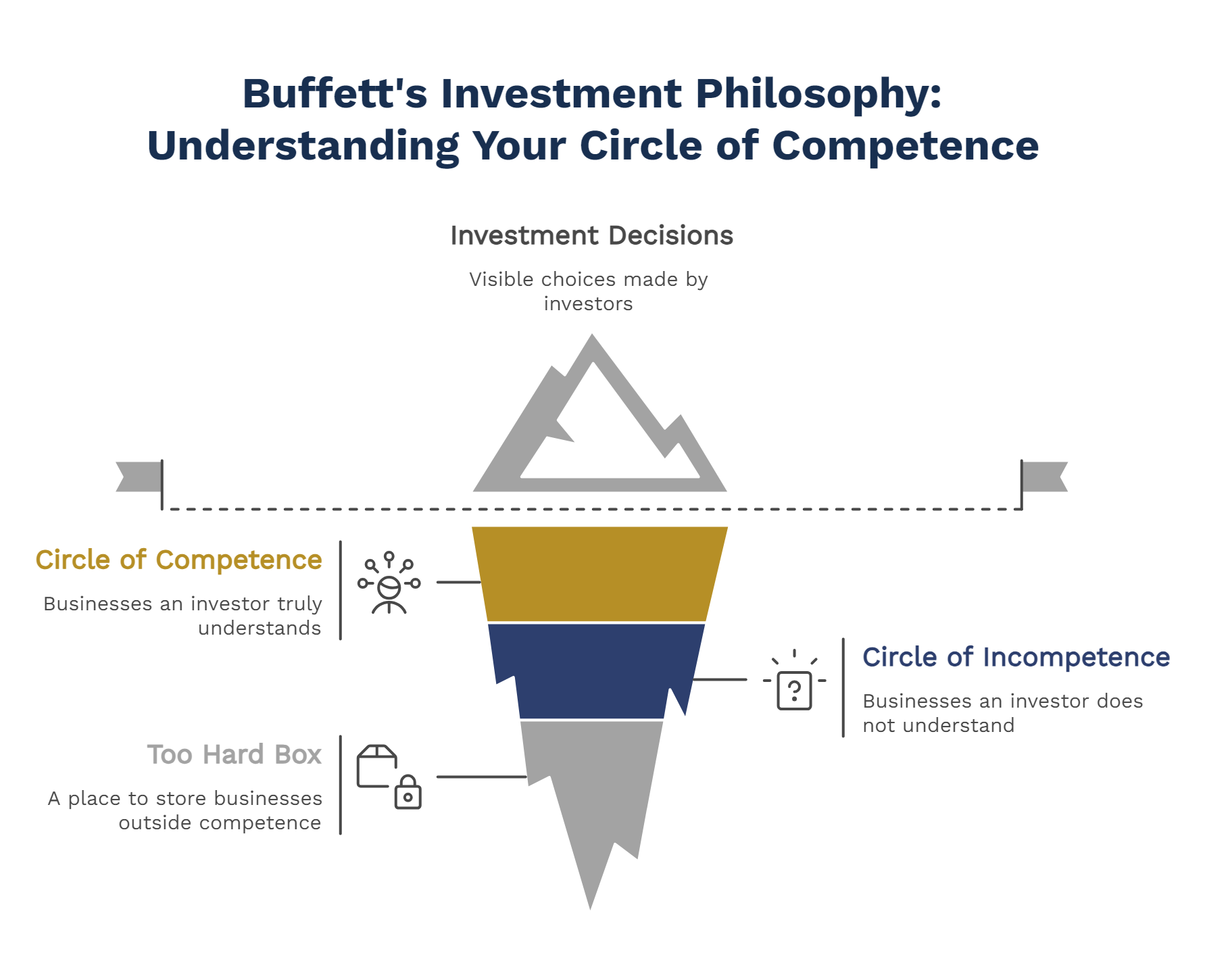
This is the thing Warren Buffett has said over and over, and the thing we teach constantly. Buy businesses you understand, not businesses that sound smart or businesses CNBC won't stop talking about.
Most investors treat the edge of their knowledge as something to hide. The legendary value investor built a career on treating it as a tool.
Knowing what falls outside your circle is worth as much as knowing what falls inside it. He keeps what he calls a too hard box for exactly this, and we've written about Warren Buffett's too hard box if you want the longer version.
Adobe and ServiceNow both went in mine. Cleanly, no second thoughts, and I moved on to the next name.
The Test I Run First
Can you explain this business to a 10-year-old? Not just what it sells, but how it makes money, who the customer is, what problem it solves, and where it's headed over the next decade.
If you need jargon to get through that, or a second read of the company's own description, you have your answer.
Four Questions That Settle It
Can you explain what the company does without looking it up? Do you understand who the customer is and why they keep coming back?
Can you describe the competition in plain language? Do you have a real view on where this industry sits in 10 years?
A no to any of those means you're not ready to own it. There'll be another company that fits.
How to Find Your Circle of Competence
Knowing what's outside your circle is the easy part. Mapping what's inside it takes a little work, and there's an exercise for that.
Draw three circles on a piece of paper and label them passions, talents, and money. What you love doing, what you're actually good at, and what you spend or earn money on.
Anything showing up in more than one circle is a place you already have an edge. That's the Three Circles exercise, and it's where Meaning starts.
Mine points at grocery stores. I don't need a software background to understand a business I walk into every week, which is why Sprouts Farmers Market sits inside my circle.
I'll take that one apart in a separate piece.
Meaning Comes First for a Reason
The Four M's run Meaning, Moat, Management, Margin of Safety, and that order is deliberate.
Meaning comes first because you can't run a credible valuation on a business you don't understand. You'd be putting a precise number on a guess.
Phil Town built Rule #1 on the same foundation Warren Buffett and Benjamin Graham laid down. In both of those, the price question comes last.
For me, Adobe and ServiceNow never became valuation problems. They stalled at Meaning, so Sticker Price and Margin of Safety never entered the conversation.
Before you buy anything, run it through the Rule #1 investment checklist and see whether you understand the business well enough to own it. If the Four M's are new to you, the Rule #1 strategy overview is the place to start.
You Don't Need an Opinion on Every Company
Financial media runs on the idea that you should have a take on everything. Adobe hits a new high and somebody wants your read. ServiceNow beats earnings and you feel like you ought to know what that means.
You don't. Invest in what you understand and pass on what you don't, and do it without apologizing for it.
The beautiful thing about this game is that you don't have to swing at every pitch. You only have to swing at the ones you understand.
Want to Learn the Full Four M's Process?
If this idea makes sense to you and you want the valuation skills to act on it, that's what the Rule #1 Virtual Investing Workshop is built for.
Three days, live, with hands-on coaching, working through the complete Four M's process from Meaning through Margin of Safety on real businesses. Join the link below to see current dates and pricing.
Join the Rule #1 Virtual Investing Workshop
You can also work through the Rule #1 investing guide at your own pace first.

About Austin Bowen
Austin is a former Air Force combat controller and now a dedicated faculty member and senior fund manager at Rule #1 Investing, where he empowers students to transform their financial futures through proven investing principles. Having guided his own family to financial independence and inspired countless others to achieve their "aha moment," he is passionate about making investing accessible for all.