










Analyzing Netflix: How Rule #1 Investors Find Opportunities
 Austin Bowen
 Netflix has long been a household name, changing the way we consume entertainment. But for investors, this global streaming giant served as a textbook example of how Rule #1 investing principles can turn market uncertainty into opportunity.
I'm Austin Bowen, and I'm an analyst for Phil Town. I want to walk you through one of the most teachable investments I've ever been part of, which is Netflix from 2022 to 2025.
Here's the punchline up front. To get this one right you didn't need a Bloomberg terminal, you didn't need a finance degree, and you didn't need an army of analysts. You needed two things: a little knowledge about how to value a business, and a Netflix subscription.
In this post, I'll walk you through how Netflix's stock decline became a real opportunity and explain the Rule #1 process that guided the decision.

Start With Your Circle of Competence
Before we touch a single number, we start where the legendary investor Warren Buffett always starts, which is your Circle of Competence.
The idea is simple. Only invest in businesses you actually understand. You don't get rewarded for being smart about everything, you get rewarded for being honest about what you do understand and not wandering past the edge of it.
The size of your circle doesn't really matter. What matters is knowing where that edge is. And here's the part most people never realize: millions of us have a Circle of Competence we don't even know we have, because we live inside it every single day as customers.
Netflix was dead center in mine. Many of us have been loyal Netflix customers for over a decade, going back to the days of DVDs delivered by mail. I was a subscriber in high school, picking movies online and waiting for those little red envelopes to show up in the mailbox.
Then in 2007 Netflix launched streaming, and for fifteen years it was one of Wall Street's rocket ships. As much as I admired the company, it was never trading at a price that made sense for investing. Meaning is the first of the four questions we run every company through, and Netflix passed it easily. It was a great story. The price just never worked.
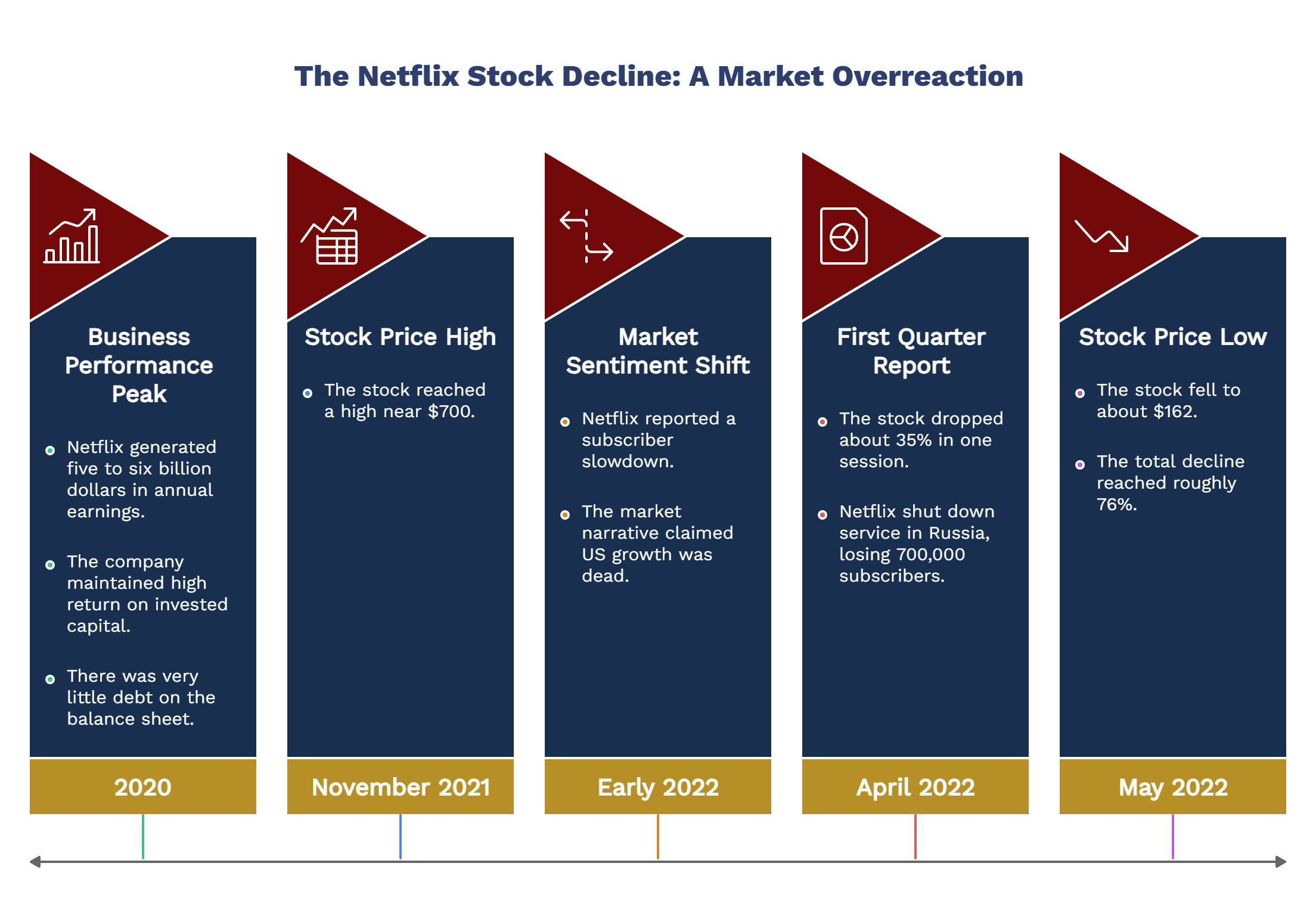
The Netflix Stock Decline: A Market Overreaction
Around 2020, two things started happening at the same time, and they pointed in opposite directions.
On one hand, the business became exactly what we want. Netflix was throwing off billions in actual earnings, roughly five to six billion dollars a year, with high return on invested capital, meaning every dollar they put into the business came back as a lot more, and very little debt on the balance sheet. That's the profile of a wonderful business, and it's what the Big Five Numbers are built to show you.
On the other hand, the story Wall Street told had flipped completely negative. In early 2022, Netflix made headlines for all the wrong reasons. The company reported a subscriber slowdown, sparking widespread pessimism in the market. The narrative became that Netflix was maxed out, the US was saturated, and growth was dead.
As negative news cycles compounded, the stock fell from its November 2021 high near $700 all the way down to about $162 by May 2022, a drop of roughly 76%.
The sharpest single day came off the first quarter 2022 report in April, when the stock dropped about 35% in one session, from around $348 to around $226.
The part almost nobody on TV mentioned was that in the same quarter, Netflix shut down all of its service in Russia in protest of the invasion of Ukraine. They walked away from roughly 700,000 subscribers on principle, and the company said plainly in its own shareholder letter that without that exit it would have added subscribers rather than lost them.
The miss was largely a decision the company chose to make. But the headline was already written.
For long-term investors, such a drastic decline in a brand this strong was a flashing neon sign. Look closer.

Would You Ever Go Back to Cable?
By the time the stock dropped to levels not seen since 2015, the question the whole market was asking was whether Netflix was broken.
If you actually understood the business, the answer was pretty simple, and you could get there from your own living room.
Everybody over thirty in the US has lived the transition from the cable bundle to streaming. So I want you to ask yourself one honest question. Would you ever go back?
Back to not being able to watch what you want when you want it. Back to ad breaks every ten minutes interrupting your show. Back to waiting a full week between episodes, which plenty of other streamers still do because they only produce enough content to fill one slot a week.
The World Wasn't Finished With Streaming
In 2022, with Netflix sitting at 220 million subscribers, all Wall Street could ask was whether we were maxed out. Maybe in the US. But here's what everybody kept forgetting: it's a big world, and Netflix is a global company.
At that point the large majority of households worldwide still hadn't gotten off the cable bundle. In plenty of countries you didn't even have the option. In some, they charged you extra while you were on the bundle just to watch Netflix.
Wall Street looked at a saturated US market and declared the whole game over. We were looking at the rest of the planet. Because when a first-time streamer anywhere on Earth picks up their first service, who do you think they reach for? The brand they already know.
Evaluating Netflix With the Rule #1 Framework
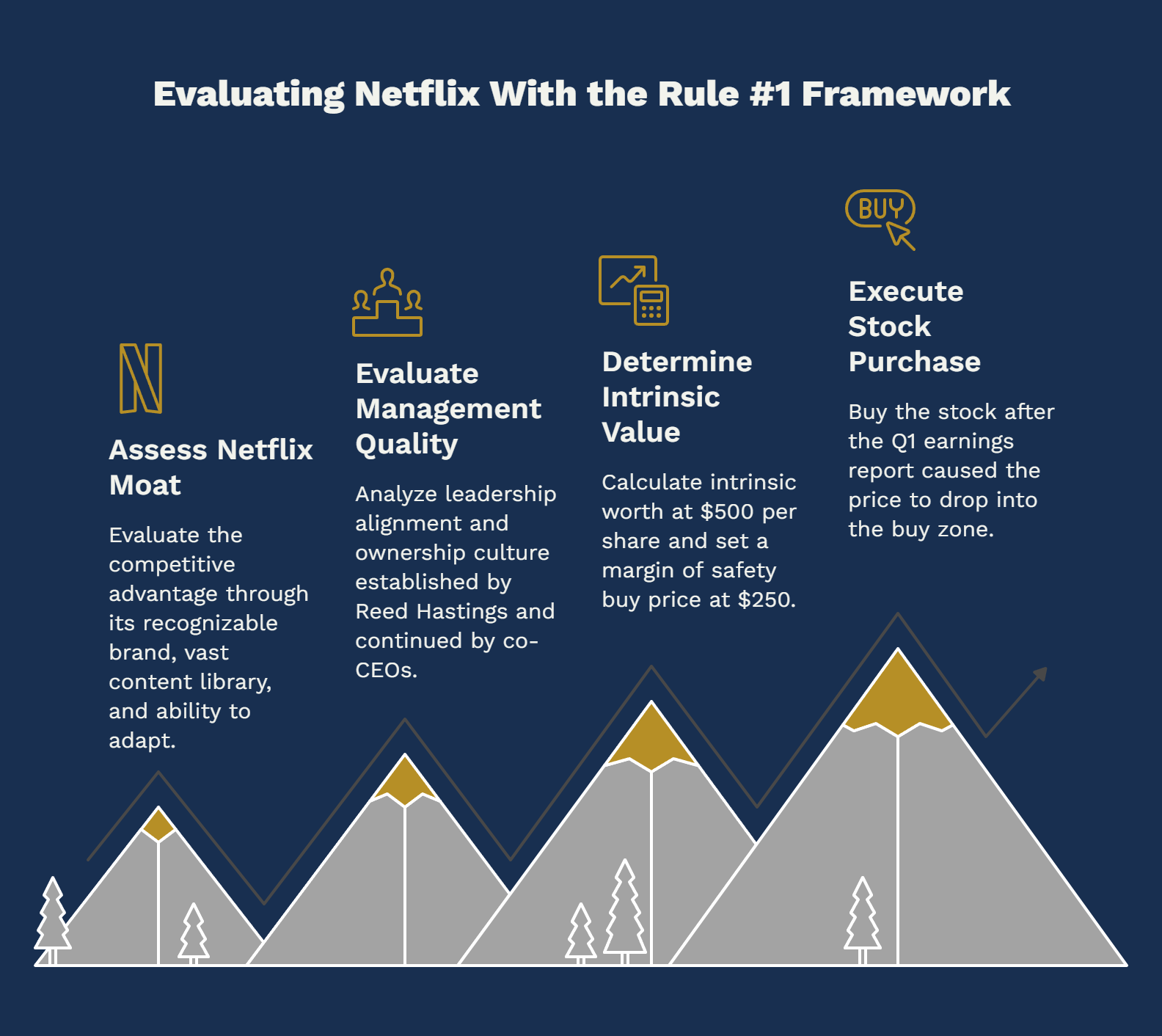
We'd already answered Meaning just by living inside the business as customers, which left three more questions to run Netflix through.
1. Does Netflix Have a Moat?
Netflix has one of the most recognizable brands in the world, making its competitive advantage, or moat, obvious. Its vast content library and ability to adapt to changing consumer preferences solidify its position as a market leader.
2. Does Netflix Have Great Management?
Reed Hastings, Netflix's founder, was CEO at the time and is exactly the kind of leader we look for. His substantial ownership stake in the company demonstrated real “skin in the game.” That alignment between management and shareholders gave us confidence in the company's leadership. Hastings has since moved into the Executive Chairman role, with Ted Sarandos and Greg Peters running the company as co-CEOs, but the ownership culture he built stayed intact.
3. Is Netflix On Sale?
Valuing Netflix revealed its intrinsic worth to be around $500 per share. To meet our Margin of Safety requirement, the stock needed to trade at 50% of that value, or $250 per share.
When Netflix's Q1 earnings report caused the stock to drop from $350 to $220 overnight, it hit our buy zone. At one point, the stock even fell below $200, making it an undeniable bargain.
Turning Market Fear Into Opportunity
At Rule #1, we believe that market pessimism creates the best opportunities for long-term investors. Netflix's rapid decline allowed us to invest in a company we'd admired for years at a deeply discounted price.
This is Mr. Market at his most emotional, and fear is the thing that puts wonderful businesses on sale. Without it, they never would.
Meanwhile, here's Wall Street acting like they know better, moving like a little herd of sheep, each one following the sheep in front of it, nobody once stopping to think about the long term.
And that right there is the single biggest advantage you and I have as individual investors. We don't lose our jobs because our portfolio is down one quarter while our peers are up. A pro does, and that fear creates all kinds of short-term incentives.
The world looks at these folks as professionals. Sure, they're professionals. They're professionals at managing career risk, and at convincing normal people like you and me that we couldn't possibly do this without them. That last part is the piece I'd push back on hardest. This stuff is made to sound complicated. It isn't.
What Happened Next
We first told this story in an earlier video, while it was still playing out. Here's how it actually ended.
The subscriber panic faded. Netflix launched an ad-supported tier, cracked down on password sharing, and kept growing its content library, all of which the market had priced in as near-impossible just months earlier. Earnings climbed, and so did the stock.
From the 2022 low to its 2025 high, Netflix stock returned roughly 8x. That's the number that matters here, not any specific share price, because Netflix completed a 10-for-1 stock split in November 2025. If you check today's share price and it looks nothing like the numbers in this article, that's why. The business didn't shrink. The shares just got sliced into more pieces.
The lesson isn't that Netflix specifically was destined to recover. It's that the price you pay for a wonderful business, set with a real Margin of Safety, is what determines your return, not the headlines driving the price on any given day.
The Takeaway: Preparation Meets Opportunity
The Netflix story isn't just a one-off success. It's a testament to the power of the Rule #1 investing process. By focusing on businesses with strong moats, exceptional management, and discounted prices, you can confidently navigate market volatility and build long-term wealth.
If you're ready to learn how to identify opportunities like Netflix, join us at the Rule #1 Workshop. We'll guide you through real-world examples, teach you how to evaluate companies, and help you create a watchlist of great businesses to invest in when they go on sale.
About Austin Bowen
Austin Bowen is a Senior Investment Analyst at Rule #1 Investing and a portfolio manager on the Rule One Fund. A former Air Force Combat Controller who completed two deployments to Afghanistan, he's spoken to more than 40,000 students on Rule #1 investing principles.
Rule One Investing provides investment education and training only. We do not provide personalized investment advice, manage client assets, or guarantee investment returns. All content is for informational purposes. Consult a qualified financial professional before investing. Past performance does not guarantee future results. Individual results vary.
This article discusses Netflix as a historical example of an investing process and is not a recommendation to buy or sell any security.

About Austin Bowen
Austin is a former Air Force combat controller and now a dedicated faculty member and senior fund manager at Rule #1 Investing, where he empowers students to transform their financial futures through proven investing principles. Having guided his own family to financial independence and inspired countless others to achieve their "aha moment," he is passionate about making investing accessible for all.