










How to Invest Like a Business Owner: The Four M's of Rule #1 Investing
 Phil Town
 In This Article
- Here are three reasons why you should listen to this episode:
- Resources
- A Stock Is a Piece of a Business, Not a Ticker Symbol
- The Four M's: How I Decide If a Company Is Worth Owning
- What Makes a Business Worth More Than Gold or Bitcoin
- Why Wonderful Businesses Go On Sale
- Patience Is the Edge Wall Street Can't Copy
- From River Guide to Investor: Why Anyone Can Learn This
- Your Framework, Your Edge
- Hear More From Phil
- Reflect on Your Own Process
- Explore More
- Expert Advice & Powerful Quotes
- Phil Town: Investor, Author, and Educator
A lot of people tell me the stock market feels more like gambling than investing. All the puts and calls and momentum charts make it look like a casino, so they stay away from it for years. I understand the feeling, because the way Wall Street talks about stocks hides what a stock actually is.
Here's what changed everything for me. A share of stock isn't a ticker symbol to trade. It's a piece of a real business. Once you see it that way, learning how to invest like a business owner gets a lot simpler, because you already know how to judge whether something that makes money is worth owning.
I sat down recently to walk through exactly how I do that. The four filters I run every company through, and why patience is the one advantage an individual has that Wall Street can't copy. Let me show you how it works.
Here are three reasons why you should listen to this episode:
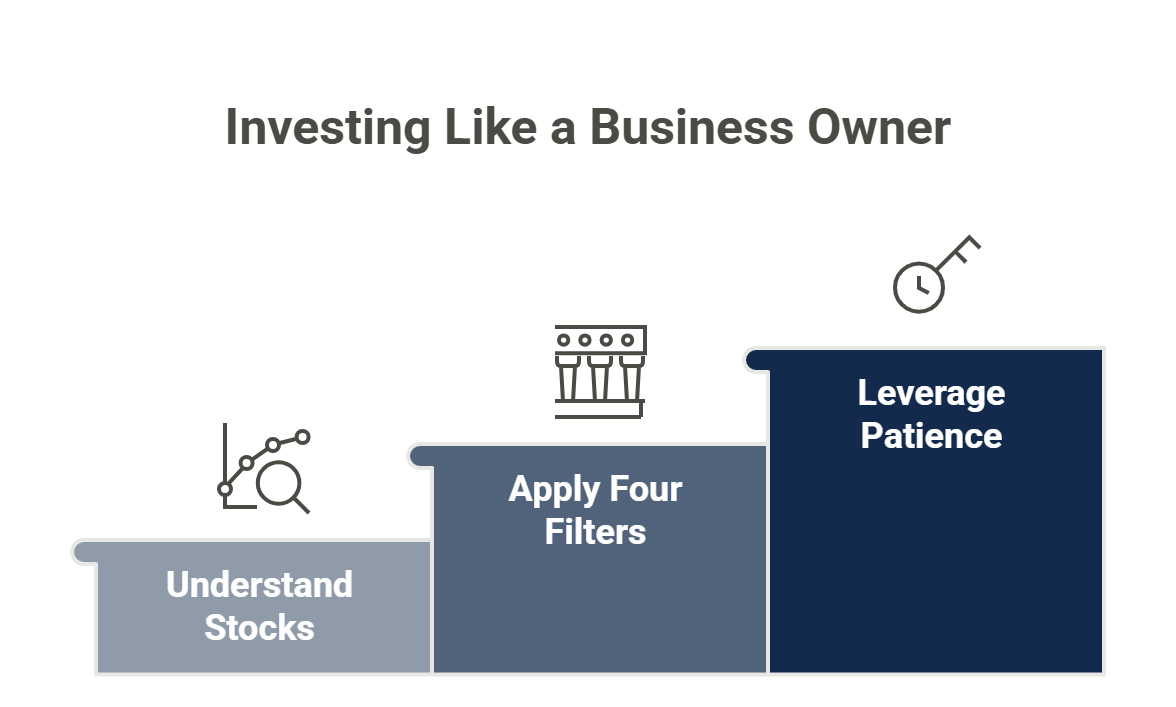
Discover why the best investors treat a stock as ownership of a business, not a ticker symbol to trade.
Learn the Four M's, a simple, repeatable way to decide whether a company is worth owning and what to pay for it.
Understand why patience and a margin of safety give an everyday investor a real edge over Wall Street.
Resources
Rule #1's "InvestED" Podcast and Website: Website | Apple Podcast | YouTube
Visit Rule #1 for more investing resources: Website | Facebook | LinkedIn | X (Twitter) | Instagram
Danielle Town: Website | LinkedIn | Instagram | Facebook | YouTube | X (Twitter)
A Stock Is a Piece of a Business, Not a Ticker Symbol
If you've ever owned a rental property or run a small business, you already know how to do this. You ask how much it brings in, what the expenses are, and what's left over at the end of the month. That number tells you what the thing is worth.
I look at a stock the exact same way. When you buy a share, you're buying a slice of a company that earns money, pays its bills, and, if it's any good, grows.
The math that works for a rental house or a corner shop works just as well for a business that trades on an exchange. Stocks versus real estate investing isn't really a contest. It's the same skill pointed at a different asset.
Warren Buffett never looked at a stock as a ticker symbol either. He looked at it the way you'd look at a company you wanted to buy outright and hold for a long time. That one shift in how you see things is where everything I teach begins.
If you want the foundation behind it, start with our value investing guide.
The Four M's: How I Decide If a Company Is Worth Owning
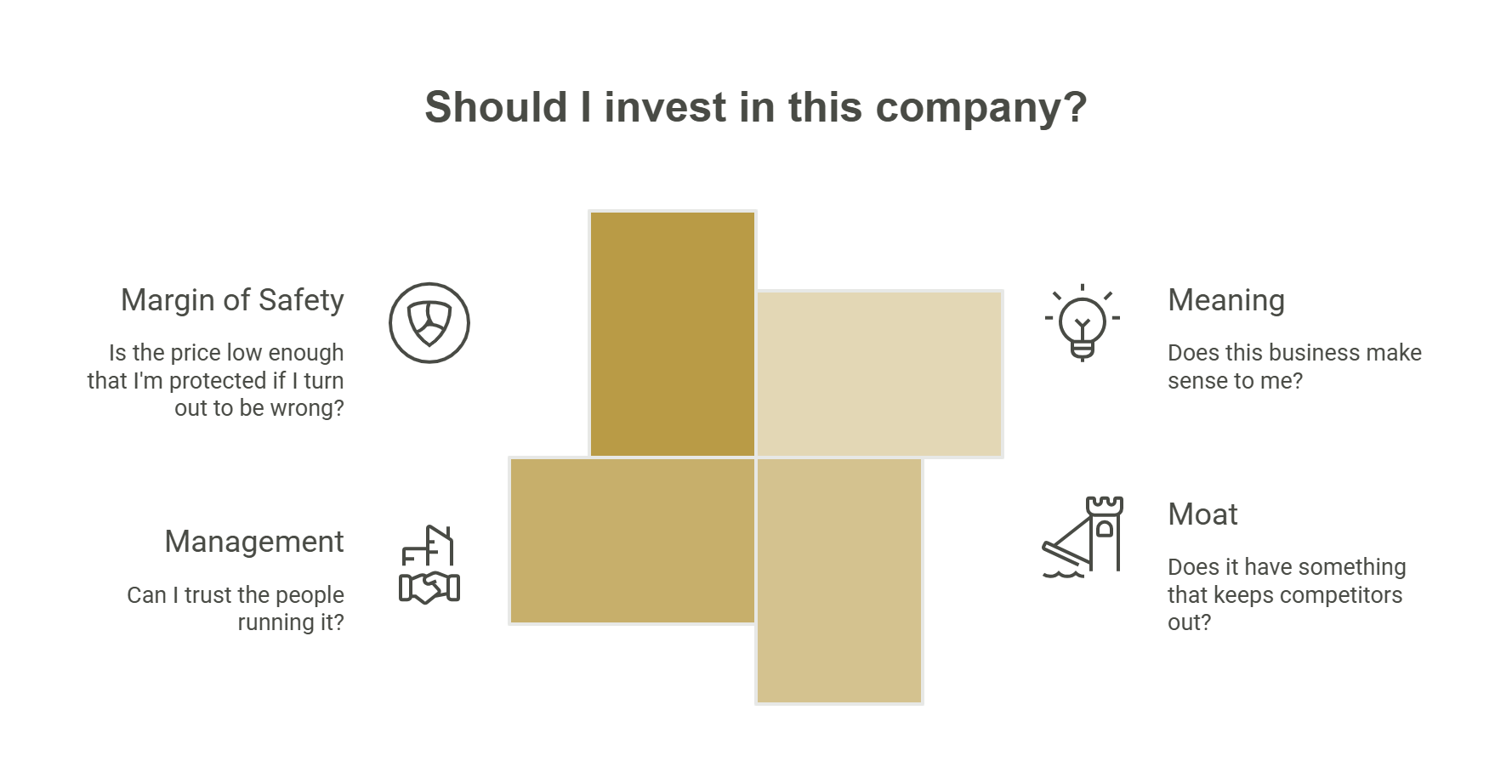
When I research a company before investing, four questions cut through all the noise. Does this business make sense to me? Does it have something that keeps competitors out? Can I trust the people running it? And is the price low enough that I'm protected if I turn out to be wrong?
Those four questions are the Four M's:
Meaning, does this business make sense to me?
Moat, does it have something that keeps competitors out?
Management, can I trust the people running it?
Margin of Safety, is the price low enough that I'm protected if I turn out to be wrong?
Charlie Munger once said this whole approach only takes a few days to learn, which is probably why the universities don't teach it as a semester course. Simple to learn doesn't mean simple to stick with, but the logic is something anyone can pick up.
Here's how each one works. For the complete picture, you can also work through the full Rule #1 framework.
Meaning: Start With Businesses You Actually Understand
The first M is the one most people skip, and it's the most important. If I don't understand how a business makes money, I have no way to picture where it'll be in five or ten years.
And if I can't picture that, I can't put a fair price on it. That's not investing. That's hoping.
Take the AI boom. If you can't honestly model what those companies will earn down the road, you've got no business guessing at their value.
But the restaurant where you eat lunch every week? You might understand that better than most analysts on Wall Street. Staying inside your circle of competence is how you turn what you already know into a real edge.
Knowing a business that well is also your protection against panic. When a stock drops and you don't know why, you're stuck reacting on fear instead of understanding. When you know the business cold, a falling price doesn't scare you. It interests you.
Moat: The Durable Advantage That Keeps Competitors Out
We once ran a student exercise in Singapore where a class built a portfolio of ten companies. Over the next decade nearly all of them grew. The one that didn't was Blackberry, which lost most of its value.
That taught more about fragile moats than any textbook could. I'm using Blackberry here as history, not as a recommendation to buy or sell anything.
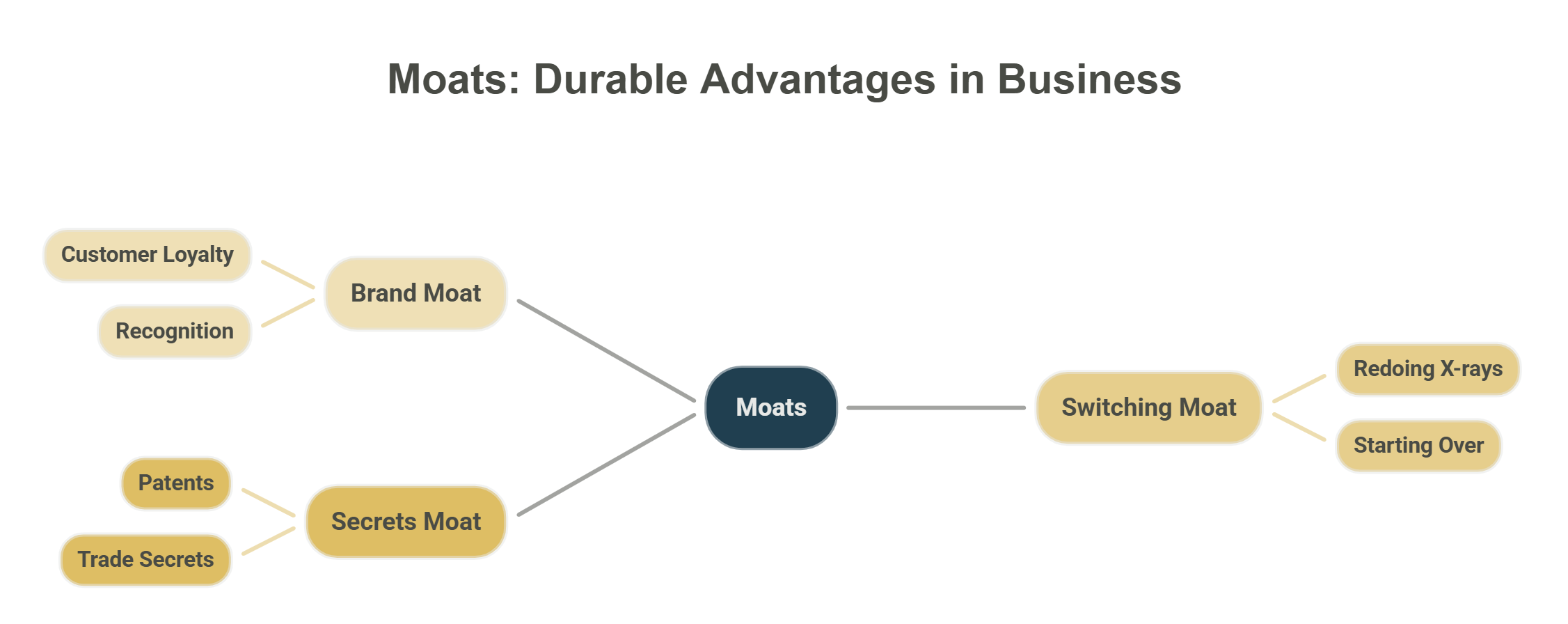
I call these the Five Moats: Brand, Secret, Toll, Switching, and Price. Here are three you'll run into most often:
Brand moat. You'll pay a dollar for the name-brand chocolate bar sitting right next to the no-name one at seventy cents, because you know exactly what you're getting. That extra thirty cents isn't for the cocoa. It's for the certainty.
Switching moat. You don't change dentists casually, because you'd have to redo the X-rays and start the relationship over. Friction is the moat.
Secrets moat. A patent or a trade secret that competitors simply can't copy.
Technology is where you have to be careful. Research In Motion built a real moat with the Blackberry. Every office ran on it. Then the iPhone showed up, and the moat didn't get copied, it got erased, because the whole category moved underneath it.
Once you think you've found a moat, confirm it in the numbers with our Big Five Numbers resource.
Management: Invest Alongside People You Trust
The third M is management, and it's the hardest to judge from the outside. What I'm looking for are leaders who act like owners, not hired hands. You can see it in how they spend the company's money, how straight they are with shareholders, and what they do when something goes wrong.
That last part is the real test. Anyone looks good when business is booming. You find out who you're dealing with the first time the company hits a wall. So I want to invest alongside people who have a reputation worth protecting, and then I watch them closely the first time they're under real pressure.
Margin of Safety: Buy at a Discount to the Sticker Price
The fourth M is where you make your money safe. Every business has a fair value, and at Rule #1 we call that the Sticker Price. The margin of safety in stocks is simple: it's the gap between that Sticker Price and what you actually pay. I want to buy when the market price sits well below the value, often around half.
Why so cheap? Because I'm not perfect, and neither are you. Businesses surprise us. Economies turn.
If I pay half of what a company is worth and I'm wrong about how fast it grows, I might still break even. If I pay full price and I'm wrong, that one hurts. The discount is what protects me from my own mistakes.
When you're ready to put a number on it, our free Sticker Price and Margin of Safety calculator will show you what a fair price looks like for any company on your watchlist.
What Makes a Business Worth More Than Gold or Bitcoin
Here's why I put almost everything into businesses and very little into anything else. A business has a machine inside it that grows on its own. It takes in capital, puts it to work, throws off cash, and does it again next year. The thing is creating value while you sleep.
Gold doesn't have that machine. Neither does Bitcoin. They don't produce a dime of cash flow.
A bond at least pays a coupon, but that coupon is fixed the day you buy it and never grows. With all three, you're really just betting that someone will pay more for them later.
A business is different. If the market shut down tomorrow and reopened in five years, a wonderful business would have spent those years getting more valuable, because it kept earning the whole time. Some of them even do better in a downturn, when customers trade down to what they sell.
If you want to understand the number that captures all of this, watch our explainer on what free cash flow means for investors. For the valuation side, the ten-cap valuation process is a good place to start on owner earnings.
Why Wonderful Businesses Go On Sale
So if these companies are so great, why would a wonderful business ever go on sale? Because the market isn't a rational pricing machine. It's a crowd of people, and people get scared. Somebody yells fire in a crowded theater and everyone runs for the door, even when there's no fire.
A bad headline, a rough quarter, one problem at one company in an industry, any of it can send Wall Street stampeding out. We call that an event.
I once watched a single food safety scare knock a major restaurant chain's stock down by more than half and keep it there for the better part of two years, while the business itself was already back to making money. There was nothing wrong with the company. There was just fear in the price.
That's the moment a patient investor has been waiting for. The crowd's panic is your opportunity, as long as you've done the work to tell the difference between a business in real trouble and a great business that's simply unloved for a while. That's Mr. Market handing you a gift.
Patience Is the Edge Wall Street Can't Copy
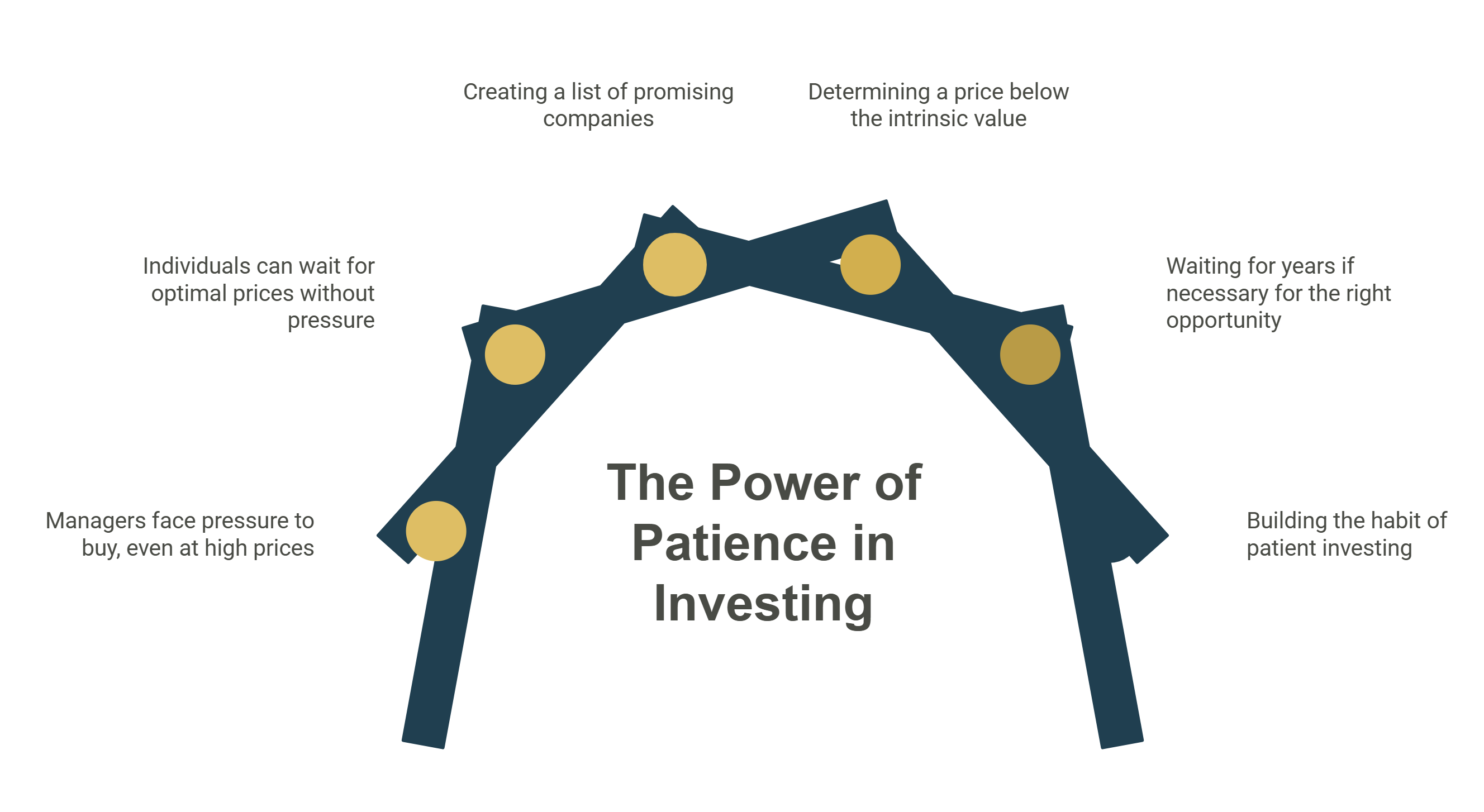
Here's the advantage almost nobody talks about. The professionals managing most of the money in the market can't wait. They've got clients on their shoulder asking why their cash is sitting idle. A manager who holds cash and waits for the right price looks bad on a quarterly report, so the pressure pushes them to buy even when prices are too high.
You don't have anyone on your shoulder. You can build a watchlist of wonderful companies, work out a margin of safety price for each one, and then just wait.
Sometimes the wait is a few months. Sometimes it's years. When the price finally comes to you, that's when you act.
That patience is the single biggest edge an everyday investor has, and it's one Wall Street structurally can't copy. If you want to build that discipline from the ground up, our free online course walks you through the basics step by step.
From River Guide to Investor: Why Anyone Can Learn This
I didn't come to this from a finance background. At nineteen, on my father's suggestion, I joined the Army and served about four years. After that I spent a decade running whitewater trips through the Grand Canyon. That's fourteen years living out of a sleeping bag, with no interest in money and a real blue collar distrust of rich people.
What turned it around was a river trip with a group of Outward Bound trustees. At Crystal Rapid, one of the most dangerous stretches on the river at high water, I made a positioning mistake and the boat got swept toward a hole that had killed people. At the last second we turned along the wall, the boat stood straight up, and somehow we came through right side up. One of the guys threw up when we finally reached calm water.
That same fellow spent every evening of the next week talking to me about investing. I kept telling him I wasn't interested.
By the end of the trip he offered me a place to stay in La Jolla and a year to learn his approach. That fall, something in me said the river chapter was over. I loaded up my Volkswagen bus and drove west.
I spent a year apprenticing, learning how value investing actually works. I started with a small stake and built a real portfolio over the next several years. Not because I had any special talent, but because this is a skill you can learn. If it worked for a guy who spent his twenties sleeping in the dirt, it'll work for you.
If you'd like to learn it hands-on with our coaches, come join us at the Virtual Investing Workshop.
Your Framework, Your Edge
Every investor needs a system they can actually use when the pressure is on. The Four M’s are that system. Understand the business, confirm the moat, trust the management, and demand a margin of safety.
Get those four right and you’re honoring Rule #1: don’t lose money. It isn’t about predicting every twist in the market. It’s about asking the right questions in the right order, so you stay rational when fear is pulling everyone else the wrong way.
Hear More From Phil
For more conversations on investing like a business owner, listen to the InvestED Podcast, where we work through the mindset, the math, and the discipline behind Rule #1 investing one topic at a time.
Reflect on Your Own Process
Ask yourself an honest question. Do you have a system you actually use when you size up a company, or are you running on memory and gut when the market gets loud?
Think about which businesses really sit inside your circle of competence, and what it would take to wait patiently for one of them to go on sale.
Explore More
Visit Rule #1 for more guides, tools, and stories to sharpen your discipline. Whatever stage you’re at, there’s a next step waiting, from the free Toolbox to our beginner’s guide to investing.
A clear framework isn’t a sign that you don’t trust your judgment. It’s a sign that you respect the process enough to protect it. That’s how Rule #1 investors work. Now go play.
Ready to build your edge? Join us at the Virtual Investing Workshop for hands-on guidance and real company analysis.
Expert Advice & Powerful Quotes
"You understand the business. You know it's got a big moat. It's got good management. You buy it with a margin of safety. And then that's it."
"Inside is a business machine that is growing all by itself."
"That patience is what is missing on Wall Street."
"It's all teaching hands on with coaches, looking over your shoulder."
Phil Town: Investor, Author, and Educator
Phil Town is a New York Times bestselling author of Rule #1, Payback Time, and Invested, the last co-written with his daughter Danielle Town. He is a former hedge fund manager and investment advisor who has helped hundreds of thousands of people learn to invest through his books, workshops, online courses, and the InvestED podcast.
Before he ever bought a stock, Phil served as a Lieutenant in the US Army Special Forces and spent a decade guiding whitewater trips through the Grand Canyon. He learned value investing through a year-long apprenticeship and built his portfolio from a small starting stake. Today he leads Rule #1 Investing, an education company dedicated to helping everyday people invest with confidence and discipline rather than speculation.
Areas of Expertise:
Value investing and the Four M's framework
Margin of Safety and business valuation
Circle of competence
Long-term wealth building
Visit Rule #1 for more investing resources: Website | Facebook | LinkedIn | X (Twitter) | Instagram
Rule One Investing provides investment education and training only. We don't provide personalized investment advice, manage client assets, or guarantee investment returns. All content is for informational purposes. Consult a qualified financial professional before investing. Past performance does not guarantee future results. Individual results vary.

About Phil Town
Phil Town is an investment advisor, hedge fund manager, 3x NY Times Best-Selling Author, ex-Grand Canyon river guide, and former Lieutenant in the US Army Special Forces.
He and his wife, Melissa, share a passion for horses, polo, and eventing. Phil's goal is to help you learn how to invest and achieve financial independence.
Get Phil's Free Guide