









Prediction Markets vs the Stock Market: What the TikToks Get Right, and Where They Fall Apart
 Austin Bowen
 In This Article
- How Prediction Markets Actually Work
- Are Prediction Markets Gambling?
- In Any Market, Two Groups Tend To Win
- Three Clips Worth Walking Through
- The One Piece of Advice I Actually Liked
- Speculation and Investing Are Not the Same Thing
- Prediction Markets vs the Stock Market, Side by Side
- What I Do Instead
- Ready To Learn How To Invest With Confidence?
A couple of weeks ago Phil did a TikTok react video that a lot of you enjoyed. So when the team came back and asked for another one, Phil looked at me and said, "Austin, you do the TikToks."
This time the subject was prediction markets. Polymarket, Kalshi, and a growing stack of videos suggesting you could leave your job and trade the news instead.
I expected to spend fifteen minutes disagreeing with everything I saw. That isn't quite what happened. Some of it is about as shaky as you'd guess, and one piece of it turned out to be close to something we've taught for years. That second part is why this is worth your time.

How Prediction Markets Actually Work
The mechanic is straightforward. You buy a position on whether a specific event happens by a specific date, and if you're right you collect. If you're wrong, the position expires and you're left with nothing.
There's no partial credit and no ownership of anything underneath.That's the first real difference between this and becoming an investor who buys a piece of a business, and it's worth pausing on.
Here's the detail that explains most of what follows. The odds on your screen aren't a neutral probability, they move with the money coming in on each side. When someone large takes a position, the number shifts, and everyone watching reads that shift as new information.
Sometimes it genuinely is. Sometimes it's one account with deep pockets moving a price in the direction that pays them.
If that sounds familiar, it should. Price and value aren't the same thing in the stock market either, and learning to tell them apart is most of the job.
Are Prediction Markets Gambling?
For most people using them, yes. You're putting money on an outcome you don't control, inside a window you can't extend, with nothing left over if it goes the other way. That's the honest answer, and the platforms would give you a different one, so let's look at theirs first.
What the Platforms Say
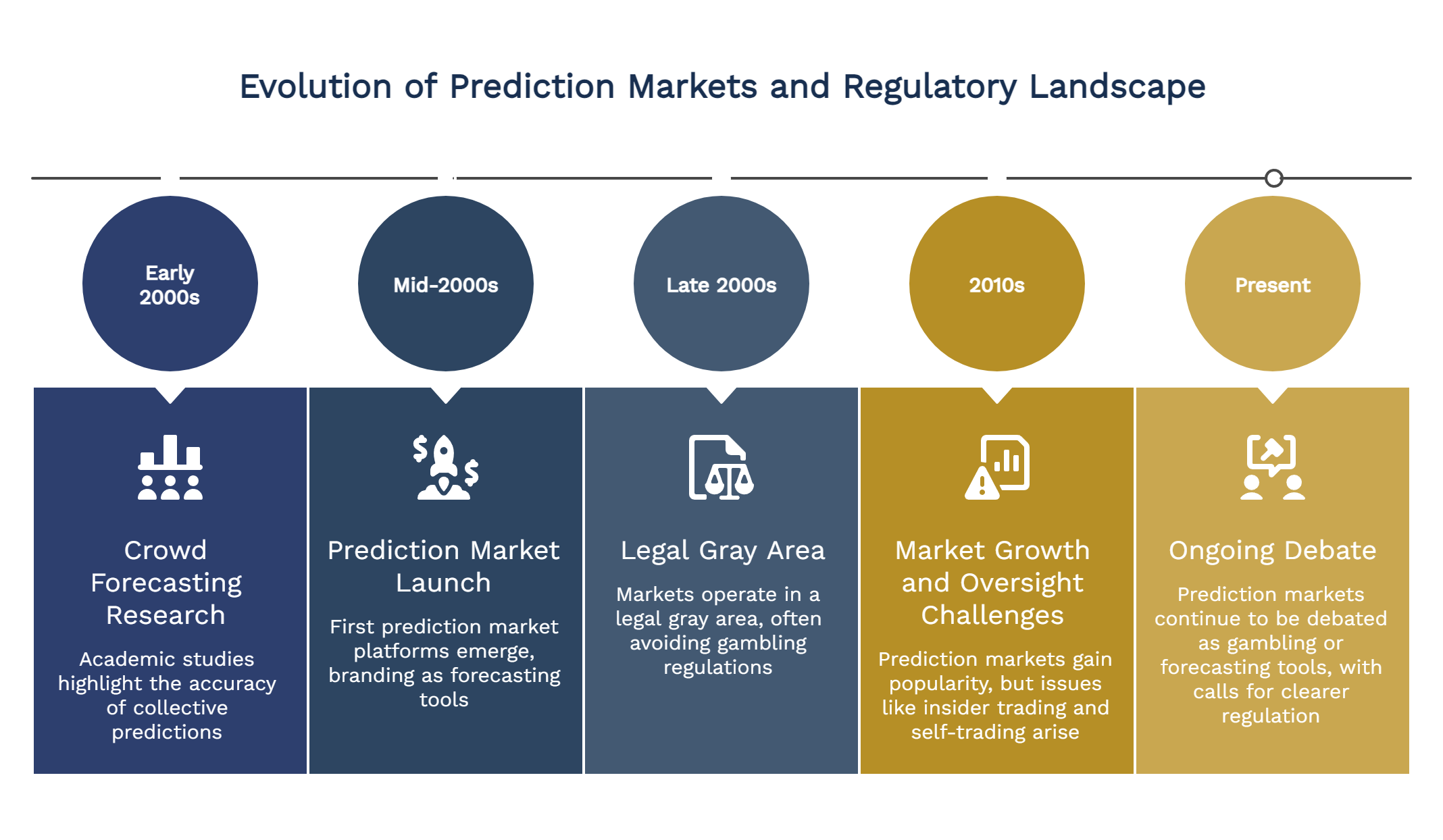
They describe themselves as forecasting tools rather than betting apps. The argument is that a large, varied group of people putting real money behind their beliefs will predict events more accurately than any single expert can.
That's a genuinely interesting idea, and there's real research on crowd forecasting behind it. It also happens to be very effective marketing, and both of those can be true at once.
What the Mechanics Say
These platforms operate legally in more places than traditional sports books, largely because they chose a different word for the activity. The activity itself changed less than the branding suggests.
This is also a young market without much oversight, which brings two problems that regulated exchanges spent a century learning to manage. Some participants know things the rest of the market doesn't. And some of the trading volume you see was created by people trading against themselves to nudge a price.
So Is Polymarket Gambling, or Is Polymarket a Scam?
Scam isn't a word I'd reach for, and honestly the label fight isn't that useful. Calling something a scam lets you dismiss it without understanding it, and understanding it is what actually protects you.
The more useful question is this. What has to happen for you to be right, and who already knows the answer?
In Any Market, Two Groups Tend To Win
This is the idea the rest of the article rests on, and it applies to every market I've spent time in.
The first group wins on information nobody else has. One clip described someone connected to a major artist's team who correctly called what that artist would do at the Super Bowl halftime show. The video didn't say how that person knew, and I'm passing the claim along as a description rather than anything I've verified myself.
The structure is what matters here, not the specifics. That person knew, the market didn't, and the market paid them.
There's no amount of research that closes that gap. When the outcome is something identifiable people already control, some of those people are going to take a position, and you won't know which ones.
The second group wins by doing the work. They study a market, notice something obvious that everyone else has overlooked, and act before the crowd catches up. That group is real here, and the full-time trader I watched is running exactly that process.
Here's where this connects to investing. That second group exists in the stock market too, and the way into it is a skill you can learn rather than an invitation you'll never receive. It's the same skill behind what actually moves a stock price, and it's exactly what we built this around.
Three Clips Worth Walking Through
The Man With the Hair Dryer
My favorite example from the batch had nothing to do with strategy.
There was a contract on the highest temperature in Paris on one day in April, carrying around $500,000 in volume according to the video. The official reading came from a single sensor outside a private airport, and one person worked out exactly where it was, drove over with a hair dryer, and pointed it at the sensor.
He did it twice, and the video puts his total at roughly $40,000. Those numbers are what the clip showed, not anything I've verified myself.
I'll be honest that I can't tell you which side of the line that lands on. What I can tell you is that a half million dollar market decided by one person with a household appliance isn't functioning the way a market is supposed to function.
The Greeting That Cost Somebody Money
Another clip had someone betting that a public official would open a press conference with something other than the greeting he uses to open every press conference.
He said what he always says, and the money was gone.
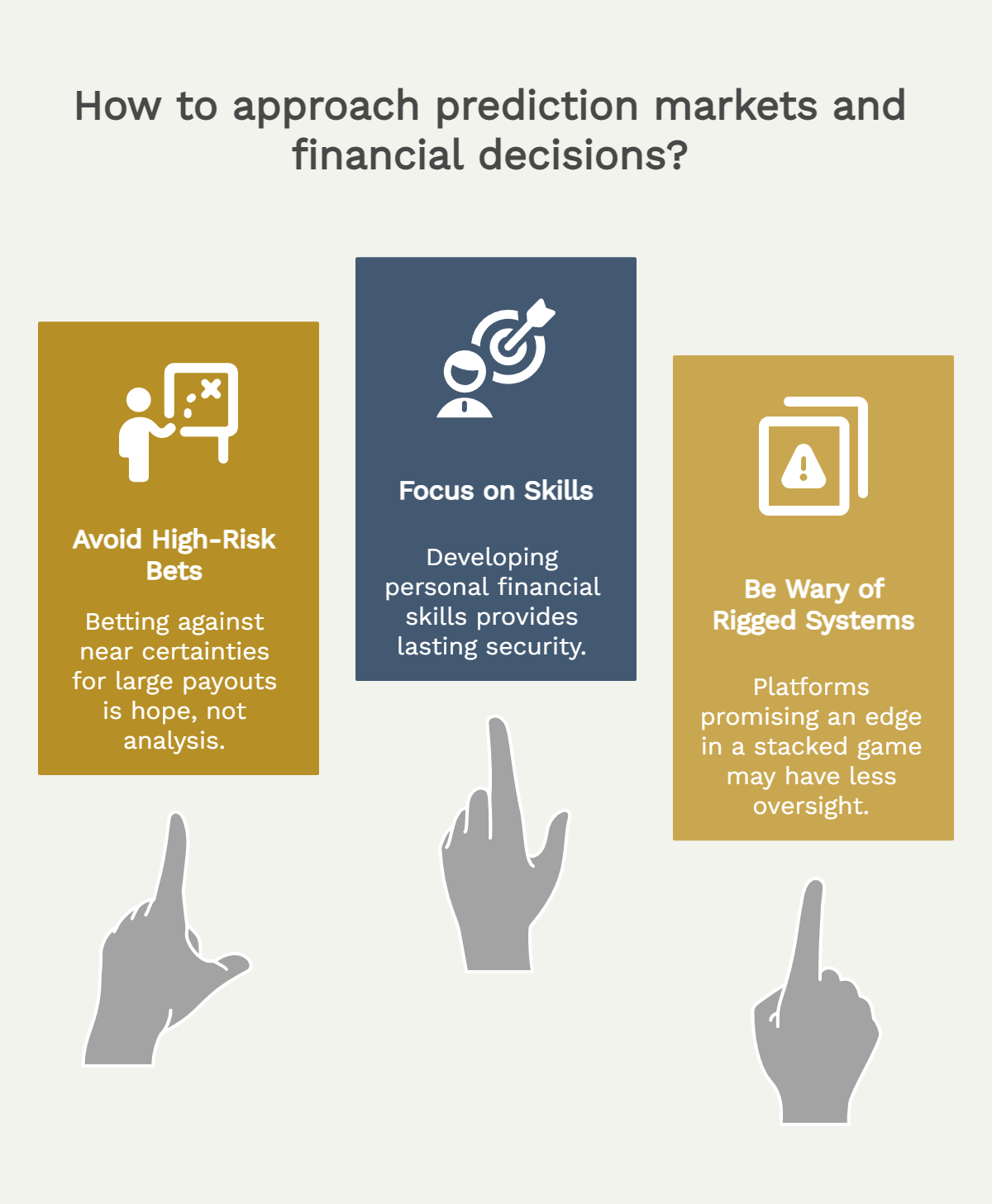
It's an easy one to laugh at, and the lesson underneath is worth keeping. Betting against a near certainty because the payout looks large isn't analysis, it's hope with a price tag.
The same pattern turns up in the stock market constantly, in people buying options on companies they haven't researched and hoping for a swing. I'm not saying that to be hard on anyone. Most of us have made a version of that decision, and recognizing the pattern is how you stop repeating it.
The Rigged Economy Pitch
Several of these videos land in the same place. Housing costs what it costs, wages haven't kept up, the system looks built for somebody else, and here's a platform where regular people finally get an edge.
I'm not going to argue with the frustration behind that, because I hear a version of it from people at nearly every workshop we run. It's a fair thing to feel.
Where I'd gently disagree is the conclusion. If the concern is that a stacked game takes your money, the answer probably isn't a newer game with less oversight and more insiders.
The answer is a skill nobody can take away from you, and that's the same reason you don't actually need a financial advisor once you know how to evaluate a business yourself. It's a slower path, and in my experience it's the one that holds up over a lifetime.
The One Piece of Advice I Actually Liked
One creator laid out a strategy I couldn't dismiss. Pull up the leaderboard, find the accounts that have been making consistent money, look at what they're doing, and follow the consensus of the sharpest traders rather than copying a single lucky account.
I actually don't hate what he's telling people to do, because we do something very similar in investing.
What Is a 13F Filing?
Large institutional investors are required to report their holdings to the SEC every quarter. Those reports are called 13F filings, and they're public, free, and completely legal for you to read.
Every three months you can see what the legendary investor Warren Buffett, along with Bill Ackman, Michael Burry and dozens of others, bought and sold. It's a bit like having those investors tell you on a schedule what they've been doing with their money.
That's how to copy Warren Buffett's portfolio, and it doesn't take an invite code or a leaderboard. It takes reading a filing. Worth remembering that Buffett has also spent long stretches doing nothing at all, which is how Berkshire's cash position got as large as it did.
Phil has spent years assembling a list of roughly 50 of these guru investors, and that list sits inside the Rule #1 Toolbox so our students don't have to build it by hand the way that creator was doing. Same instinct he had, pointed at something considerably steadier.
The Part People Skip
A 13F tells you what someone bought. It doesn't tell you what they paid, why they bought it, or whether today's price still makes sense.
That distinction matters more than almost anything else in this section, because the same business can be a sound investment at one price and a poor one at another. The filing hands you ideas, not a shopping list.
You still need to understand the business and work out its Sticker Price before deciding whether today's price gives you a Margin of Safety.
Our Margin of Safety calculator will run that number for you once you have the inputs. Skipping that step puts you in the same position as someone copying a leaderboard without knowing why the winners won.
If you'd like the foundation underneath all of it, start with how stock investing actually works.
The Four M's For Successful Investing
How to invest with certainty in the right business at the right price
Speculation and Investing Are Not the Same Thing
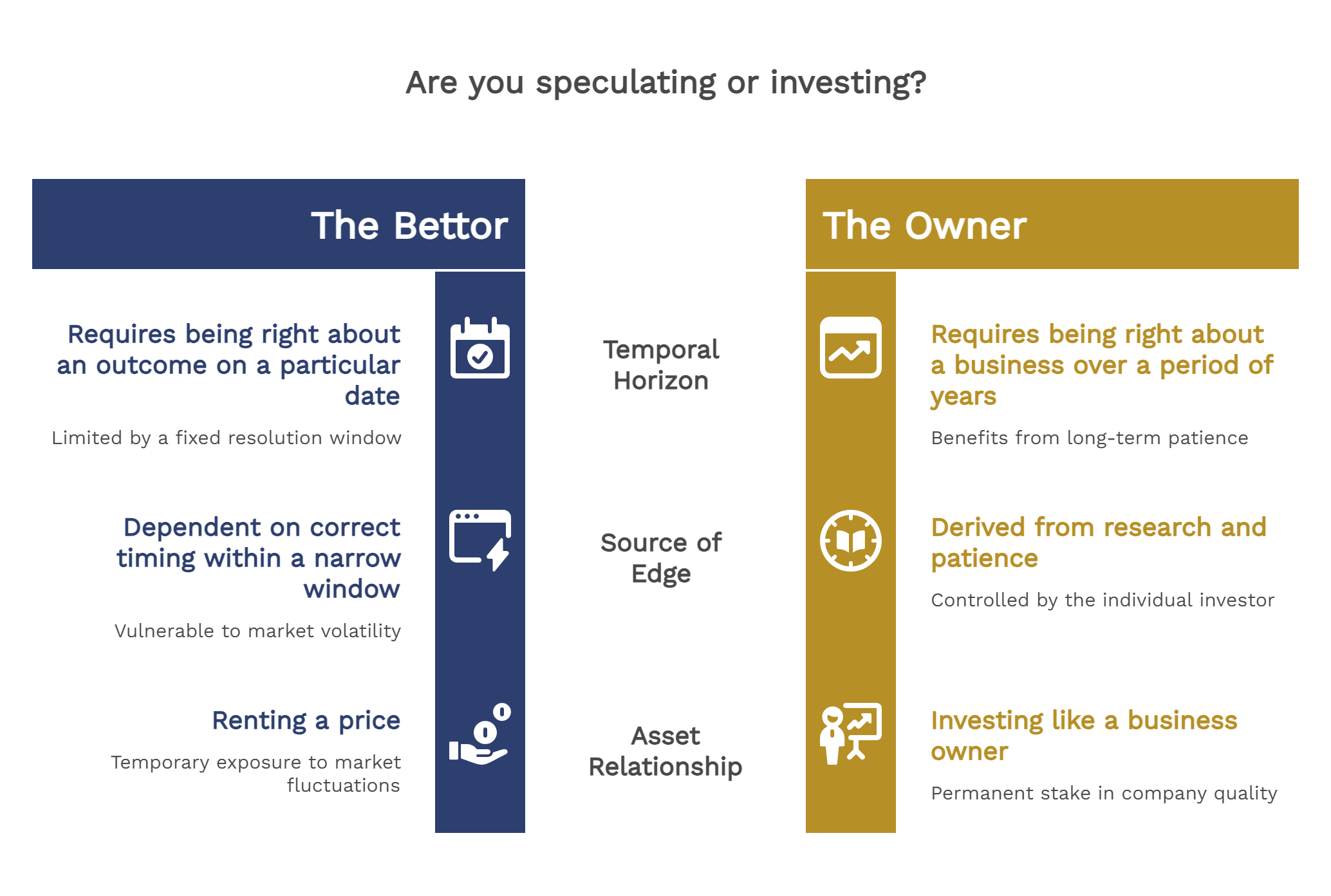
The Bettor's Position
You need to be right about an outcome on a particular date. Being right about where things are eventually headed doesn't help if the contract resolves against you inside the window you were given.
Wrong timing undoes correct reasoning, and there's nothing left afterward to hold.
The Owner's Position
You need to be right about a business over a period of years, at a price you chose deliberately. Your edge comes from research and patience, and those are two things entirely within your control. That shift, from renting a price to investing like a business owner, is the one that changes everything else.
Putting money into things you don't understand isn't investing, it's speculation, and speculating on stocks isn't far from gambling. Value investing is the alternative, and it's been around a lot longer than any of these platforms.
So the question was never really whether the stock market is gambling. It's whether you're doing the work. It's also worth knowing that even the pros struggle to beat the market when they're pushed to trade on short-term pressure instead of business quality.
Prediction Markets vs the Stock Market, Side by Side
What you need to be right about: a specific event by a specific date, compared with a business over a decade.
Where the edge comes from: private information or luck, compared with public research and patience.
What you hold at the end: nothing, compared with a piece of a real company.
Whether the price protects you: it can't, compared with a Margin of Safety you set yourself.
What happens if you're wrong: the position expires, compared with a cushion you built in before buying.
That last line is the real dividing line. There's no way to buy the same bet at a discount once it moves against you, while in investing that discount is the entire strategy.
What I Do Instead
I won't rebuild the whole framework here, since we've already written it up as a disciplined, research-based process. But here's the shape of it, so you can see what replaces the guessing.
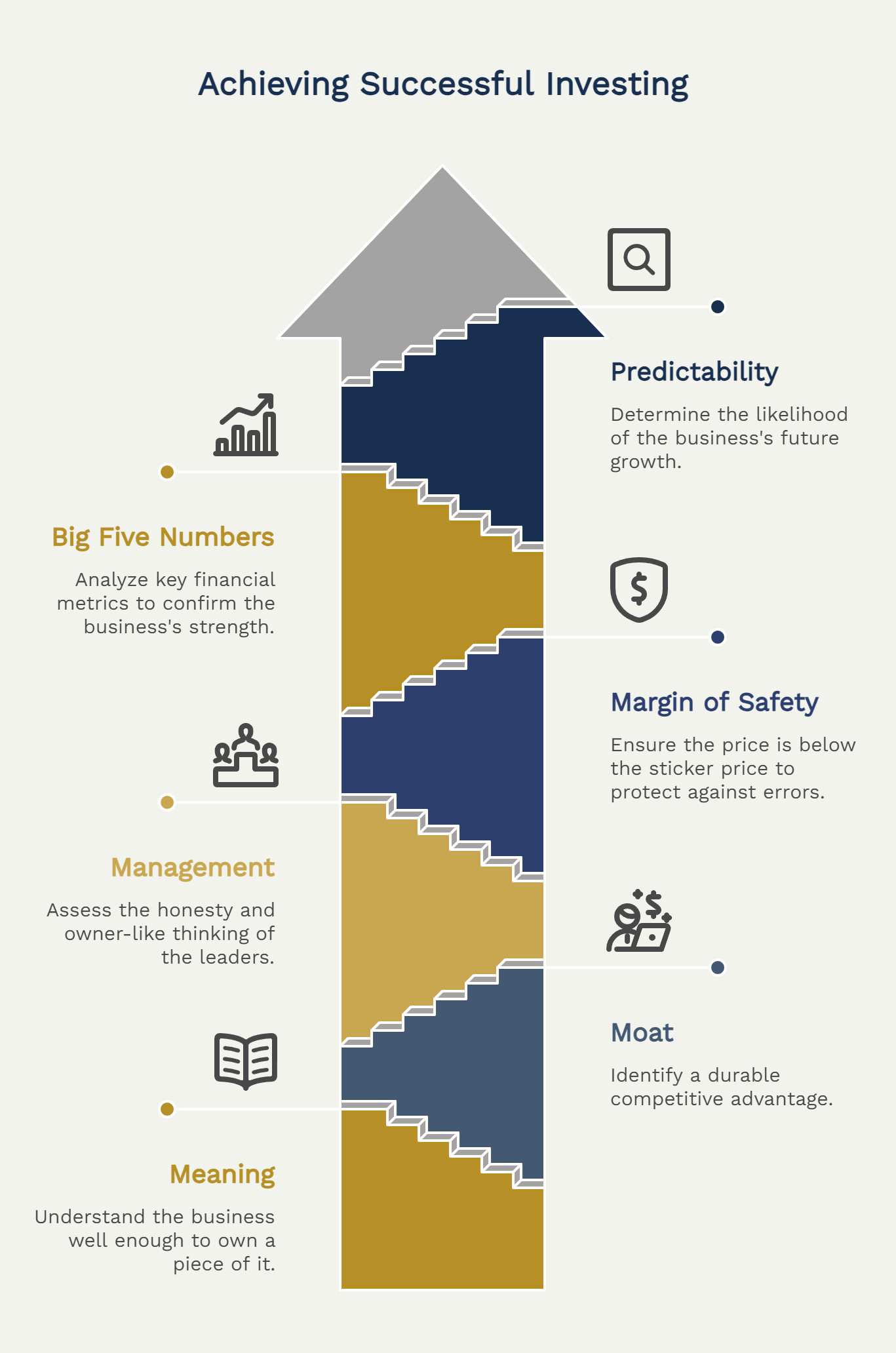
The Four M's are four questions I ask about any company.
Meaning, do I understand this business well enough to own a piece of it. Moat, does it have a durable advantage that keeps competitors at a distance.
Management, are the people running it honest and thinking like owners. Margin of Safety, is the price far enough below the Sticker Price to protect me if I turn out to be partly wrong.
Underneath the first three sit the Big Five Numbers, which are return on invested capital, sales growth, earnings per share growth, equity growth, and free cash flow growth. When a company has a real moat, it usually shows up there, and there's more on how to evaluate a company if you want to work through the metrics one at a time. When those numbers are inconsistent, I move on, and part of the discipline is being willing to put something in the too hard box and walk away.
The predictability piece is simpler than most people expect. Some businesses are woven so deeply into ordinary life that working out whether they'll be larger in ten years doesn't require calling any particular event. I'm not pointing you toward any one of them. I'm saying the question is answerable, which is more than you can say for the weather in Paris on a Friday.
Key Takeaway: Prediction markets ask you to be right about an event you don't control on a date you can't move. Rule #1 asks you to be right about a business you've researched, at a price you chose. Same instinct, very different odds.
Ready To Learn How To Invest With Confidence?
If this resonated and you'd like to learn the version I've been describing, come spend three days with us at the Virtual Investing Workshop. My coaches and I are with you the whole way through.
Here's what those three days look like:
The full Rule #1 process, from finding meaning through calculating your buy price.
Real company analysis with live coaches working alongside you in real time.
Access to the Toolbox, including the guru list, so you're not building it by hand.
A watchlist you built yourself, from your own research and your own judgment.
Well over 30,000 people have come through our workshops, spanning 56 countries, and over two million people have gone through Rule #1 training.
As Arthur Levitt, former Chairman of the SEC, put it: "Follow Town's simple, time-tested precepts, and even unsophisticated investors will leave most mutual fund managers in the dust."
If you'd rather start smaller, Phil's free investing guide walks through the basics at your own pace, and our investment calculators are free to use whenever you want to run a number.
I've been teaching this alongside Phil for over a decade, and the thing I'd want you to hear is that nobody arrives already knowing how to do it. People show up curious and a little unsure, and they leave with a process they can repeat on their own. That's the whole point.
You don't need an edge nobody else has. You need a method, and this one is learnable.
Now go play.
Join us at the Virtual Investing Workshop
Rule One Investing provides investment education and training only. We do not provide personalized investment advice, manage client assets, or guarantee investment returns. All content is for informational purposes. Consult a qualified financial professional before investing. Past performance does not guarantee future results. Individual results vary.

About Austin Bowen
Phil Town is an investment advisor, hedge fund manager, 3x NY Times Best-Selling Author, ex-Grand Canyon river guide, and former Lieutenant in the US Army Special Forces.
He and his wife, Melissa, share a passion for horses, polo, and eventing. Phil's goal is to help you learn how to invest and achieve financial independence.
Get Phil's Free Guide