











How to Calculate the Buy Price of a Stock
 Phil Town
 In This Article
- Start Here, Why You Can't Calculate Buy Price Without This First
- What "Buy Price" Actually Means in Rule One Investing
- Method One, The Margin of Safety Analysis (The MBA Way, Made Simple)
- Method Two, The Private Company Payback Test
- Method Three, The 10-Cap Analysis
- Why Margin of Safety Is the Rule That Makes All Three Methods Work
- How to Put It All Together — Making the Decision
- The One Thing Wall Street Will Never Tell You About Stock Valuation
- Learn to Value Businesses the Right Way
Of all the questions I get asked after forty years of investing, this one comes up more than any other. How do you figure out what price to pay for a stock?
Most people assume the answer is a formula. Plug in a few numbers, run the math, and out comes the right price. I get why it seems that way. The financial world loves formulas. They make everything feel precise, scientific, inevitable.
But here is the truth: nobody knows the exact right price to pay for any stock. Not me, not the analysts on Wall Street, not anyone. And the sooner you make peace with that, the better investor you become.
What I can give you is something more useful than a formula. I can give you a framework. One that lets you act with real confidence even when the future is uncertain. That is what Rule One investing is built around. Not certainty. Confidence through process.

Start Here, Why You Can't Calculate Buy Price Without This First
You cannot calculate a meaningful buy price for a business you do not understand.
Think about it this way. Imagine someone asks you to figure out a fair rent for a property you have never visited, in a neighborhood you know nothing about. You could run the math. You could come up with a number. But that number would not mean anything, because you have no idea whether the property is worth renting in the first place.
Stocks work the same way. The calculation is only as good as your understanding of the business underneath it.
Rule One investing is built around the Four M's:
Meaning: Do you understand this business well enough to own it, and does it align with your values?
Moat: Does the business have a durable competitive advantage that protects its future growth?
Management: Are the people running it honest, capable, and thinking like long-term owners?
Margin of Safety: Is the business available at a price that protects you if things do not go perfectly?
That fourth M is what this article is about. But it only works if the first three are already answered.
The margin of safety protects you from miscalculating value. It does not protect you from buying the wrong business.
Start with understanding business meaning, how to identify a moat, and evaluating management if you are still working through the first three M's.
What "Buy Price" Actually Means in Rule One Investing
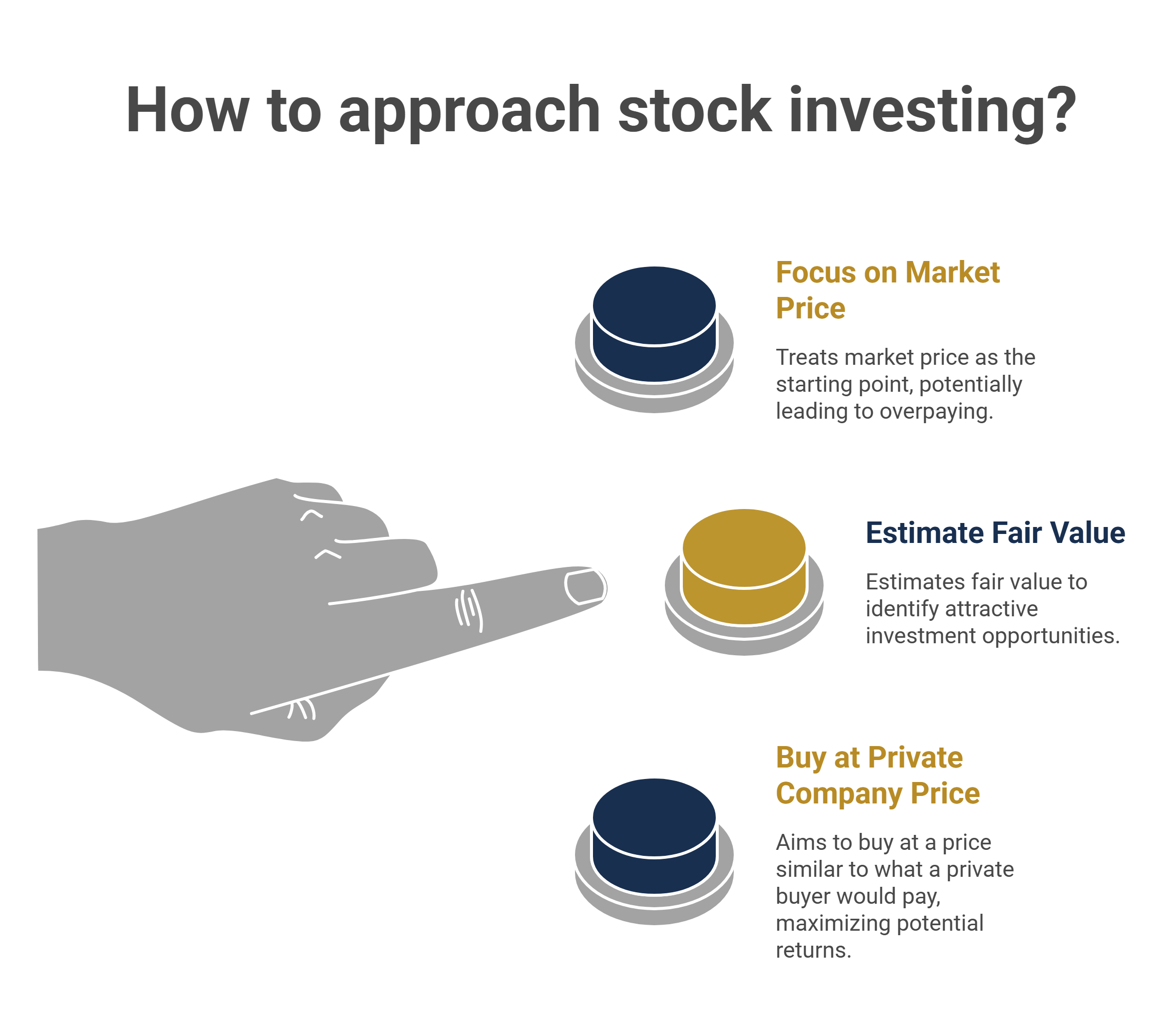
Most investors treat the market price of a stock as the starting point. I treat it as almost irrelevant.
Price Is Not Value
What matters is the Sticker Price, what I call the fair value of the business. It is the price the market should be charging, based on what the business is actually worth to a rational owner. Not what Mr. Market is offering today. Not what it traded at last week. What the business is genuinely worth.
The gap between those two numbers is where the opportunity lives.
Precision Is Not the Goal
Here is something important to understand about the Sticker Price: it is always an estimate. No one knows exactly what any business will earn over the next ten years. The goal is not a precise number. The goal is a defensible range, calculated conservatively, that gives you a clear sense of whether today's price is attractive or not.
Buy at Private Company Price
Intrinsic value which means the Sticker Price, is typically about double what a private buyer would pay for the same business. Think about what a business owner would pay to acquire a company outright, based on its cash flow and future prospects. That private company price is the number I actually want to buy at.
We are not trying to time the market. We are not looking for a trading entry point. We are trying to buy a wonderful business at private company price, then wait for the market to recognize what it is worth.
That is the whole game.
Method One, The Margin of Safety Analysis (The MBA Way, Made Simple)
The first method is what MBAs call a discounted cash flow analysis. It sounds intimidating. It is not. Here is the plain-English version.
The Core Question
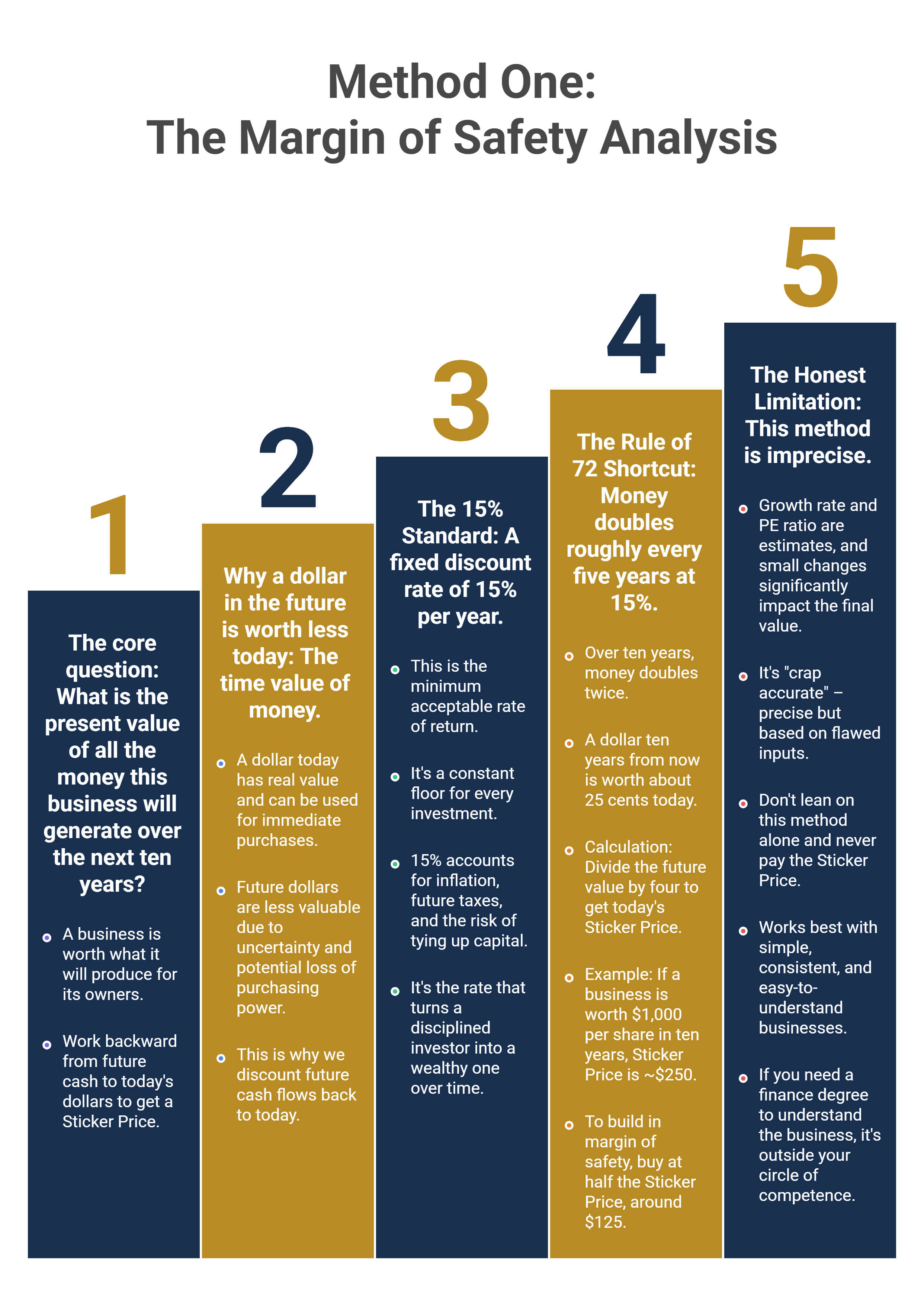
What is the present value of all the money this business will generate over the next ten years?
The logic behind this is simple. A business is worth what it will produce for its owners. If you can figure out how much cash it will generate in the future, and work backward to what that future cash is worth in today's dollars, you have a Sticker Price.
Why a Dollar in the Future Is Worth Less Today
Here is the thing about future money: I am not going to pay you a dollar today for a dollar you are going to hand me in 2035. That dollar sitting in my hand right now has real value. I can buy something with it today. Ten years from now? I do not know what I will be able to buy with it. Maybe half as much.
The farther away that future dollar is, the less I value it. That is the time value of money. And it is why we discount future cash flows back to today.
The 15% Standard
At Rule One, we use a fixed discount rate of 15% per year. That is our minimum acceptable rate of return. Not a variable we adjust based on market conditions or mood. A constant floor that every investment has to clear.
Fifteen percent is not arbitrary. It is high enough to account for inflation, future taxes on gains, and the risk of tying up capital. It is also the rate, by my calculations, that turns a disciplined investor into a wealthy one over time.
The Rule of 72 Shortcut
Here is where the math gets surprisingly easy. At 15% per year, money doubles roughly every five years. Over ten years, it doubles twice. That means a dollar ten years from now is worth about 25 cents today.
So the calculation runs like this:
If I believe a business will be worth $1,000 per share in ten years, I divide by four to get today's Sticker Price, roughly $250. Then I want to buy it at half that, around $125, to build in my margin of safety.
That is the whole calculation. Divide the future value by four. That is your Sticker Price.
The Honest Limitation
Here is what I will tell you that most valuation tutorials will not: this method is imprecise. Truly imprecise. The growth rate going into the calculation is an estimate. The PE ratio you apply to future earnings is an estimate. Small changes in either number can swing the final value dramatically. As I have said before, it is crap accurate.
That is not a reason to avoid the method. It is a reason not to lean on it alone, and why we never pay the Sticker Price. It is also why this approach works best with businesses that are simple, consistent, and easy to understand. If you need a finance degree to figure out how the business makes money, it is outside your circle of competence. Move on and find one you actually understand.
Method Two, The Private Company Payback Test
The second method has nothing to do with spreadsheets or discount rates. It is the way a private business buyer thinks. And in my view, it is closer to how the legendary investor, Warren Buffet, actually evaluates a company than anything you will read in a finance textbook.
Think Like a Buyer, Not a Trader
Forget the stock price for a moment. Forget the market. Ask yourself a single question:
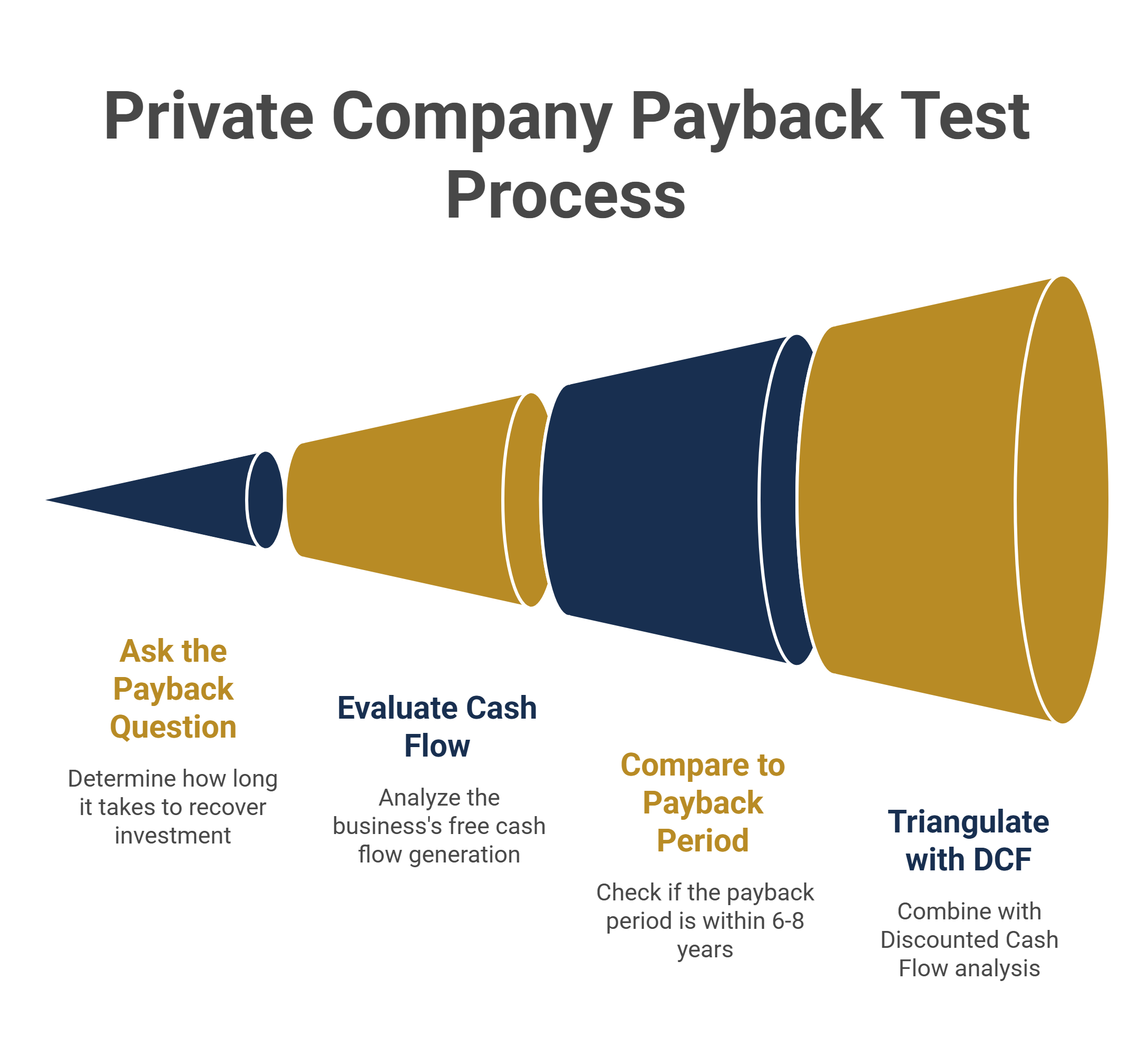
If I bought this entire business today, how long would it take me to get my money back from the cash it generates?
That is it. That is the whole test.
If the business generates enough free cash flow to return my full investment within six to eight years, that is a compelling deal. The same logic a seasoned entrepreneur applies when evaluating a private acquisition. The same logic you would apply if someone offered to sell you a profitable small business in your town.
Where This Comes From
I believe this is how the legendary investor actually thinks about value, not from any published formula, but from watching the examples he has shared over the years. His purchases of farmland. His acquisition of a commercial building in New York. In both cases, the reasoning was grounded in cash flow and payback, not projected growth rates. That is private equity thinking applied to public markets. And it is a powerful lens.
How It Works Alongside Method One
The discounted cash flow analysis in Method One projects a future value and works backward. This test does something different. It anchors the decision in what the business is producing right now.
Together, they triangulate. If the DCF gives you a Sticker Price of $50 and the payback test at current free cash flow also points toward a fair value in that range, you have two independent lines of reasoning arriving at the same neighborhood. That convergence matters. It means your valuation is not hanging on a single set of assumptions.
When they diverge significantly, that is a signal to understand the business more deeply before you act.
Method Three, The 10-Cap Analysis
This is the one I keep coming back to. And I think it is the most powerful valuation method available to an individual investor, not because it is the most sophisticated, but because it is the most honest.
Start With a Rental Property
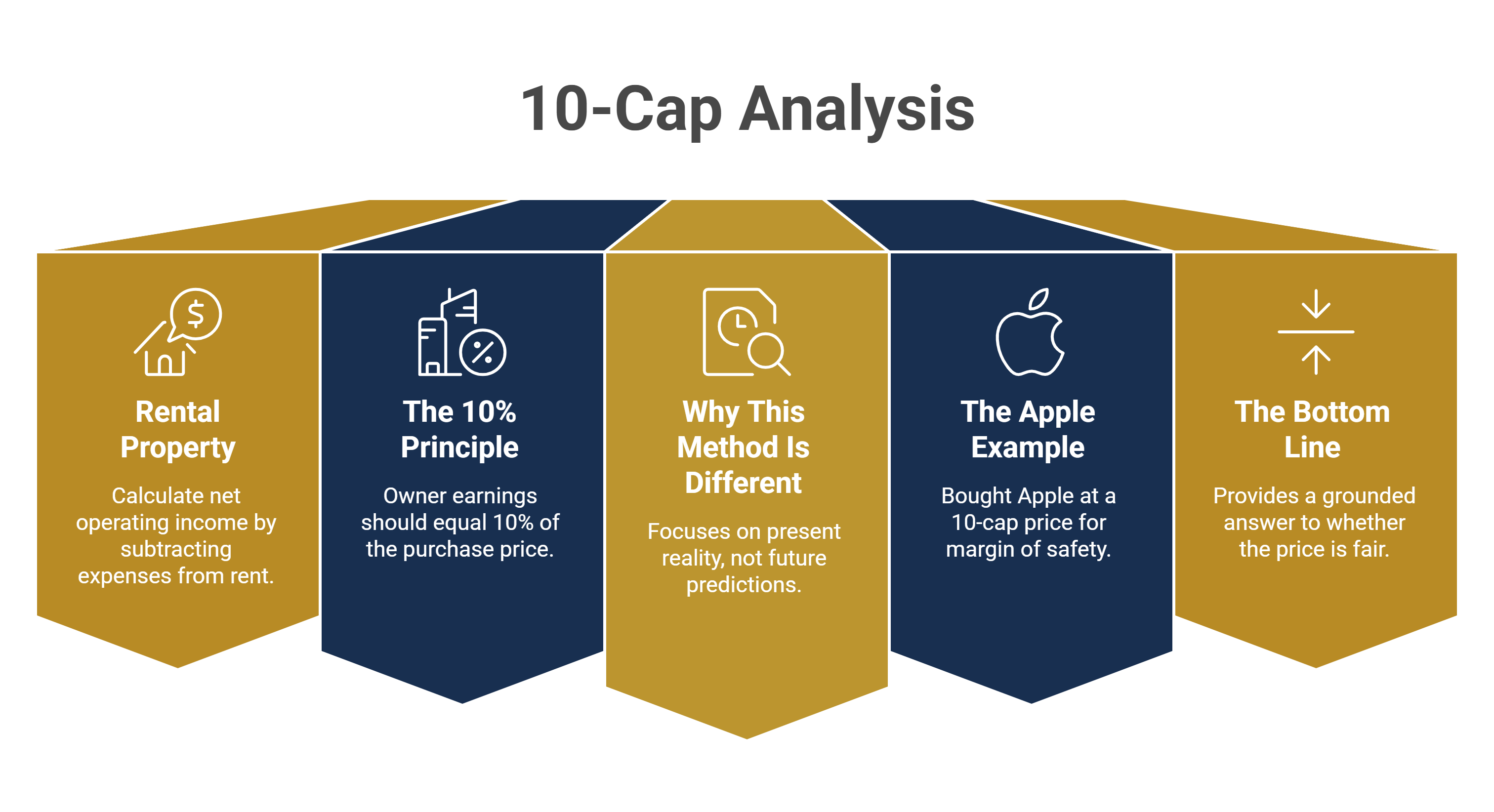
Imagine you are looking at a house to buy as a rental. You calculate the rent coming in every year. Then you subtract all the expenses you need to keep the property running including maintenance, insurance, property taxes, everything required to keep your tenant in place. What is left over is yours to pocket.
In real estate, that remainder is called net operating income. In business terms, the legendary investor calls it owner earnings. You might also see it called free cash flow. Different names, approximately the same thing: the money the business generates for its owners after everything required to maintain and run it has been paid.
The 10% Principle
Here is the principle, and it is beautifully simple.
If the owner earnings of a business equal 10% of the price you paid for it, that is a compelling deal. The legendary investor has said as much directly.
Think about it in property terms. You buy a $250,000 house and it puts $25,000 a year in your pocket. You do that deal all day. Now apply the same logic to a business. You buy a company at $100 per share and it generates $10 per share in owner earnings. That is a 10-cap. Same principle, different asset.
Why This Method Is Different
Every other valuation approach requires you to predict the future. The DCF asks you to estimate a growth rate. It asks you to estimate what PE ratio Mr. Market will apply in ten years. Both of those numbers are guesses, and as I said earlier, they are imprecise ones.
The 10-cap analysis does not ask you to predict anything. It anchors the decision entirely in what the business is generating right now. You are not betting on a future number. You are evaluating a present reality.
The Apple Example
I bought Apple at approximately a 10-cap price a few years ago. Not because I knew exactly what it would be worth in a decade. But because I knew it was a great company, I knew it would be bigger and better in the future, and the price I was paying relative to its owner earnings gave me a margin of safety that was built directly into the math. I did not need to get the growth rate right. The price itself was the protection.
That is the real power of this method. If you can buy a wonderful business which is one with a durable moat and great management, at a 10-cap price, you are already protected even if your other assumptions turn out to be wrong.
The Bottom Line
The 10-cap analysis still requires you to understand the business deeply and confirm it has a real moat. But once you have done that work, this method gives you the clearest, most grounded answer to the question every investor is really asking: am I paying a fair price for what this business actually produces?
Why Margin of Safety Is the Rule That Makes All Three Methods Work
Everything we have covered so far, the DCF analysis, the payback test, the 10-cap comes down to one thing. Getting the buy price right so that even when you are wrong about something, you do not lose money.
That is what margin of safety means. Not a formula. A principle.
The Three Most Important Words in Investing
Ben Graham put this forward nearly a century ago. He said the three most important words in investing are margin of safety, because the vicissitudes of life, the unexpected changes, the mistakes in judgment, the events nobody saw coming, can take down even the best company.
The protection is not in predicting the future correctly. The protection is in the price you pay today.
If you buy a wonderful business well below its intrinsic value, you can be wrong about things and still come out without violating Rule One. That is the whole point.
The Rule One Standard
Here is how we apply it.
First, we calculate the Sticker Price, our conservative estimate of what the business is worth. Then we cut that number in half. That is the Margin of Safety price. The price at which we actually buy.
This means we are applying two layers of conservatism simultaneously. We are conservative in the valuation itself. Then we are conservative again in the buy price. Both layers working together are why Rule One investors can be imprecise about the future and still protect their capital.
The Discipline It Requires
This approach demands patience. Most great businesses will not be available at the Margin of Safety price on any given day. The market spends most of its time pricing things reasonably.
But Mr. Market panics. He overreacts. And when he does, when fear drives prices well below what a business is worth, you need to already know your number. The investors who are ready to act in those moments are the ones who did the work beforehand and held their price with discipline.
Know your Margin of Safety price before the opportunity arrives. Then wait.
How to Put It All Together — Making the Decision
After walking through three valuation methods, here is the question that matters: what do you actually need to get right?
You Do Not Need Perfect Inputs
The growth rate is an estimate. The future PE ratio is an estimate. The payback period is an estimate. Every number you put into these methods carries some uncertainty, and pretending otherwise is how investors get into trouble.
What you need to get right is simpler than any of those inputs.
Is this a wonderful business? Will it be bigger and better in the future than it is today? And are you buying it at a price so good that even a modest outcome does not cost you money?
If the answer to all three is yes, the system works. Not because you predicted the future correctly. Because you bought well enough that the future does not have to go perfectly.
The Standard That Holds Everything Together
Conservatively valued. Bought at half that conservative valuation. Applied only to businesses you genuinely understand.
That is Rule One. Not a formula. A standard. And it is built to withstand uncertainty rather than pretend it does not exist.
The investors who lose money are usually not the ones who got the growth rate slightly wrong. They are the ones who paid too much, did not understand the business, or skipped the margin of safety because they were convinced they had found something special.
Follow the process. Know the business. Wait for the price. That is the whole decision.
The One Thing Wall Street Will Never Tell You About Stock Valuation
Here is something worth knowing before you go looking for more information on this topic.
The predominant theory of valuation on Wall Street is modern portfolio theory. It holds that markets price businesses correctly at all times. If that is true, there is no point in figuring out what a business is actually worth — the market has already done it for you. That position conveniently takes most fund managers off the hook for doing any valuation work at all.
And then there are ETFs. An enormous percentage of professional investing today is pure index tracking. No valuation. No business analysis. Just follow the index.
The result is that very few people on Wall Street actually do what we have been talking about in this article. Looking at a business. Figuring out what it is worth. Waiting for the price that gives you a real margin of safety.
That is not a reason to avoid this approach. It is a reason to learn it.
The investors who have practiced disciplined, principle-based valuation over long periods have shown what this framework can produce when followed with patience and consistency. The method is not complicated. It is just that almost nobody on Wall Street is using it.
Learn to Value Businesses the Right Way
Understanding the framework is the first step. Being able to apply it to a real business with real numbers, in real time, is where the skill develops.
That is what the Rule One Virtual Investing Workshop is designed to do. Over three days, entirely online, my coaches and I walk you through the full process: how to find wonderful businesses, how to evaluate them through the Four M's, how to run these valuation methods on an actual company, and how to use options trading to generate cash for your investments.
More than 2 million people around the world have learned to invest using Rule One principles. The workshop is where that learning becomes hands-on. You practice with live coaches, not just listen to lectures.
If you are ready to move from understanding these principles to actually using them, I would love to have you join us.

About Phil Town
Phil Town is an investment advisor, hedge fund manager, 3x NY Times Best-Selling Author, ex-Grand Canyon river guide, and former Lieutenant in the US Army Special Forces.
He and his wife, Melissa, share a passion for horses, polo, and eventing. Phil's goal is to help you learn how to invest and achieve financial independence.
Get Phil's Free Guide