










The Leadership That Transformed Sprouts Farmers Market: A Case Study of Jack Sinclair
 Phil Town
 In This Article
- Why Integrity in Leadership Matters
- Operational Expertise: Jack Sinclair's Track Record
- A Strategic Pivot: Focusing on What Matters
- The Moat Most Investors Miss: Buying at the Speed of the Harvest
- What the Numbers Say About the Moat
- Where Sprouts Goes From Here
- Recognition and Results
- Lessons from Jack Sinclair's Leadership
- Learn to Evaluate Management Yourself
- Final Thoughts
Additional analysis by Austin Bowen, Analyst, Rule #1 Investing
At Rule One Investing, we believe that identifying exceptional management is crucial for long-term investment success. A great CEO is not just someone who delivers strong financial results. They are a leader with integrity, a proven track record, and a clear vision for the future.
In the world of business, strong leadership can make or break a company. Jack Sinclair, the CEO of Sprouts Farmers Market, is a shining example of how integrity, vision, and experience can turn a struggling company into a thriving one.
His approach to management and strategic focus on core values has positioned Sprouts Farmers Market as a leader in the health-focused grocery niche.
Why Integrity in Leadership Matters
One of the standout traits of Jack Sinclair is his unwavering integrity. In his letters to shareholders and earnings calls, he demonstrates openness and honesty about the company's performance. He doesn't shy away from addressing mistakes or areas for improvement.
This level of transparency is rare but crucial for building trust with investors. For shareholders, this integrity is a sign of reliability.
Sinclair's candid acknowledgment of setbacks reassures investors that he is committed to not only celebrating successes but also confronting challenges head-on. This is a fundamental quality for a steward of investors' capital, a leader who prioritizes sustainable growth over glossing over flaws.
You could see it again in February 2026. Sprouts had just closed a year with sales up 14%, and on the earnings call Sinclair told investors he was not happy with how the year finished, pointing at slowing comparable store sales and disappointing transaction counts.
Most CEOs would have led with the 14%. He led with the problem.
Operational Expertise: Jack Sinclair's Track Record
Jack Sinclair's extensive background in the grocery industry is another factor contributing to his success at Sprouts Farmers Market. With more than 35 years of experience in retail and grocery, including eight years as executive vice president of Walmart's U.S. Grocery Division, where he ran grocery across more than 4,000 stores, Sinclair brought a wealth of knowledge to his role at Sprouts in 2019.
When he joined Sprouts Farmers Market, the company faced significant challenges in maintaining its competitive edge. Drawing from his experience at Walmart, a business known for excelling in low-cost strategies, Sinclair recognized that attempting to compete directly with retail giants like Walmart was not a viable option.
Instead, he steered Sprouts toward a differentiated approach. Having run grocery at that scale himself, he also knew exactly where the giants are slow.
A Strategic Pivot: Focusing on What Matters
Rather than emulating Walmart's focus on low prices, Sinclair emphasized Sprouts' unique value proposition: fresh, healthy food and niche products. He realigned the company's priorities to better serve its core customer base, health-conscious shoppers seeking high-quality, specialized products.
Under Sinclair's leadership, Sprouts carved out a distinctive niche in the grocery industry. This strategic pivot allowed the company to grow steadily while staying true to its mission.
What makes this a management story rather than a marketing one is how he arrived at it. He laid out plainly every way Sprouts would lose in a head-to-head fight against Walmart, Kroger, or Publix, and then committed to competing only where Sprouts could build a real edge.
Knowing where not to fight is one of the most valuable qualities a CEO can have, and it is exactly what the Management M is designed to find. If you want a structured way to test it on any business, run it through the Rule #1 investment checklist.

The Moat Most Investors Miss: Buying at the Speed of the Harvest
Choosing a lane is one thing. Defending it is another. The machinery that makes Sprouts' lane defensible is something most investors never look at, because it sits in the supply chain rather than in the marketing.
Giant grocers run centralized procurement. One department handles the buying and negotiates with large suppliers on volume, which is the right way to run a business built on the lowest price at scale.
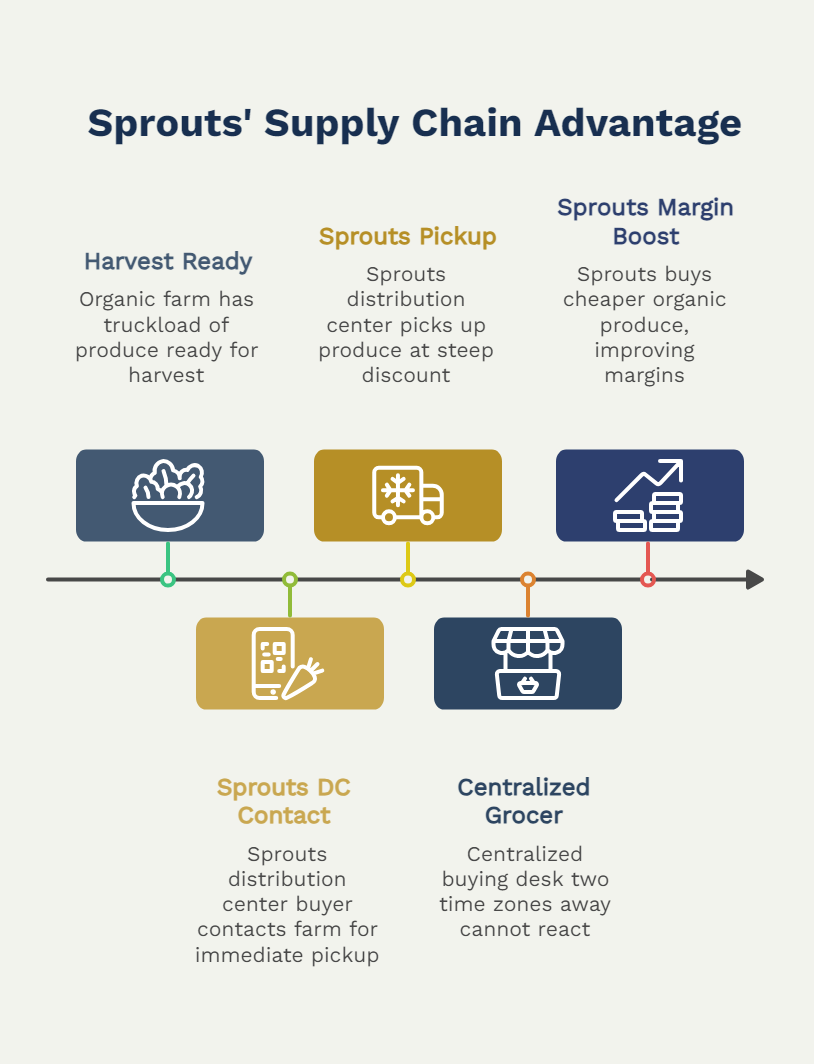
Sprouts inverted it. Buying authority is pushed down to individual distribution centers, so local buyers can move on their own.
Why Centralized Buying Can't Catch This Supply
Here is what that makes possible. When an organic farm has a truckload of produce that will turn in a few days, a Sprouts distribution center can pick up the phone and take it that afternoon at a steep discount.
A centralized buying desk two time zones away cannot decide fast enough to catch that supply, and mostly is not trying to.
Austin Bowen on my team calls it "buying at the speed of the harvest," and it is the clearest example I know of a moat that does not show up on a billboard. It shows up in the margins. His read is that on a lot of their organic produce, Sprouts is buying cheaper than Walmart.
Let me be honest about the limits here. Groceries are a brutal industry, with thin margins and relentless competition, and Sprouts does not have a hundred-foot moat like a railroad network.
What it has is a differentiation moat and a brand moat, aimed at a customer the big-box stores are not serving well. If you want to compare how different moat types hold up across industries, we break down the four types of moat separately.
What the Numbers Say About the Moat
A moat you can describe is a story. A moat that shows up in the financials is an advantage. For fiscal 2025, which ended December 28, Sprouts reported net sales of $8.8 billion, up 14% from the prior year, on comparable store sales growth of 7.3%.
Gross margin came in at 38.8%, improved from 38.1%. Operating income was $686 million, close to a 7.8% operating margin, and net income was $524 million, or 5.9% of sales. Diluted earnings per share went from $3.75 to $5.31.
What the Returns Actually Tell You
Return on equity landed around 37%, though I would add a caveat there. The company repurchased $472 million of its own stock during that same fiscal year, and buybacks shrink the equity base, which lifts the ratio without the business itself doing anything differently.
Return on invested capital is the more telling figure. It comes in near 16% once the store leases are counted as debt, which is the conservative way to look at a business operating hundreds of leased locations. Leave the leases out and the number looks closer to 35%, which is exactly why you want to know how a figure was built before you trust it.
The business also generated $716 million in cash from operations during the year while spending $224 million on new stores, net of landlord reimbursements.
Those would not be remarkable numbers in software. In grocery, where the big operators run net margins in the low single digits, they stand out, and that gap is the argument for the buying advantage being real rather than theoretical.
One thing matters more than any single year of this. The Big Five numbers ask whether growth has been consistent over a decade, not whether one year looked good. That is the test to run before you get anywhere near a price.
Where Sprouts Goes From Here
Sprouts opened 37 stores in 2025 and finished that fiscal year with 477 locations across 24 states. As of the second quarter of 2026, reported at the end of July, the count stood at 490 stores across 25 states, with management guiding to roughly 42 net new stores for the full year.
Sinclair has said publicly that he sees room for roughly 1,400 stores across the country eventually. He has pointedly declined to attach a timeline to that, which is consistent with how he handles every other forecast.
The constraint is worth understanding, because it ties straight back to the buying advantage. Stores need to sit within roughly 250 miles of a distribution center for fresh produce to work, so the expansion is gated on where the next distribution centers go rather than on ambition.
Management has also been straight about the near term. Full-year 2026 guidance calls for net sales growth of 5.5% to 6.5%, with comparable store sales somewhere between negative 0.5% and positive 0.5%, and the second quarter came in at negative 1%.
In other words, the store count keeps climbing while same-store sales sit roughly flat in a cautious spending environment. Growth plans and near-term results are two different things, and this management team has not confused them.
Recognition and Results
Sinclair's efforts didn't go unnoticed. In 2020, he was named CEO of the Year by Grocery Dive, a recognition that highlighted his transformative impact on Sprouts Farmers Market.
In 2023, the W. P. Carey School of Business at Arizona State University named him its Executive of the Year, and the citation singled out his commitment to integrity in leadership. That is not a word business schools hand out casually.
Not only did he stabilize the business, but he also laid out a clear roadmap for growth. That roadmap, and the numbers behind it, are covered above.
Lessons from Jack Sinclair's Leadership
Jack Sinclair's story offers a few things worth carrying into how you look at any CEO.
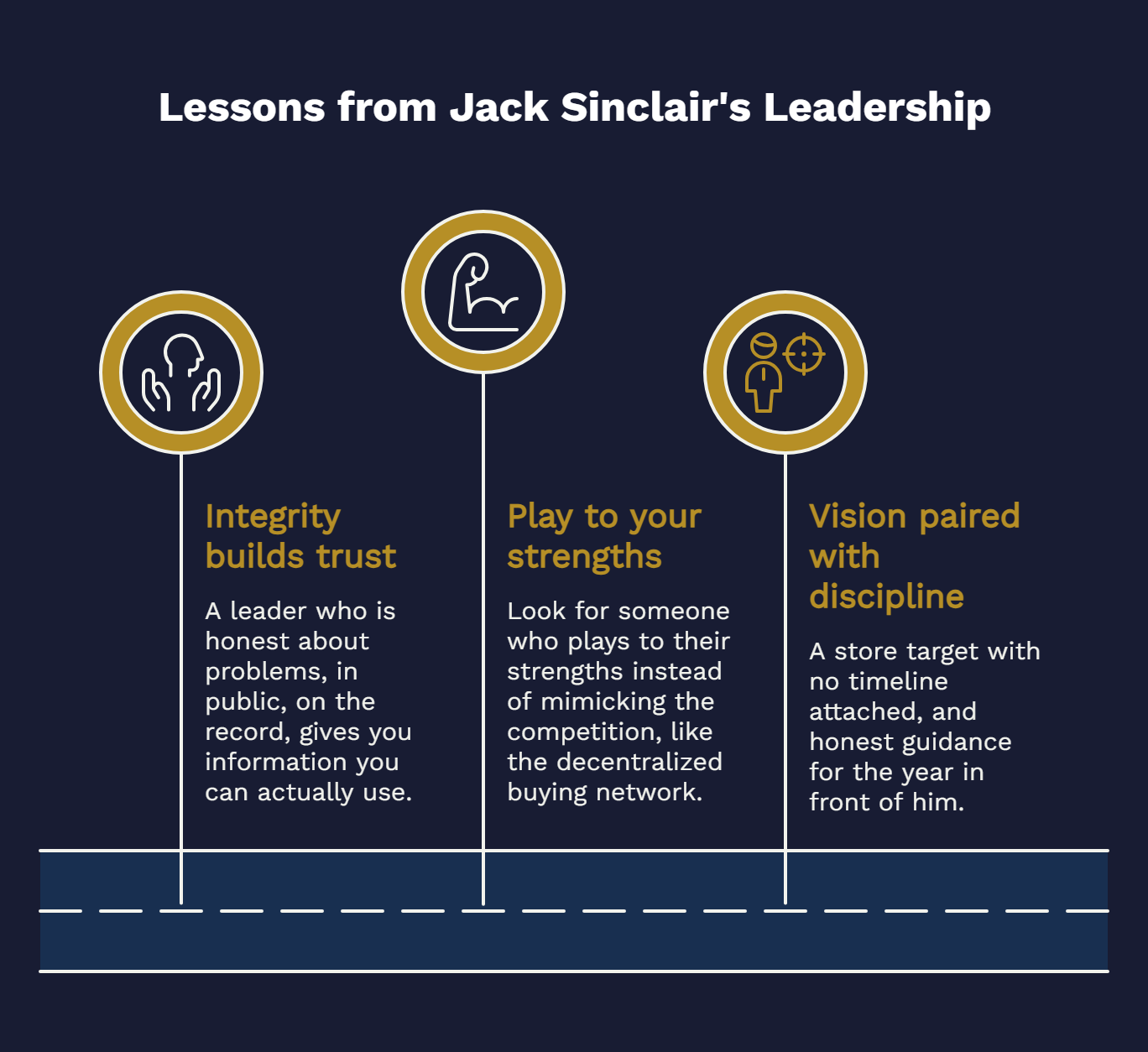
The first is that integrity builds trust. A leader who is honest about problems, in public, on the record, gives you information you can actually use.
The second is to look for someone who plays to their strengths instead of mimicking the competition. In Sinclair's case that decision was operational rather than cosmetic, and the decentralized buying network is what "play to your strengths" looks like when it reaches the supply chain.
The third is long-term vision paired with discipline. A store target with no timeline attached, and honest guidance for the year in front of him, is what that combination sounds like coming from a CEO.
The Value Investing Cheat Sheet
Learn what 10 steps you should take to make smarter investing decisionsLearn to Evaluate Management Yourself
Management is the third M, and it is the one most investors skip because it feels subjective. It isn't. There are specific things to read and specific questions to ask, and we teach all of them at the Rule #1 Virtual Investing Workshop.
Spotting a CEO like Sinclair, someone who knows exactly where not to compete, is a real skill. Building it is a big part of what we cover at the Virtual Investing Workshop. Three days, live, hands-on, working the full Four M's process on real businesses. Join the link below for current dates.
Join the Rule #1 Virtual Investing Workshop
Final Thoughts
By prioritizing transparency, drawing on decades of experience, and focusing on a niche market, Sinclair has transformed Sprouts into a formidable player in the health-focused grocery space.
The pairing is what makes this a case study rather than a profile: a CEO who knew exactly where not to fight, paired with an operating advantage quiet enough that most people miss, showing up in the margins year after year.
That combination is what the Management and Moat M's exist to find.
Related reading:
How to Invest: A Basic Overview of Rule #1
Disclosure: Phil Town and Austin Bowen have both owned shares of Sprouts Farmers Market since approximately 2020.
Rule One Investing provides investment education and training only. We do not provide personalized investment advice, manage client assets, or guarantee investment returns. All content is for informational purposes. Consult a qualified financial professional before investing. Past performance does not guarantee future results. Individual results vary.

About Phil Town
Phil Town is an investment advisor, hedge fund manager, 3x NY Times Best-Selling Author, ex-Grand Canyon river guide, and former Lieutenant in the US Army Special Forces.
He and his wife, Melissa, share a passion for horses, polo, and eventing. Phil's goal is to help you learn how to invest and achieve financial independence.
Get Phil's Free Guide