











Company Valuation Methods: How to Know What to Pay for a Stock
 Phil Town
 In This Article
- Here are three reasons why you should listen to this episode:
- Resources
- Valuation Is Simpler Than Wall Street Makes It Sound
- The Four Methods I Use to Value Any Company
- Method 1: The 10 Cap
- Method 2: The Sticker Price and Margin of Safety
- When to Buy and When to Wait
- Investing as a Practice, Not a Project
- Expert Advice & Powerful Quotes
- Danielle Town: Attorney, Author & Investing Advocate
- Know What a Company Is Worth Before You Buy
Most people think figuring out what a company is worth requires a finance degree or a Wall Street job. I hear it constantly, and I understand why. Valuation sounds complicated because Wall Street has made it sound that way. But the fear of valuation is one of the biggest things keeping everyday investors on the sidelines, and that is a problem I want to fix.
In this episode of the InvestED Podcast, Company Valuation Methods, Danielle and I walk through the four methods I use to determine what any company is worth. I break down the 10 Cap, a straightforward approach borrowed from real estate, and the Sticker Price and Margin of Safety calculation, which gives you a clear number for what a business is worth and what you should actually pay for it. I also introduce Payback Time and Zombie Value, two more methods that round out the full valuation picture.
When all four methods point to the same number, you have the kind of conviction that makes investing feel a lot less like guesswork.
Valuation is a skill, not a gift. It gets sharper the more you practice it, and even 15 minutes a week is enough to start building real knowledge. Anyone willing to learn the framework can do this. Tune in to discover how four simple methods can give you the confidence to know exactly what to pay for a stock and the patience to wait until you get it.
Here are three reasons why you should listen to this episode:
Discover how four simple valuation methods work together to give you a confident price range for any company you want to buy.
Learn how to apply the 10 Cap and Sticker Price methods step by step, using real numbers, no finance degree required.
Gain a clearer sense of how patience and discipline, not IQ, are what separate great investors from the rest.
Resources
Rule #1's "InvestED" Podcast and Website: Website | Apple Podcast | YouTube
Visit Rule #1 for more investing resources: Website | Facebook | LinkedIn | X (Twitter) | Instagram
Danielle Town: Website | LinkedIn | Instagram | Facebook | YouTube | X (Twitter)
Valuation Is Simpler Than Wall Street Makes It Sound
Figuring out what a company is worth is not as hard as most people think. Wall Street has done a great job of making it feel complicated. But the truth is, you do not need a finance degree or years of training to do this well.
Charlie Munger, Warren Buffett's brilliant partner at Berkshire Hathaway, put it this way: investing is totally easy. And I agree with him. Here is what you actually need:
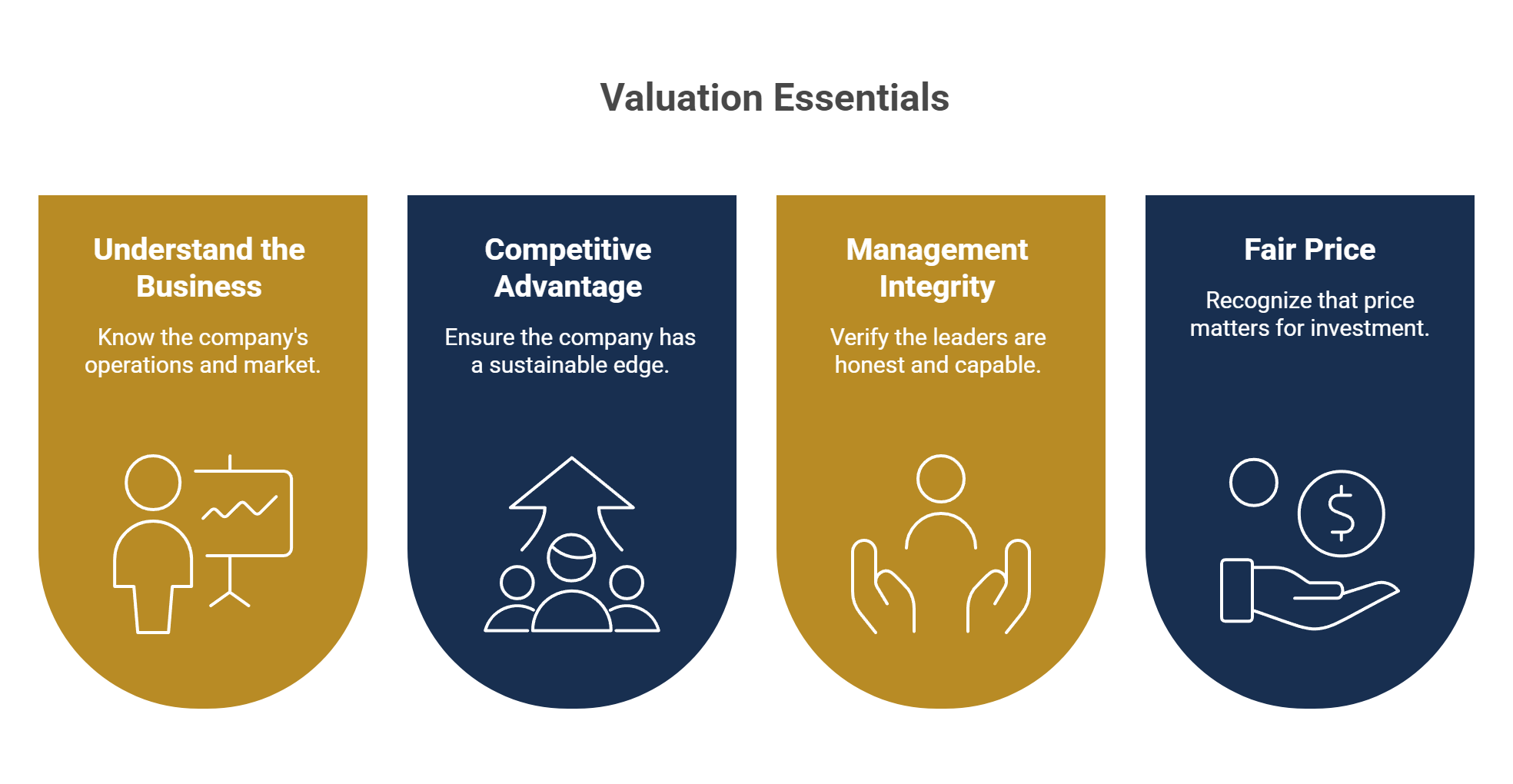
Understand the business you are looking at
Make sure it has a real, durable competitive advantage
Make sure the people running it have integrity and talent
Know that you cannot pay just any price you feel like paying
Buy it at a fair price or with a margin of safety. That is the whole system.
The hard part is not the math. The hard part is the discipline. Staying out of the market most of the time, waiting for the right price, doing nothing when everything around you feels urgent. That is what is genuinely difficult. And it is what separates great investors from everyone else.
As Danielle told me, she was "completely intimidated by the idea of actually buying something." I hear that all the time. But the fear goes away when you have a clear process. When you know exactly what you are looking for and exactly what you are willing to pay.
That is what I am going to walk you through today.
The Four Methods I Use to Value Any Company
I do not use just one method to figure out what a company is worth. I use four. Not because the math is complicated, but because when four different approaches all point to the same number, you can invest with real conviction. That convergence is what gives you confidence as an investor.
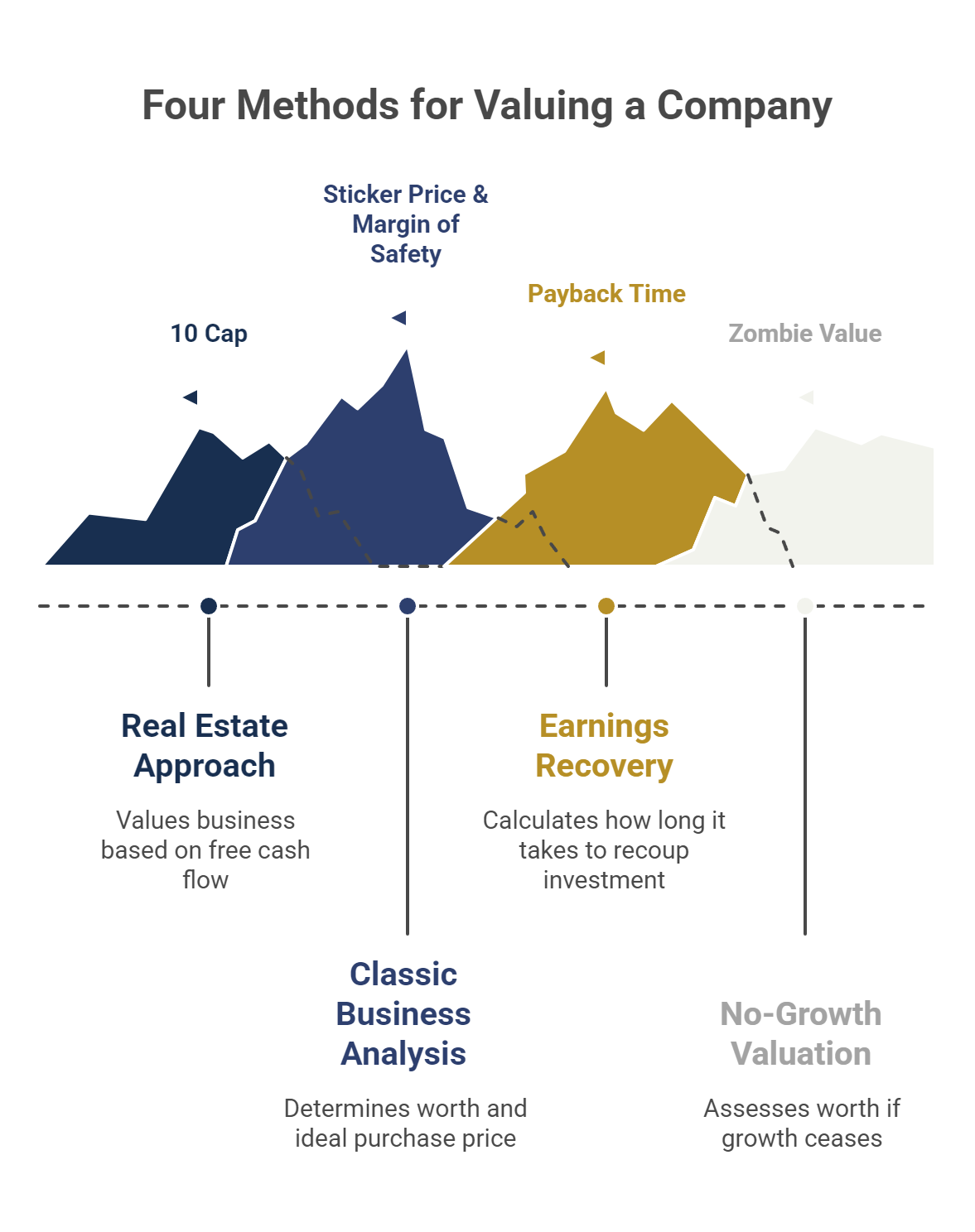
Here are the four methods:
The 10 Cap: a real estate approach to valuing a business based on its free cash flow
The Sticker Price and Margin of Safety: a classic business analysis that tells you what a company is worth and what you should pay for it
Payback Time: how long it takes for the business to pay you back through its earnings
Zombie Value: what the business is worth if growth stops completely
Danielle and I walk through the first two here. We’ll cover Payback Time and Zombie Value separately, so you can take these one step at a time without getting overwhelmed.
Prem Watsa, often called the Warren Buffett of Canada, said something that has always stuck with me. The biggest mistake you can make is thinking the people on Wall Street know more than you do. These four methods are how you level that playing field. They give you a way to reach your own conclusions, based on your own analysis, independent of what the market says a business is worth.
Ready to put all four methods into practice on real companies? Join the Rule #1 Virtual Investing Workshop for hands-on experience, live coaching, and proven strategies to help you find wonderful businesses at the right price.
Let's start with the simplest one of all.
Method 1: The 10 Cap
The 10 Cap is the simplest valuation method I know. I borrowed it from real estate, and once you see how it works, you will wonder why anyone makes valuation more complicated than this.
Think Like a Real Estate Investor
Imagine you own a rental property that generates $100 a year in rent, straight into your pocket. You want at least a 10% return on your investment. So how much should you pay for it?
Simple math: $100 divided by 10% equals $1,000. That is your price.
Now apply that same thinking to a business. Instead of rent, you are looking at free cash flow. That is the money the business generates that goes straight to the owner. Warren Buffett calls it owner cash flow, and for most businesses I look at, the two are about the same thing.
In our lemonade stand example, the free cash flow is $8 per share. Divide $8 by 10% and you get $80 per share. That is the 10 Cap price. That is what I am willing to pay.
The formula is simple:
Owner/Free Cash Flow ÷ 10% = 10 Cap Price
When Does the 10 Cap Apply?
I originally used this method for suboptimal businesses; companies going through a rough patch, like a run-down rental property that needs work before it can command a higher rent. You buy it at a depressed price, improve it, and watch the value grow.
But it works just as well for a business that is already running well. Our lemonade stand is growing at 13% a year. That growth is doing the same job as fixing up the property. It is creating value year after year, which is why the 10 Cap still gives us a fair price.
It also works for businesses that are temporarily distressed. Think of banks in 2009. Earnings were near zero or even negative. In a case like that, I skip the current numbers and look at what the business will earn once it is back on its feet. Same method, same logic.
What If the Price Is Too High Right Now?
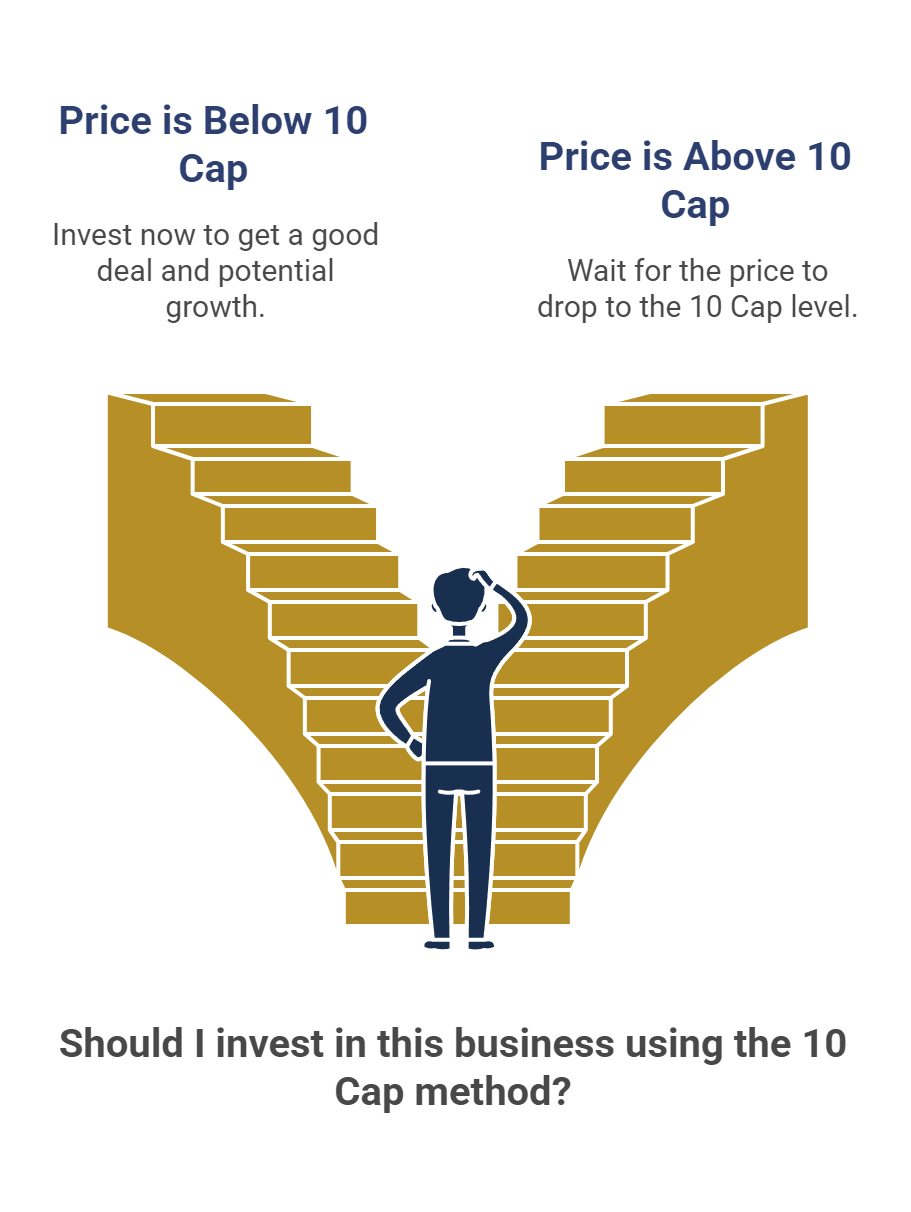
Here is where patience comes in. Let's say our lemonade stand is trading at $160 or $190 per share. Our 10 Cap price is $80. We are not even close.
So what do we do? We put it on the watch list and we wait.
Mr. Market does not stay euphoric forever. Prices come down. And when they do, we are ready. We have already done the homework. We know exactly what we are willing to pay. When the price gets there, we load up the truck.
That is the discipline this method requires. Not just knowing the right price, but being patient enough to wait until you can get it.
Want to start building your own watch list? Try Rule #1's free online course and learn the step-by-step process for finding and tracking wonderful businesses at the right price.
Method 2: The Sticker Price and Margin of Safety
This is the method I use most. It is a classic business valuation approach, and it starts with four simple numbers. Once you have those four numbers, the rest is straightforward math.
The Four Numbers You Need
Here are the four inputs:
Current earnings per share (EPS): The most recent earnings of the business, adjusted for anything short-term or unusual. For our lemonade stand, that is $11 per share.
Growth rate: How fast earnings are growing over the long term. I look at sales growth, book value growth, earnings growth, and cash growth to find a number the business has proven it can sustain. For the lemonade stand, that is 13%.
PE ratio: The price-to-earnings multiple I expect the market to apply in the future. I use 20, which is historically the high-end multiple for a good business.
Minimum required return: The annual return I need to make this investment worth my while. Rule #1's benchmark is 15% per year.
Four numbers. That is all you need to get started.
Growing Earnings Into the Future
I take that $11 in earnings and grow it at 13% per year for 10 years. You can do this with a simple FV formula in Excel or any basic financial calculator. The result: $37 per share.
Danielle rounded it to $40 to keep the math clean, and that is exactly what I mean when I say this is windage. You are not trying to hit a precise target. You are sticking a finger in the air to feel where the wind is coming from. A close, reasonable estimate is what we are after.
Multiply $37 by a PE of 20 and you get $746. Multiply $40 by 20 and you get $800. That range of $746 to $800 is the future value of the business in 10 years. That is what the lemonade stand should be worth in a decade if our numbers are in the right ballpark.
From Future Value to What You Pay Today
Now the key question: if the business will be worth $746 in 10 years, what should I pay for it today to target 15% per year?
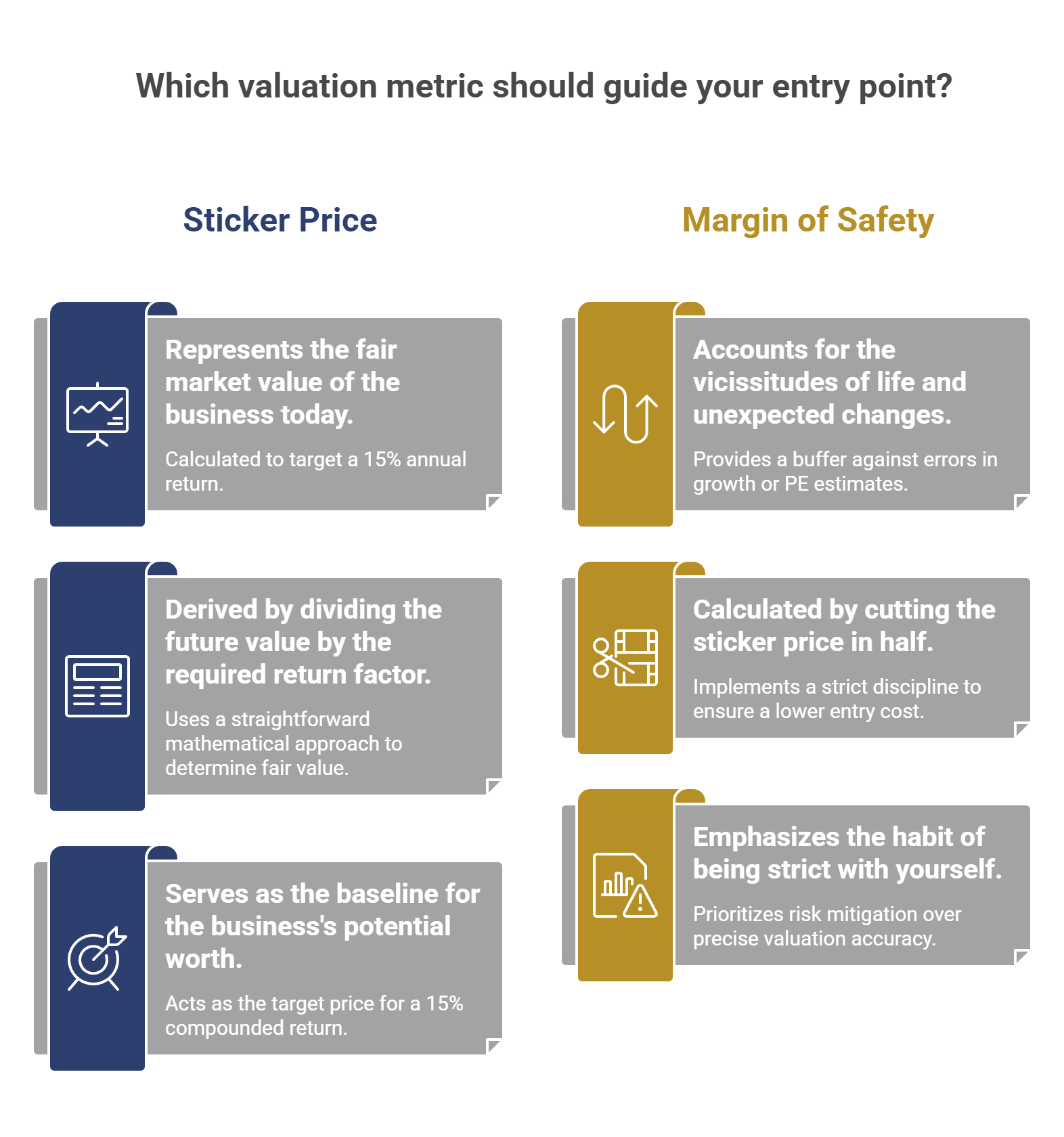
The math is simpler than it sounds. Divide $746 by four. You get $186. That is the sticker price, the fair market value of the business today. If I buy it for $186 and sell it for $746 ten years from now, I may earn 15% per year compounded.
But I do not stop there. I cut that sticker price in half.
Why? Because the vicissitudes of life are real. Growth rates can be off. PE ratios compress. Management changes. Something unexpected always happens. The margin of safety is how I account for all of that. Half of $186 is $93. That is my Margin of Safety price. That is what I am actually looking to pay.
Danielle noticed that our earlier rounded calculation gave us a Margin of Safety price of $100. The more specific number comes out to $93. That is a $7 difference. And at this level of margin of safety, that gap is not what matters. What matters is the discipline of sticking to your number.
That discipline is especially important when you are just starting out. Insist on getting your price. Do not waffle your way into a position. The habit of being strict with yourself as a beginner builds the foundation that will serve you for the rest of your investing life.
When to Buy and When to Wait
At this point, I have two numbers. The 10 Cap says buy at $80. The Margin of Safety says buy at $93. Both methods are pointing in the same direction, and that is exactly the point.
When Danielle first heard I use four valuation methods, she was not excited about it. As she put it, "I did not like the idea originally of multiple kinds of valuation because it sounded like a lot of work." But here is what changed her mind. When four separate approaches all arrive at roughly the same number, you are no longer guessing. You have a genuine appraisal of what the business is worth. And that appraisal gives you the emotional confidence to act when the price is right.
The range we have now, $80 to $93, will get tighter once Payback Time and Zombie Value point to the same area. That convergence is where real conviction lives. It is also what tells you clearly when the price is still too high and patience is the right move.
As you gain experience, you will develop a feel for when you can be slightly more flexible. Buffett buys wonderful businesses at 20 to 40% below the sticker price, not necessarily the full 50% he may have required earlier in his career. That kind of judgment comes with time and practice.
Investing as a Practice, Not a Project
Valuation is not a one-time event. It is a practice, the same way yoga or meditation is a practice. There is no finish line. There is just the discipline of showing up, doing the work, and getting a little better every time.
The knowledge compounds just like the wealth does. Someone spending 15 minutes a week studying companies is accumulating something real. The snowball starts small. Keep it rolling for a few years, and it becomes something remarkable.
That is what all of this is really about. Not just two valuation methods, but the beginning of a process that, at every single step, is designed to protect you from losing money.
Here is how that protection builds:
Understanding the business is margin of safety
Knowing the moat is margin of safety
Trusting the management is margin of safety
Cutting the sticker price in half is margin of safety
Rule #1 is not just a formula. It is a philosophy applied at every level. By the time you arrive at your final price, you have already built in protection four times over.
You do not need to be smarter than Wall Street. You need to be more disciplined. That is the whole game.
Expert Advice & Powerful Quotes
"It requires an iron discipline to not do stuff most of the time, to not invest most of the time."
"If we know we're going to get $8 from the lemonade stand on a per share basis, we simply divide the $8 by 10% and we get a 10 cap valuation of 80 bucks per share."
"We're going to cut the price in half and give ourselves an enormous margin of safety."
"We'll see these starting to coalesce around a point. And when we see that, we start to become more and more confident that we're looking at the world at a pretty decent appraisal of the value of the business from four different points of view."
Danielle Town: Attorney, Author & Investing Advocate
Danielle Town is a best-selling author, attorney, and passionate advocate for empowering new investors. She has a background in law and a deep curiosity about financial independence. Danielle is dedicated to demystifying investing for anyone seeking financial control. She co-authored Invested, sharing her journey learning value investing with her father, Phil Town. Danielle believes anyone can build confidence in investing by focusing on clarity, patience, and wisdom.
Through her writing, podcasting, and teaching, Danielle helps others cut through the noise of the market. She guides people in developing sound investing habits that last. Her approach encourages aligning money choices with personal values and long-term goals. Danielle shows that investing is a lifelong practice, built on steady learning and self-awareness. She inspires anyone to take the first step and make smart, values-driven decisions.
Expertise: Value Investing · Financial Education · Personal Finance · Mindful Money Management
Danielle Town: Website | LinkedIn | Instagram | Facebook | YouTube | X (Twitter)
Know What a Company Is Worth Before You Buy
Knowing what to pay for a stock is not a gift reserved for professional investors. It is a skill, built method by method, practiced one company at a time. Danielle and I walked through two of the four valuation methods I use: the 10 Cap and the Sticker Price and Margin of Safety. Together, they give you a price range grounded in real analysis, not guesswork.
Listen to the Full Episode – In this InvestED Podcast episode, Company Valuation Methods, Danielle and I walk through the four methods I use to value any company. I cover the 10 Cap, a straightforward real estate approach to determining what a business is worth based on its free cash flow, and the Sticker Price and Margin of Safety, a four-input method that tells you exactly what to pay today for a business worth far more in the future. You will walk away with a clear framework and the confidence to start applying it.
Reflect on Your Own Process – Do you know what any company on your watchlist is actually worth right now? Have you run the 10 Cap? Have you calculated a Sticker Price? If not, this is where to start. Pick one company you already know well and run the numbers. That first calculation is where the practice begins.
Explore More – Visit Rule #1 for more resources on building your investing discipline. Discover workshops, tools, and stories that support your journey to becoming a mindful and successful Rule #1 investor.
Valuation is not the hard part. Patience and discipline are. Learn the process, trust the numbers, and wait for the right price. That is the Rule #1 way to lasting financial success.
Ready to run these numbers on a real company you love? Join us at the Rule #1 Virtual Investing Workshop for hands-on guidance and real company analysis.

About Phil Town
Phil Town is an investment advisor, hedge fund manager, 3x NY Times Best-Selling Author, ex-Grand Canyon river guide, and former Lieutenant in the US Army Special Forces.
He and his wife, Melissa, share a passion for horses, polo, and eventing. Phil's goal is to help you learn how to invest and achieve financial independence.
Get Phil's Free Guide