











The Truth About Investment Diversification: What Warren Buffett and Top Investors Really Do
 Phil Town
 Over-diversification is one of the most common and costly mistakes individual investors make.
Warren Buffett famously stated: "Diversification is protection against ignorance. It makes little sense if you know what you are doing."
Most people trust a financial advisor to spread their money across cash, bonds, real estate, commodities, or hundreds of stock funds. Good investors consider this unnecessarily over-diversified and unlikely to outperform.
Consider what the legendary investor actually does with his own money. As of December 31, 2024, approximately 70% of Berkshire Hathaway's $267.2 billion portfolio was invested in just five companies: Apple, American Express, Bank of America, Coca-Cola, and Chevron.
The standard of the industry is four different exchange-traded funds, each with 200 stocks in them. The man most often cited to justify spreading your money across hundreds of assets has roughly 70% of his own money in five businesses he knows deeply.
That is not a coincidence. It is a philosophy. When you know what you own and you know it is worth owning, you do not need the protection that diversification offers.
You choose knowledge over ignorance, and that changes everything about how you invest.
To be clear, you may diversify your portfolio a bit, maybe 3 to 5 different businesses. I like to say 10 for people who are just getting started.
Obviously, you won't end up with them all at once unless the market crashes and puts everything on sale. Generally, you step in and put money in one at a time.
Here are the four principles that will show you how.

1. Get Focused on One Area of the Market
I say it's best to be an inch wide and a mile deep. That is not just a preference. It is a structural advantage, and most individual investors are throwing it away without realizing it.
Why Most Investors Diversify in the First Place
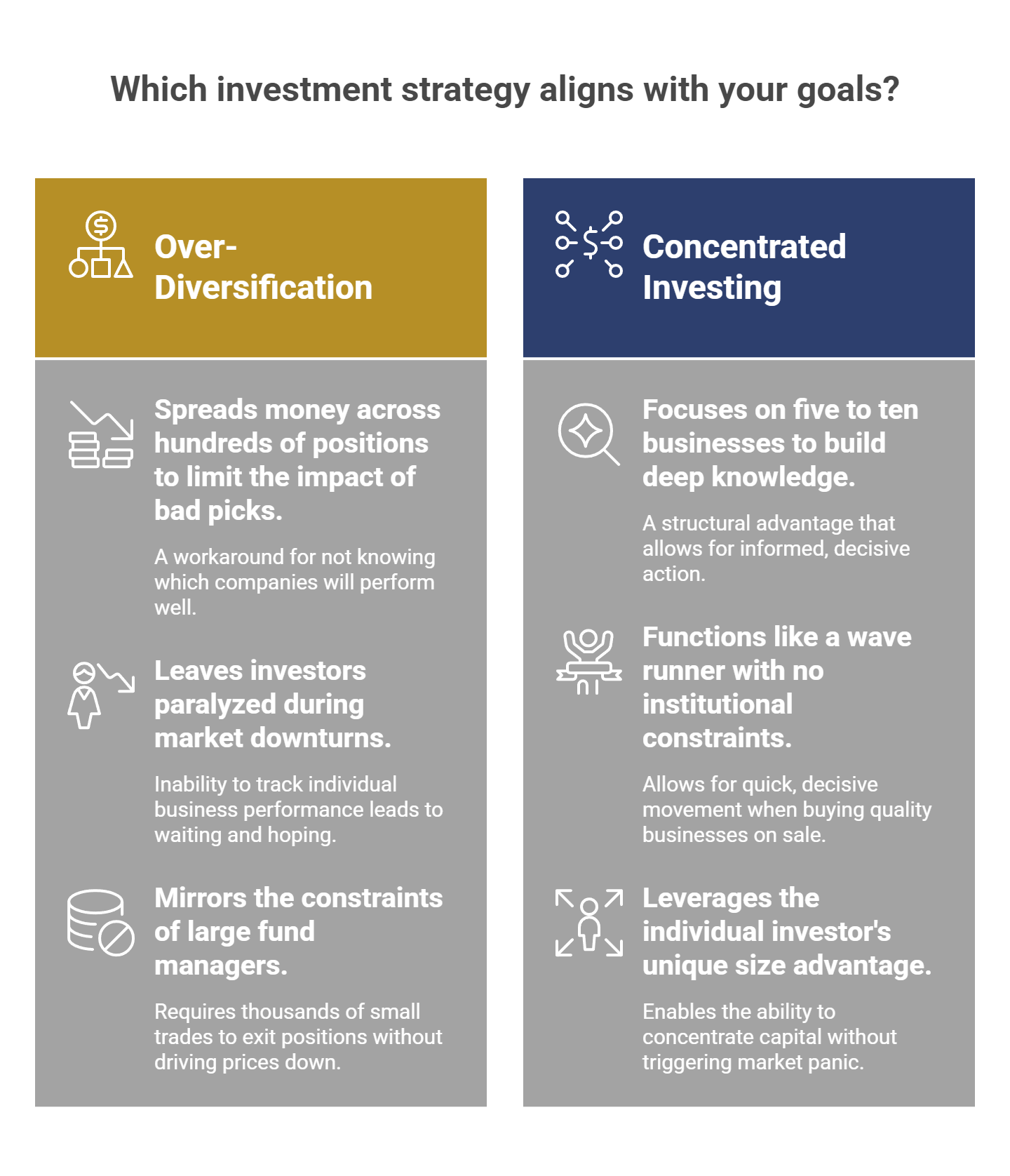
The conventional case for diversification is not crazy. If you have no idea which companies will do well, spreading your money limits how much any one bad pick can hurt you. Most financial advisors call this smart risk management.
The problem is the assumption underneath: that you cannot actually know which companies will perform well. Over-diversification is a workaround for not knowing. Knowing more is the answer. That is what Rule #1 is built to help you do.
Your Edge Over Every Institution on Wall Street
Large fund managers cannot do what you can do. When you are managing billions of dollars, you cannot concentrate your money in five or ten businesses. Think of them as cruise ships: enormous, powerful, and almost impossible to turn quickly.
If a big fund needs to exit a position, it has to do it in thousands of small trades over days or weeks. Move too fast and other managers notice the selling, panic, and drive the price down. That is the trap that institutional investors and financial advisors operate in every single day.
You are a wave runner. You face none of those constraints.
Why a Down Market Is an Opportunity, Not a Threat
Find companies that match your values, and wait patiently to buy them on sale. During the 2008 financial crisis, when markets were in freefall, Warren Buffett was asked, "Aren't you upset the market is going down?" He replied, "No, I want to buy more as it goes down."
When you know what you own and you know you have a good business, a down market is a wonderful time to invest.
Why Over-Diversification Leaves You Paralyzed
A down market is a nightmare for over-diversified investors. When your money is spread across hundreds of positions, you cannot track what is happening inside each business. Without that knowledge, you cannot act. You wait, and you hope.
Concentrated investing is not recklessness. It is the result of knowing your businesses deeply. Any investor can build that knowledge, one company at a time.
2. Know the Value of the Business
Professionals tell you to diversify to protect yourself from risk.
Risk Comes From Not Knowing the Value of a Business
Imagine yourself driving your car to work. You know you'll get to work safely, you've done this a million times. Now imagine driving the same route, in the same vehicle, except a 12-year-old is behind the wheel. You probably won't make it into work today.
The car did not change. The route did not change. The only variable was knowledge. Investing works exactly the same way.
This is not just Buffett's approach. Charlie Munger kept a similarly concentrated portfolio, at times holding as few as three to four positions. His view was simple: putting capital into your 100th best idea instead of your best idea does not make sense.
Mohnish Pabrai runs his fund the same way, often fewer than ten positions. That level of concentration forces the kind of deep research that actually protects you.
I have lived this myself. I started with $1,000 and a framework I learned from a mentor. I focused on one business at a time.
That is the approach that changed everything for me. It can do the same for you.
The Four M's: How to Know What You Own
I have a specific framework I use to evaluate every business I consider buying. I call it the Four M's. It is the difference between investing with conviction and guessing with money.
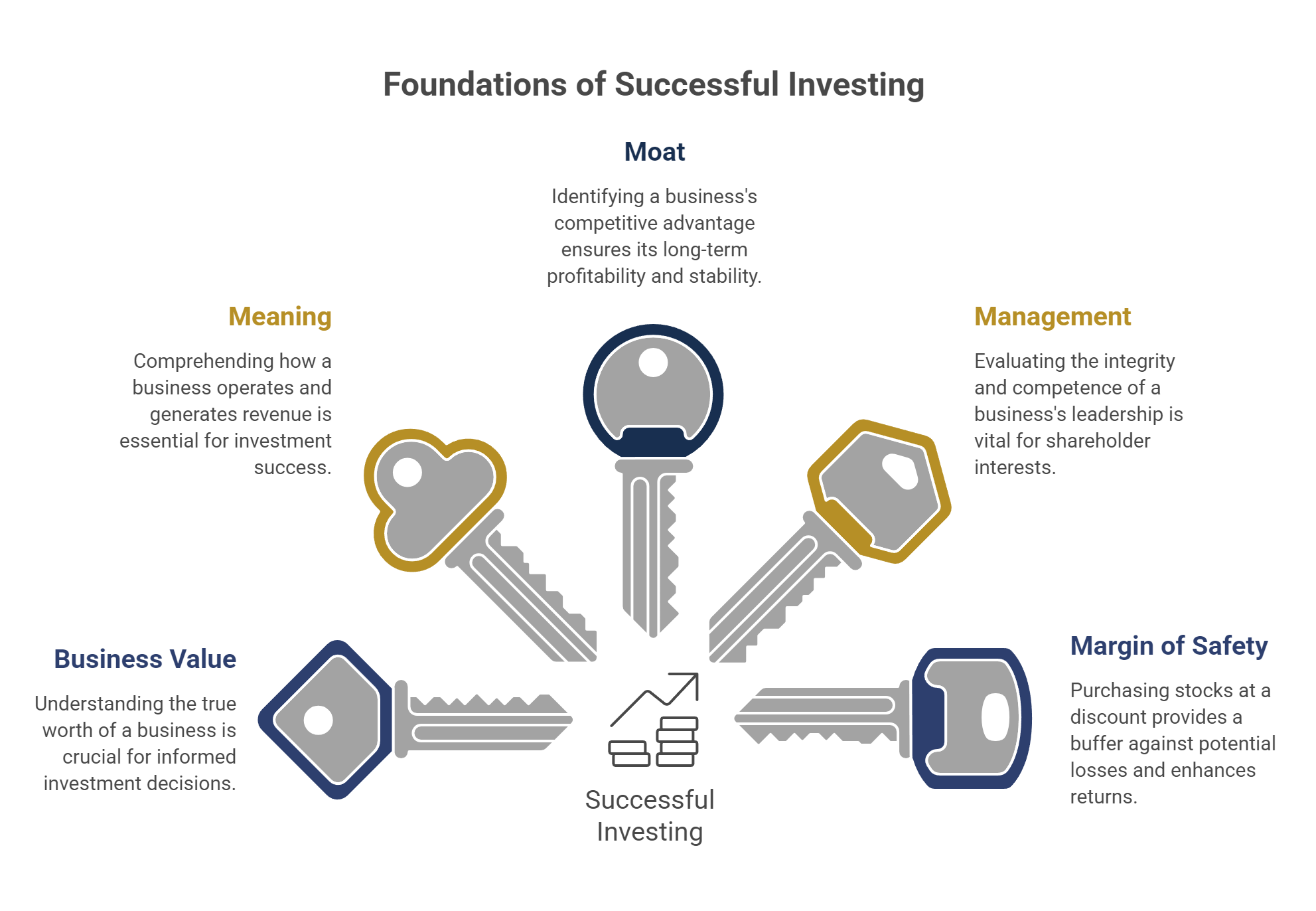
Meaning: Do you actually understand this business? Can you explain how it makes money, what drives its growth, and what could hurt it? If a business falls outside your Circle of Competence (the industries and businesses you genuinely understand), the numbers do not matter.
Moat: Does the business have a durable competitive advantage that protects it from competitors, like a moat around a castle? A strong moat means the business can defend its profits for decades. Without one, any success it has today is temporary.
Management: Are the people running this business honest, capable, and acting in the interest of shareholders? Great businesses in the wrong hands do not stay great for long.
Margin of Safety: Is the stock available at a price that gives you a cushion if you turn out to be even a little bit wrong? If you know what a business is worth, you know when it is on sale. That knowledge is what makes this question answerable.
When you can answer all four questions with confidence, you are not speculating. You are investing. The Four M's give you a repeatable process where most investors are guessing.
Think about what over-diversification actually produces. When your money is spread across hundreds of stocks, you cannot answer those four questions for most of them. You do not know the business, the moat, the management, or whether you are paying a fair price. That is ownership without understanding. And that is where real risk lives.
3. Buy $10 for $5
Buying $10 for $5 is what we're out to do as investors. The nature of the game is buying companies at half price. Do it when rare opportunities come along.
Every business has a real, calculable value. In Rule #1, I have a specific process for finding it:
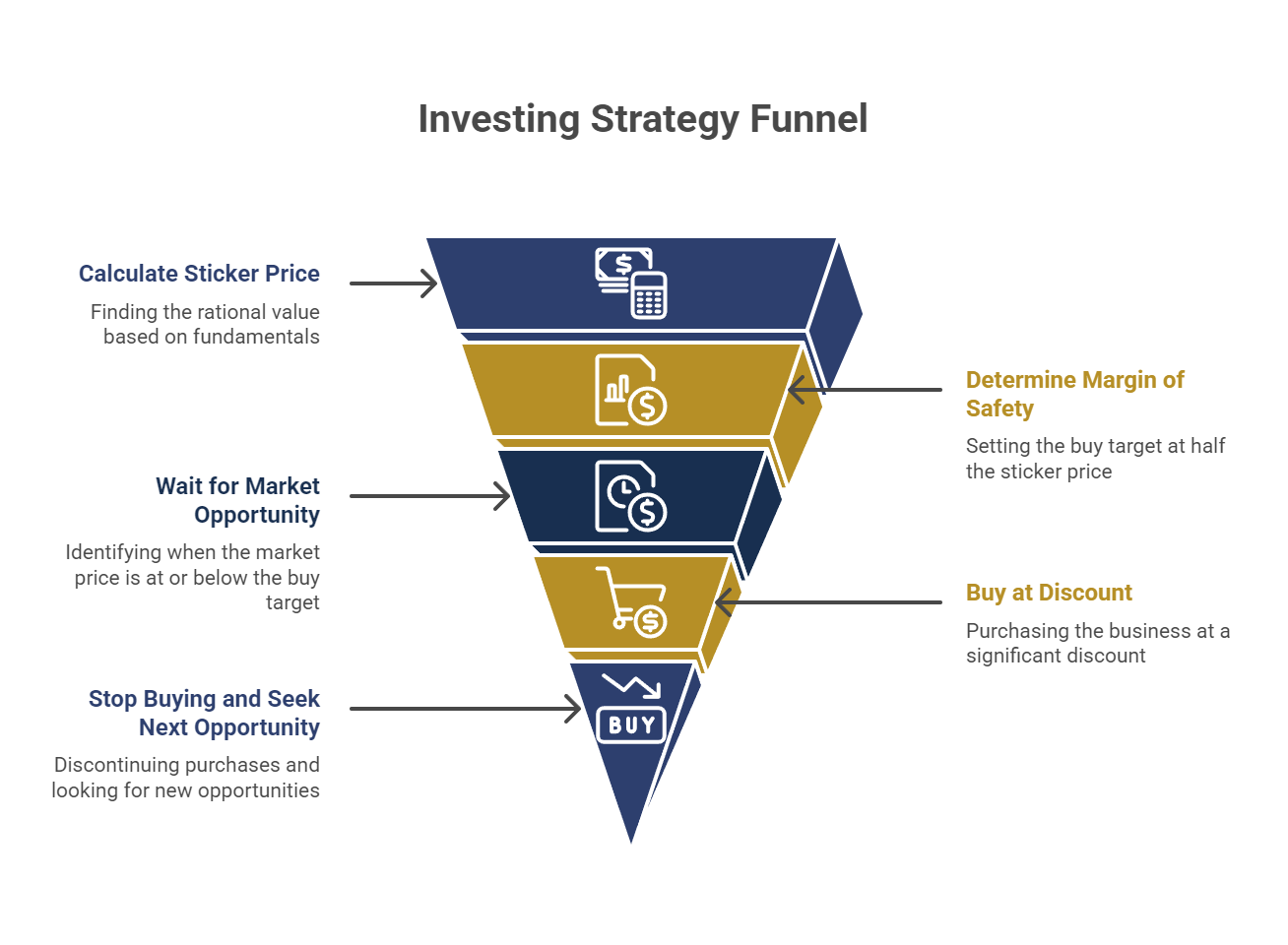
Step 1: Determine the Sticker Price The rational value of the business based on its fundamentals
Step 2: Calculate the Margin of Safety price Half of the Sticker Price. That is your buy target
When the market prices a wonderful business at or below that level, you buy. The gap between what a business is actually worth and what you are paying for it is your real protection. Not investment diversification. Not asset allocation. Price.
When you buy at a significant discount to the Sticker Price, you do not need to be perfect. You just need to be right that the business is good. The price does the rest of the work.
These opportunities do not come along every day, and that is fine. Think of a great hitter at the plate:
He does not swing at every pitch.
He waits for the one he can drive.
He is never penalized for not swinging.
In investing, patience works the same way. Waiting for the right price is not inaction, it is strategy.
When the price rises back toward the Sticker Price, stop buying and look for the next opportunity. Use the Rule #1 Toolbox to calculate the Sticker Price and Margin of Safety for any business you are researching.
4. Let Diversification Happen Naturally
In 20 years, you might own a total of 20 companies as the result of natural diversification. Each one chosen, understood, and bought at a price that made sense. That is how a focused portfolio is built.
That is a very different thing from buying 400 stocks on day one and hoping they average out. This kind of diversification is earned, not assembled. Every business in the portfolio passed the Four M's. Every one was bought with a Margin of Safety.
Think about what Berkshire Hathaway actually represents. It is not a random collection of assets spread across industries for the sake of it. It is the accumulated result of decades of focused, disciplined acquisitions in businesses Buffett understood deeply.
Each holding is chosen with conviction. Each one held with patience. That is what a well-built, naturally diversified investment portfolio looks like in practice.
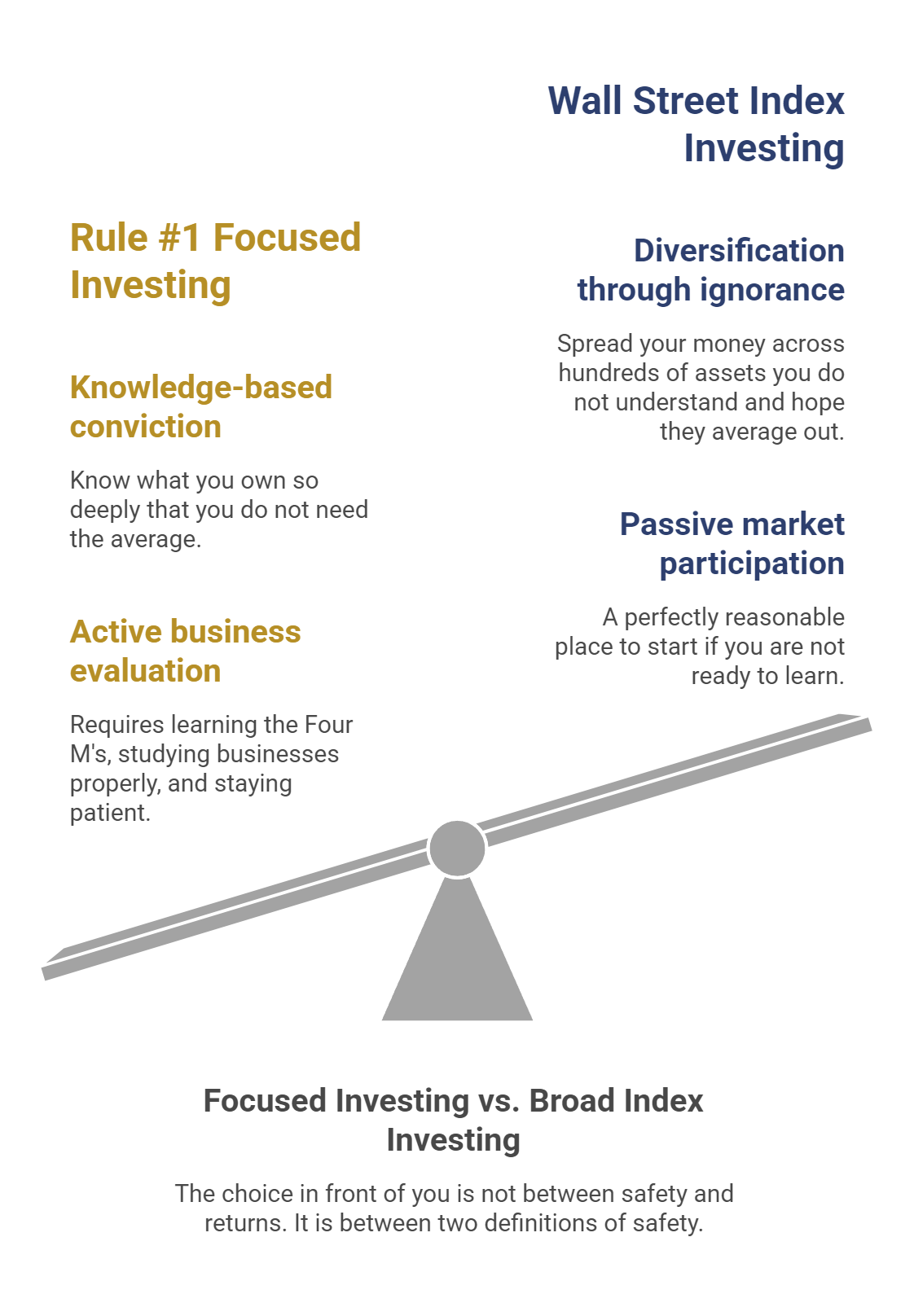
The choice in front of you is not between safety and returns. It is between two definitions of safety:
Wall Street's version: spread your money across hundreds of assets you do not understand and hope they average out.
Rule #1's version: know what you own so deeply that you do not need the average.
One of those definitions requires ignorance. The other requires knowledge. And knowledge is something any investor can build.
Now, I want to be honest with you. This approach takes real work. You have to be willing to learn the Four M's, study businesses properly, and stay patient when the market is not cooperating. If that does not sound like you right now, a broad index fund is a perfectly reasonable place to start.
But if you are ready to learn how to evaluate a business and buy it at the right price, then focused investing is not just for professional money managers. It is for you. A good place to start is building your investment plan around these principles.
Take the Next Step
Everything covered in this article is a system you can learn and apply to real businesses. Understanding the principles is a start.
Being able to use them with confidence on an actual company is the goal.
That is exactly what the Virtual Investing Workshop is designed to do. Over three days, my coaches and I work through the entire Rule #1 process with you live.
You research real companies, practice in small group Zoom sessions, and walk away with a watchlist of businesses you have actually evaluated yourself.

About Phil Town
Phil Town is an investment advisor, hedge fund manager, 3x NY Times Best-Selling Author, ex-Grand Canyon river guide, and former Lieutenant in the US Army Special Forces.
He and his wife, Melissa, share a passion for horses, polo, and eventing. Phil's goal is to help you learn how to invest and achieve financial independence.
Get Phil's Free Guide