










Viral Finance Advice: What Phil Town Says to Avoid
 Phil Town
 I'm not much of a social media guy, but I went and watched the popular finance videos making the rounds. A lot of it worried me.
I've been investing the Buffett way for 40 years, and I've been a fund manager since 1982. I didn't start there. I started out broke, working as a $4,000-a-year river guide in the Grand Canyon, with no idea how I'd dig my way out.
The secret was never being the smartest in the room. It's avoiding the obvious mistakes, and right now those mistakes are going viral.

Why Social Media Is a Risky Place to Learn to Invest
The feed rewards whoever is loudest and most certain, not whoever is right. Newcomers have no filter for the difference, and that's a serious problem. A lot of these clips get passed around as how to invest for beginners, but the last place you want that education is a 60-second video with 2 million likes.
The most viral finance content works because it feels exciting and urgent. It's designed to make you feel like you're missing something. What it rarely tells you is why the trade could blow up, what the underlying business is actually worth, or who ends up holding the bag.
I watched a stack of these videos so you don't have to. Let me walk you through what I saw, and what's actually going on.
The Most Common Investing Mistakes I See
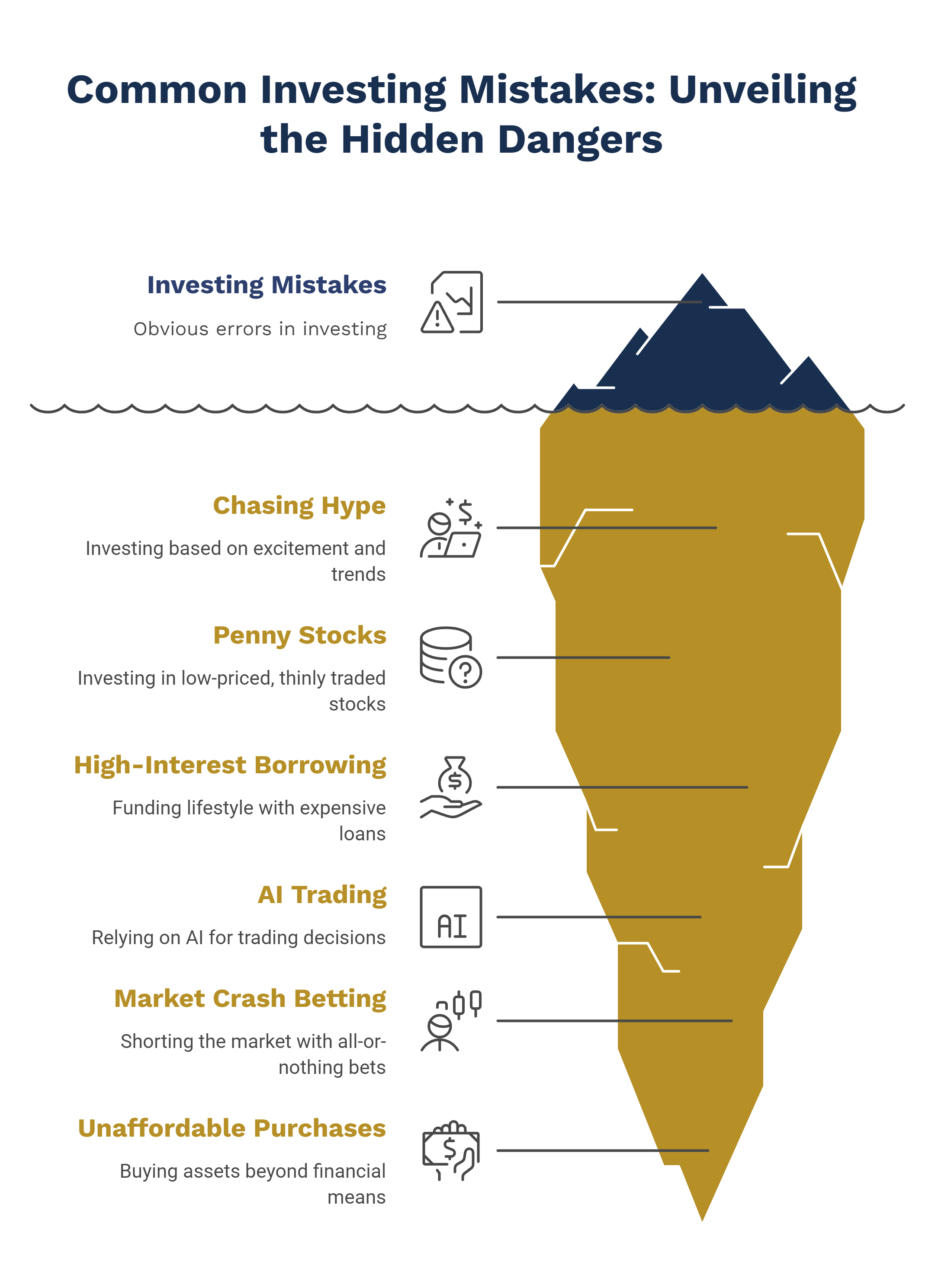
Here are the common investing mistakes to avoid that I keep seeing on repeat. Every one of them sounds reasonable on the surface, which is exactly what makes them dangerous.
Chasing Hype and "Easy Money"
I watched a clip where a creator was literally shaking with excitement. She told viewers that the average person can make millions right now by investing in AI and tech stocks. The pitch was this: read for 15 minutes, put in $5,000, watch it become $220,000.
I have no idea what she's talking about.
The stock market does misprice things when emotions run hot. That's real. But what she's missing is that a lot of very smart people have already looked at AI and tech companies and bid them up to the moon. The kind of video she's making is exactly what I'd expect to see right before a sector drops hard. That's not a hidden bargain. That's a warning sign.
Buying Penny Stocks
A friend and I once put roughly $20,000 into a penny stock at about 25 cents a share. The thing went up to $125. Sounds great, right? It wasn't. By the time we tried to get our money out, the stock had collapsed back to 10 cents.
Here's the problem with penny stocks, and it's structural: they're very thinly traded. It might take months to build a $50,000 position without changing the price at all. That means you're driving the price up yourself just by buying. Then when you try to sell, you crash it on the way out. The gain you saw on paper was never real money you could actually access.
I've seen plenty of people tell stories about huge returns on penny stocks. But they almost never mention what happened when they tried to get out. If you want to understand this more, I put together a full video on exactly why penny stocks are a bad investment for retail investors.
Borrowing at High Interest to Fund a Lifestyle
There's another clip from a guy whose lender offered to let him skip three car payments if he refinanced at 18% interest. He was excited. His plan was to use the freed-up cash for new speakers, rims, and a light bar for his truck.
"He is the exact opposite of what you want to be thinking."
Here's the math. That's the Rule of 72: divide 72 by the interest rate, and you get the number of years it takes to double. Seventy-two divided by 18 is four. So borrowing at 18% to buy speakers and rims means the money you owe doubles in about four years. That's compounding working against you instead of for you. He wasn't getting ahead. He was falling behind faster.
Don't pay 18% to get rims. That's not a path to wealth.
Letting an AI Tool Trade for You
At a convention, a group of high school students showed off a tool they were using. They'd screenshot a chart, feed it into an AI analyzer, and the AI would tell them whether to buy. They were stoked. They were going to make some money right now.
Here's the thing: I've known people who made money day trading with charting tools for three years before losing it all. "They always blow up. They always do."
AI analyzing chart patterns is still just charting. It has no idea what the underlying business is actually worth. It has no understanding of whether the company has a durable competitive advantage, and no way to tell you whether you're buying at a fair price or an insane one. The chances of it lasting? Approaching zero.
Betting the Whole Market Will Crash
One investor I came across has been shorting the market since May 2022, when the S&P 500 was at 3,900. He believes valuations are extreme and a violent correction is coming. He might be right about the valuations. But the market can be irrational longer than you've money if you're betting against it.
People ask me whether the stock market is overvalued right now, and honestly, parts of it probably are. But the answer is not to make an all-or-nothing bet that everything collapses on your timeline. That's not investing. That's gambling, with your financial future riding on a specific outcome at a specific time.
Buying What You Can't Afford to "Motivate" Yourself
One creator argued that buying a supercar you can't afford is the best financial decision you can make. The idea is that the pressure of the payments pushes you to work harder and earn more. I understand the logic. I even kind of like the spirit of it.
But motivation fades. And one of the things that can make it disappear fast is not being able to make car payments, with repo people knocking on your mom's door. That's not motivation anymore. That's stress. What actually works is discipline. Go get a job, start saving, then buy good assets. That's how you build toward the things you want, and when you finally get there, you'll enjoy them without the threat of losing them hanging over you.
This really comes down to discipline versus motivation. Discipline shows up every day. Motivation is a feeling that comes and goes.
How to Avoid Losing Money: Think Like Charlie Munger
Every one of those mistakes has something in common. They all point toward the same solution: stop asking "how do I make money?" and start asking "what would cause me to lose it?"
That's Charlie Munger's inversion thinking, and it's one of the most important ideas in investing.
Charlie was a really brilliant Caltech graduate before World War II, and his job was to keep pilots from dying in bad weather. Instead of trying to figure out all the conditions that keep pilots safe, he did something smarter. He figured out how to kill the pilots. He looked at weather from that inverted point of view and simply avoided sending them where they couldn't survive.
"Rule number one is don't lose money. If you focus on all the things you could do to cause you to lose money and not do those, you're going to do really, really well. And that's what we teach."
That's how to avoid losing money in stocks. Not by predicting the next hot sector, but by spotting the obvious traps and steering clear of them. Do that, and you've already won half the game.
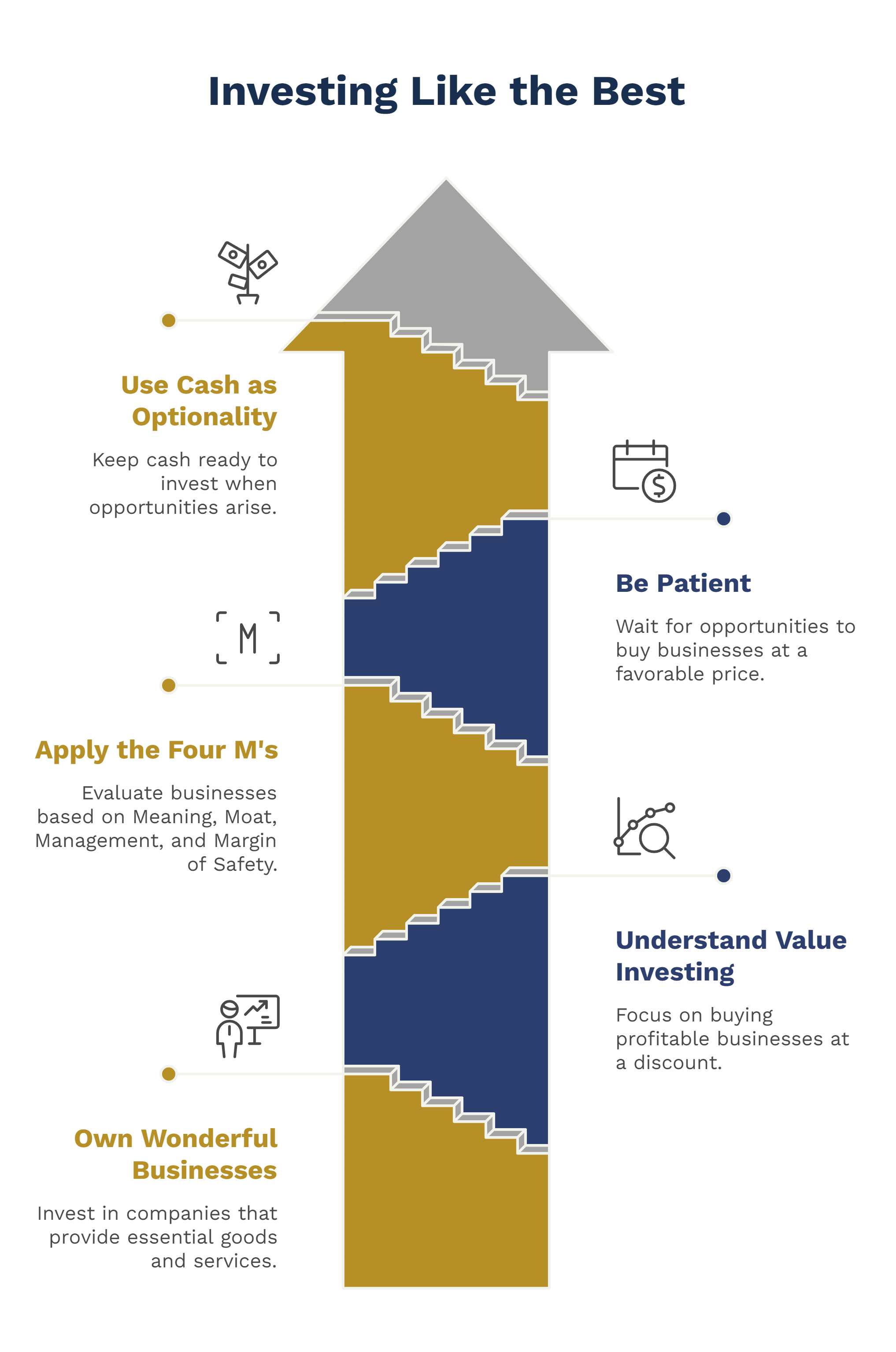
What to Do Instead: Invest Like the Best
Knowing what to avoid is one side of it. Here's the other: what to actually do with your money. If you're just getting started, this beginner's guide to investing will give you the foundation you need before going any further.
Own Wonderful Businesses People Actually Need
I agreed completely with something Buffett said in one of those clips: through wars, recessions, and even currency devaluation, the businesses people actually need just keep on rolling. Even if a currency gets devalued overnight, those businesses keep producing and selling.
Think about Procter and Gamble, which makes things like diapers. People are still going to buy diapers. People are still going to buy a Coke. Those businesses produce real cash flow through every kind of economic turmoil, which is why productive assets beat cash, gold, or speculation over the long run.
This is the core of value investing:
Value investing means buying shares in profitable businesses for less than they're worth, with the goal of holding them long term as they grow. The number a business is actually worth has a few names, but I call it the Sticker Price. Rather than chasing hype or timing the market, value investors focus on owning wonderful, durable companies at a price comfortably below that Sticker Price, which gives them a margin of safety.
For a deeper framework on what makes a business worth owning, start with the Four M's:
Meaning: a business you understand and would be proud to own
Moat: a durable competitive advantage that protects it
Management: leaders who run it like owners
Margin of Safety: buying well below the Sticker Price
Be Patient and Wait for Them to Go on Sale
Rather than bet everything on a collapse, I'd do what Warren has been doing: own a few businesses I really like, hold some cash as dry powder, and wait. No matter how high the market gets, there's always something going on sale.
Cash here isn't a place to hide forever. It's optionality. It lets you move when something you've been watching finally drops to a price that makes sense. Know your price before the opportunity arrives and you won't make emotional decisions under pressure.
That's what a margin of safety calculator is built for: knowing your Sticker Price before you need to act.
Find a Real Mentor, Not a Guru
The best advice I heard in any of those clips came when someone was asked: if you had one message to leave with the younger generation, what would it be? The answer was to find a great mentor. Find a real person who has actually done it.
"There's nobody better in the world to follow than Warren Buffett. This guy has a 70-year track record."
Buffett recently started to retire, and his longtime partner Charlie Munger has passed. But everything they thought about and built is still out there, for free. Read Buffett's shareholder letters from the last 50 to 60 years. Read books about Charlie Munger's wisdom. That's a complete investing education sitting in front of you, and it costs nothing.
That's how to invest like Warren Buffett: not by mimicking his specific trades, but by absorbing his framework for thinking about businesses. I've been a student of that approach my entire career, and it's the same thing we teach at Rule #1.
Ready to Learn This the Right Way?
You've just seen what's out there. That's what's passing for investing advice right now. If anything, all that noise makes a disciplined method worth more, not less.
The mistakes I walked through aren't rare. They're the default. And the antidote isn't complicated. It's learning to evaluate businesses the way Buffett and Munger have for decades, and applying those principles with patience.
If you want to work through this with live coaches in real time, I'd love for you to join one of our Virtual Investing Workshops. We've had over 25,000 people go through it, and we built it for people who are tired of noise and ready to learn something that actually works.
Find the details and sign up at the Virtual Investing Workshop.
Now go play.
Rule One Investing provides investment education and training only. We don't provide personalized investment advice, manage client assets, or guarantee investment returns. All content is for informational purposes. Consult a qualified financial professional before investing. Past performance does not guarantee future results. Individual results vary.

About Phil Town
Phil Town is an investment advisor, hedge fund manager, 3x NY Times Best-Selling Author, ex-Grand Canyon river guide, and former Lieutenant in the US Army Special Forces.
He and his wife, Melissa, share a passion for horses, polo, and eventing. Phil's goal is to help you learn how to invest and achieve financial independence.
Get Phil's Free Guide