










The Investing Checklist Step Most Investors Skip (And Why It Matters)
 Phil Town
 In This Article
- Here are three reasons why you should listen to this episode:
- Resources
- Why Most Investing Checklists Fall Short
- The RULES Framework: A Complete Value Investing Strategy
- The Hardest Step: Story Inversion
- The Four-Point Inversion Checklist
- How Chipotle Proves the System Works
- The Certainty Standard: How Confident Should You Be?
- The Checklist Is Gospel
- Danielle Town: Attorney, Author & Investing Advocate
- Stop Building the Case. Start Breaking It.
- Ready to practice Story Inversion on a real company?
You've done the research. You've studied the business, checked the numbers, and built a solid case. By this point, you're confident this is the right company. Most investors stop right there. But in my Rule #1 process, that moment of confidence is actually where the most important work begins.
In this episode of my InvestED Podcast, Danielle and I continue our step-by-step walkthrough the RULES checklist, the complete framework I use to identify wonderful businesses at the right price. We've already covered Radar, Understand, Love, and Event.
Now we're at the final step: Story Inversion. It's the step that asks you to take everything you've just concluded about a company and challenge it. This isn't just another box on the list. It's the hardest one, and it's the most important one.
Tune in to learn why the moment you feel most certain about a company is exactly when you need to question everything you've built.
Here are three reasons why you should listen to this episode:
Learn the one step in the Rule #1 investing checklist that most investors skip, and why skipping it is exactly how good investors make expensive mistakes.
Discover how Charlie Munger's "invert, always invert" principle applies to a real stock analysis decision, with a real case study showing exactly how it works.
Understand the certainty standard that separates disciplined investors from emotional ones, and how to know whether your conviction is strong enough to act.
Resources
Rule #1's "InvestED" Podcast and Website: Website | Apple Podcast | YouTube
Visit Rule #1 for more investing resources: Website | Facebook | LinkedIn | X (Twitter) | Instagram
Danielle Town: Website | LinkedIn | Instagram | Facebook | YouTube |X (Twitter)
Why Most Investing Checklists Fall Short
Most investing checklists teach you how to build a case. They walk you through the numbers, the business quality, the management team, the competitive advantages. And that's genuinely useful. A good checklist gets you a long way toward making a smarter decision.
But here's what most checklists don't account for. By the time you've finished your research, you're not a neutral observer anymore. You've put in the hours. You've built the story. And somewhere in that process, without realizing it, you've started rooting for this company to be the right one. That's confirmation bias. It doesn't arrive before you start your research. It grows during it, and it's strongest right at the moment you feel most ready to act.
That's the gap I want to talk about. Most checklists stop exactly where the hardest work actually begins. And in my experience, what you do at that moment makes all the difference.
The RULES Framework: A Complete Value Investing Strategy
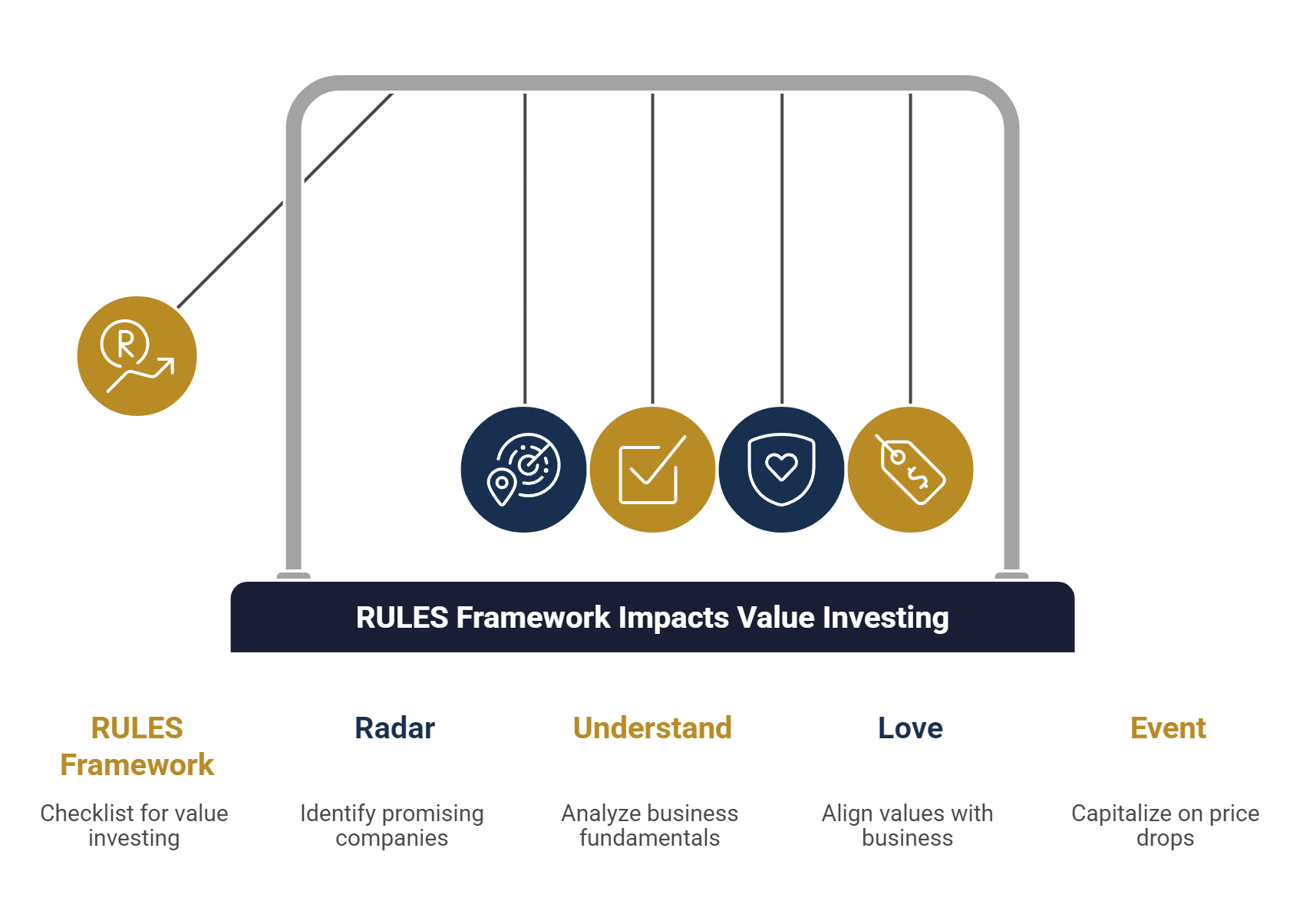
The Rule #1 investing process is built around a checklist I call RULES. Each letter represents a step in the analysis, and together they help you determine whether a business is worth owning and whether the price is right.
R — Radar. Know where you found a company and why it caught your attention.
U — Understand. This is where the Four M's live: Meaning, Moat, Management, and Margin of Safety. It's the core of the business analysis.
L — Love. Ask whether this company's values align with yours. Do you feel good about what this business does and how it operates in the world?
E — Event. A temporary catalyst has pushed the stock price down significantly, creating the opportunity to buy a wonderful business at a discount.
By the time you've worked through R, U, L, and E, you've built a powerful story. Great moat. Trustworthy management. A business you understand and believe in, available at a price that makes sense. You'd be happy to own it for life.
That's exactly when S kicks in. But before we get there, if you want to build a real foundation in this process, start with my free Rule #1 investing course. It covers how I analyze a business step by step, so you're ready to apply every part of this checklist with confidence.
The Hardest Step: Story Inversion
Here is what happens after you finish R, U, L, and E. You don't just have a thesis. You have a conviction. You want to buy this company today. And the last thing you want to do is find reasons not to.
That feeling is confirmation bias. It builds up quietly during the research process, and it peaks right at the moment you feel most ready to act. That is exactly when Story Inversion begins.
This is the hardest step on the checklist. Not because it's complicated, but because it goes against every instinct you've built up. It asks you to flip the story. To take every great reason you found to own this business and challenge it. To look for the reasons you might be wrong before you put your money in.
The foundation of this step comes from Charlie Munger. He said it plainly: "Invert, always invert." The best way to solve a hard problem is to turn it around. In investing, that means you stop asking why this company is great and start asking what would have to be true for everything you've concluded to be completely wrong.
That question is what Story Inversion is built on.
The Four-Point Inversion Checklist
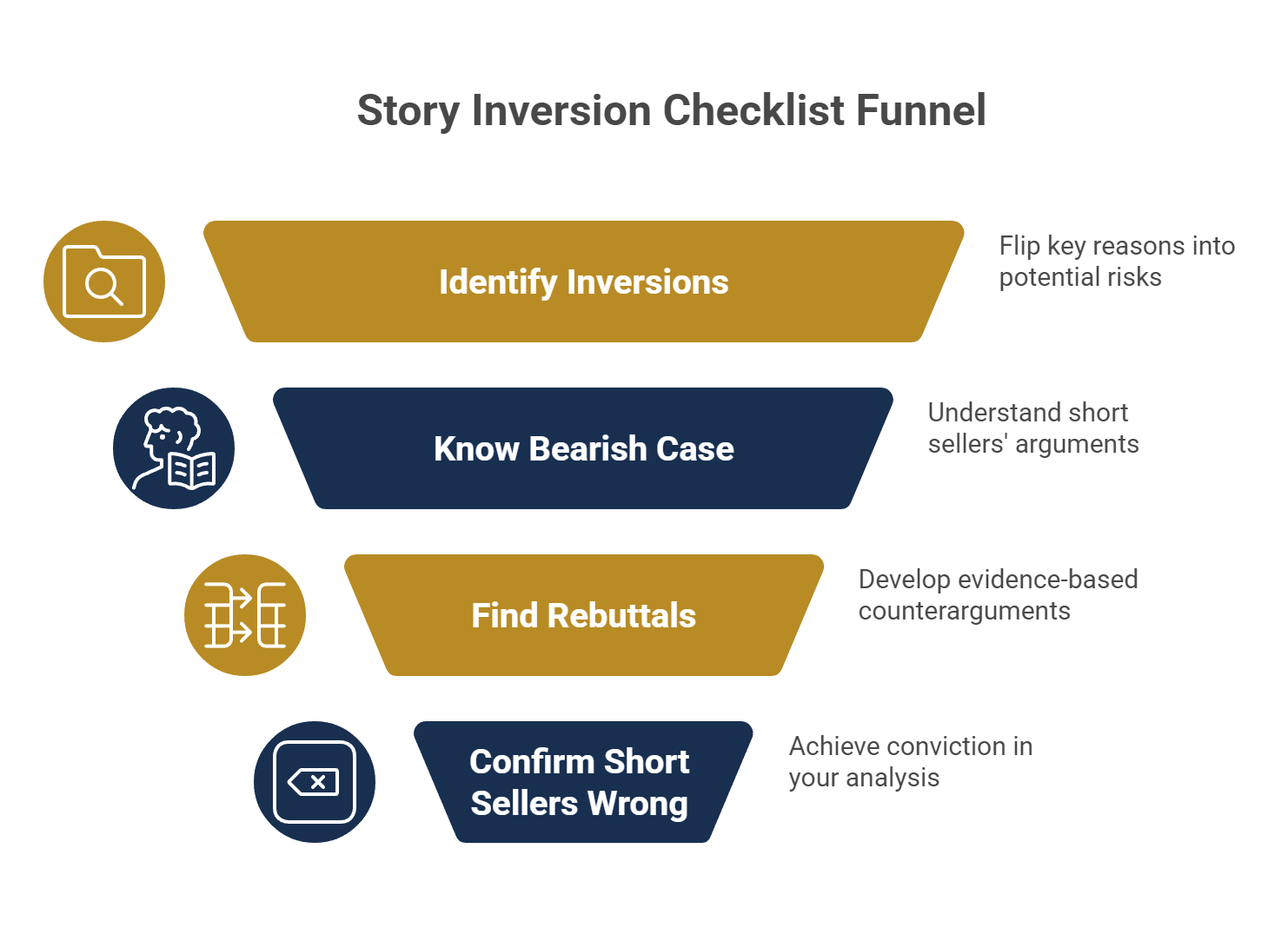
So what does Story Inversion actually look like in practice? It comes down to four checklist points. Work through them in order, and be honest with yourself at every step.
1. Identify a Serious Inversion for Every Key Reason to Own the Business
Take the top three reasons you found during RULE and flip each one. If the moat is a great reason to own the business, the inversion is: the moat is broken. If great management is a reason to own it, the inversion is: management is corrupt or incompetent. Simple as that. You're not imagining unlikely disasters. You're directly challenging the strongest parts of your own case.
2. Know Every Reason Not to Buy Better Than the Short Sellers
This is where the research gets serious. Go find what the short sellers are publishing. Read the bearish case. Make sure every argument they're making is already on your list. If they're using a reason you haven't considered, add it. By the time you're done, you should know the case against this company at least as well as the people who are betting it fails.
3. For Every Inversion, Find a Solid Rebuttal That Erases It
This is not a gray area exercise. A rebuttal is not "I think they're probably wrong" or "I hope this works out." A rebuttal is a specific, evidence-based argument that definitively defeats the inversion. If you can't find one, that's important information. It means you're not ready to invest.
4. The Short Sellers Are Wrong. Not Maybe Wrong. Definitively Wrong.
Charlie Munger put it this way: "I'm right, and you are smart, and pretty soon you'll realize I'm right." That's the level of conviction this step requires. Not arrogance, but genuine, evidence-backed certainty. If you find yourself thinking the short sellers might have a point, listen to that. It's telling you something.
If you want to practice working through this checklist on a real company, my Rule #1 Virtual Investing Workshop is the place to do it. You get live coaching, hands-on analysis, and the tools to apply every step of the RULES framework with confidence.
How Chipotle Proves the System Works
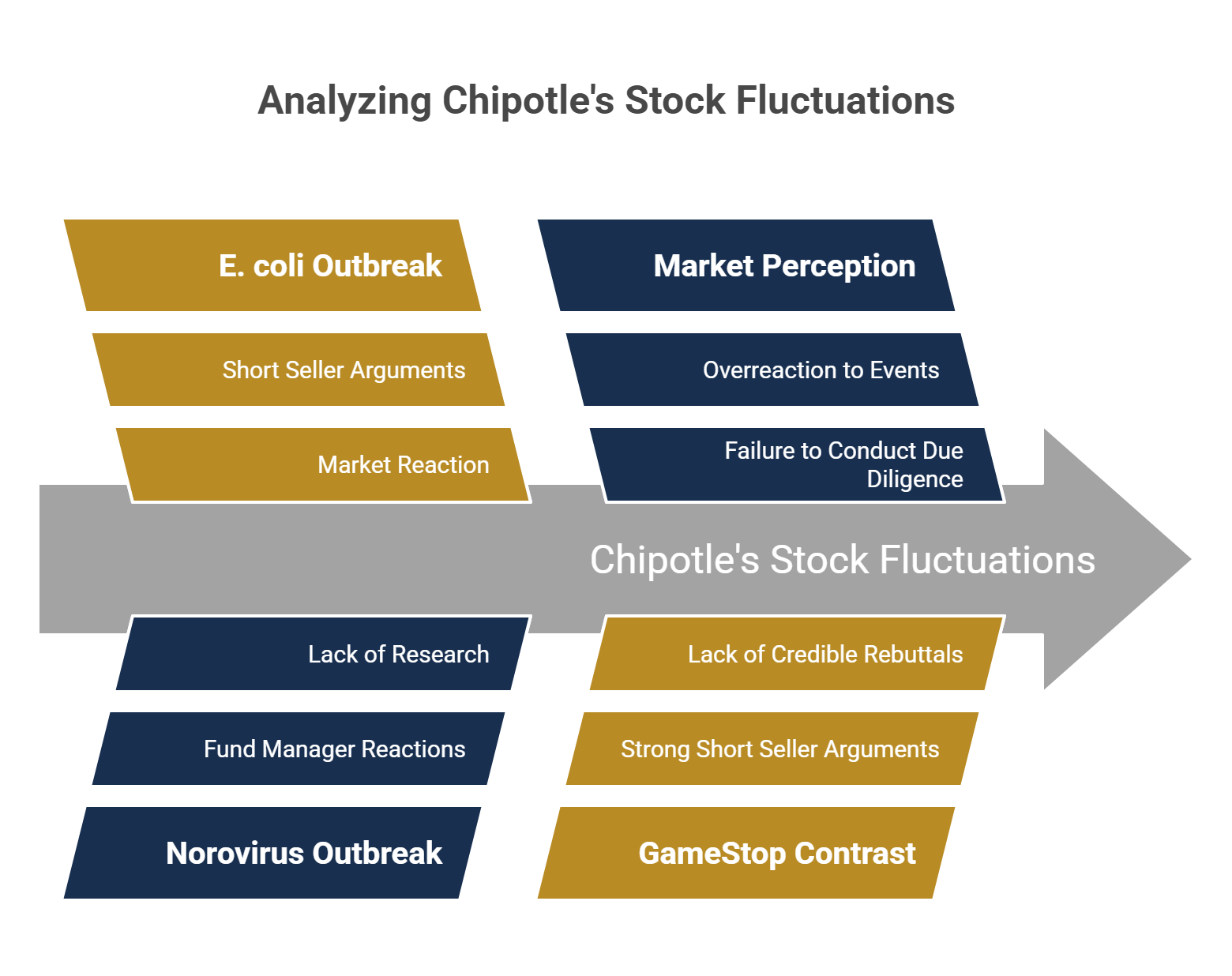
Let me show you what this process looks like with a real example. Chipotle is one of the best case studies I know for Story Inversion, because the inversion was loud, the short sellers were confident, and the rebuttal was clear to anyone willing to look at the evidence.
The Inversion
Chipotle's moat is real and significant. They created a niche that no other company has replicated at scale: organic, natural, gourmet food at a fast food pace and a fast food price. That moat is one of the strongest reasons to own the business. So the inversion is straightforward. The moat is broken. When the E. coli outbreak hit, that is exactly what the short sellers argued. Health food company with a food safety crisis. Damaged brand. Nobody is coming back. The stock dropped from $760 to $250.
The Rebuttal
Here is what a serious rebuttal looks like. Multiple other restaurants have had E. coli outbreaks, and every single one of them recovered. E. coli is not a brand-ending event in the restaurant industry. It is a fixable operational problem. The moat was not broken. The brand was not permanently damaged. The short sellers were not maybe wrong. They were definitively wrong, and anyone who did the research could see that at the time.
When the Market Got It Wrong Again
The stock began recovering and climbed back toward $500. Then it dropped again to $250 when norovirus showed up in a couple of restaurants. Here is the thing about norovirus: it is completely different from E. coli. You can pick up norovirus from a doorknob. It has nothing to do with food safety systems or operational failures. And yet fund managers, people who are supposed to know better, sold off the stock anyway. They never did the work. They just reacted.
The GameStop Contrast
GameStop tells the other side of this story. The short sellers argued that the moat was broken, that physical game retail was dying with the rise of cloud gaming, and that the business had no credible path forward. Those were strong arguments. When investors went looking for solid rebuttals, they could not find them. That is the checklist doing its job. When the inversions are right and the rebuttals do not hold up, the answer is simple: do not invest.
The Certainty Standard: How Confident Should You Be?
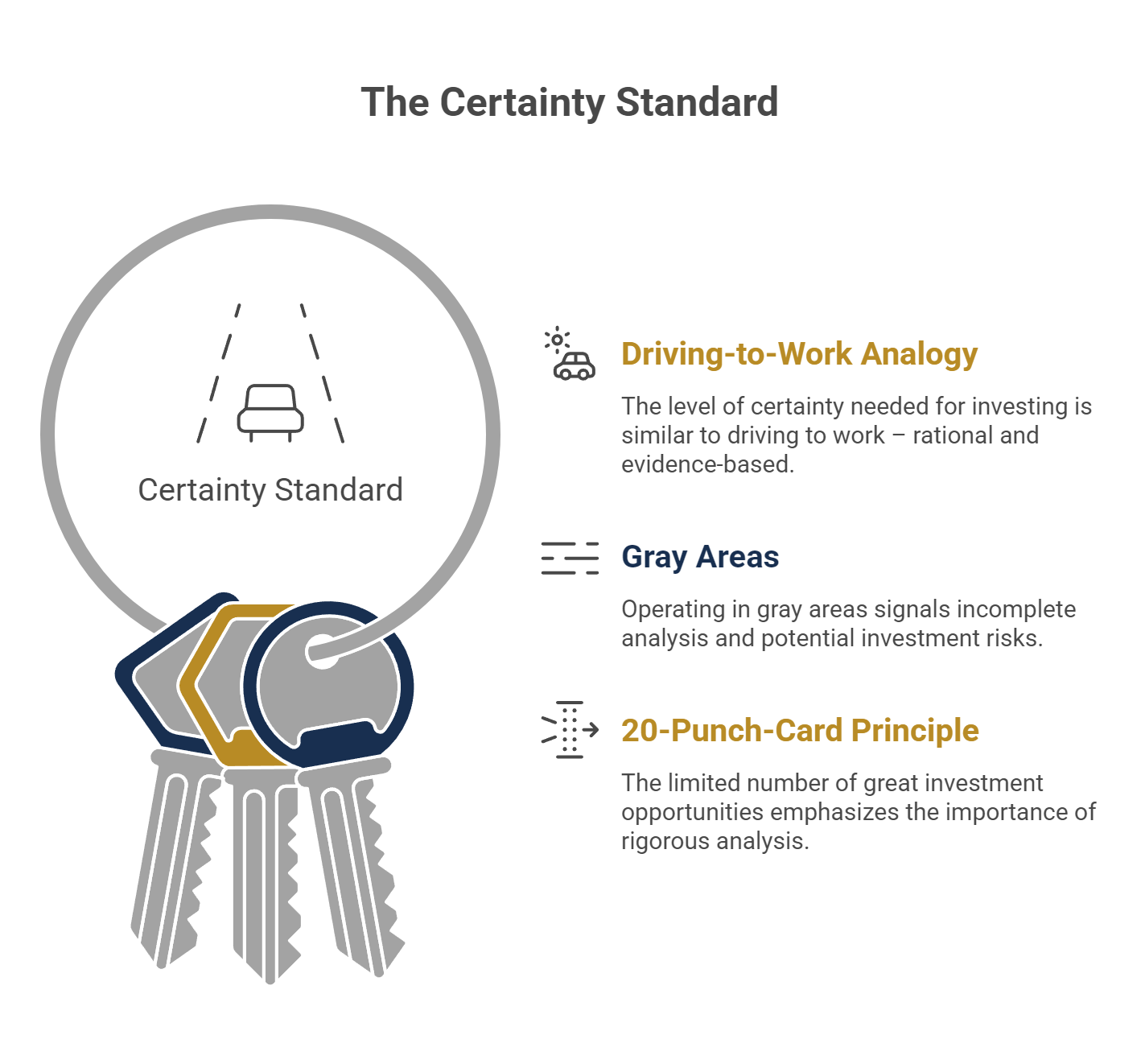
One of the questions Danielle comes back to is a fair one. What does certain enough actually mean? How high does the bar need to be?
The Driving-to-Work Analogy
My answer is this. The level of certainty you need to invest is the same level of certainty you have when you get in your car and drive to work. You are not thinking about lightning strikes. You are not writing your will before you leave the driveway.
But you are not guessing either. You have a rational, evidence-based expectation that you are going to get there. That is the standard. Not 100% certainty, but genuine conviction grounded in the facts.
Why Gray Areas Are Dangerous
If your rebuttals leave you in a gray area, that is a signal. It means the inversions have not been fully defeated, and you are not ready to invest in that company. A lot of investors treat this kind of uncertainty as normal, something you just have to accept and move past. I think that is dangerous. The moment you get comfortable operating in a gray area, you stop demanding the level of rigor the process requires.
The 20-Punch-Card Principle
This is where the stakes become clear. Warren Buffett's framework is simple: in a lifetime of investing, you get roughly 20 great companies. Out of hundreds of thousands of public companies that will cross your radar over 30 or 40 years, you are looking for 20.
And according to Buffett, if you get those 20 right, just a handful of them will be enough to build real wealth. Every slot on that card is precious. Sloppy certainty fills your dance card with the wrong companies, and you do not get those slots back.
The Checklist Is Gospel
This checklist was earned through real investing experience, through mistakes, through losses, through years of figuring out what actually works. I treat it as gospel, and I mean that without apology. When I say gospel, I mean you do not reinterpret it. You do not soften a point because it feels too demanding. You do not skip a step because you are not sure what it is asking. You ignore something on this list to your own detriment. If there are parts that are not yet clear to you, make notes, ask questions, keep working at it. But do not change it.
Think about a pilot running through a pre-flight checklist. That checklist is not open to interpretation. It is not a suggestion. The pilot does not decide that a particular step does not apply to them today.
They go down the list, they do each thing, and they move on. That is exactly how I want you to approach this. Use the RULES checklist as it is. Master it first. And if over time you want to add your own extra checkpoints on top of it, based on your own experience and the mistakes you want to make sure you never repeat, go ahead. But do not reinterpret what is already there. The checklist works because it is followed, not because it is personalized.
Expert Advice & Powerful Quotes
"Invert, always invert."
"The level of certainty you should have going into an investment is the same level of certainty you have driving your car to work."
"This checklist was earned with blood and tears. And you ignore something on this list to your own detriment."
"Everyone who's selling it off and everyone who's shorting it are all wrong. They're all wrong. Not, I hope they're wrong. Or maybe they're wrong, but they're wrong."
"You have to be rigorous and recognize that there's a level of certainty that you need to achieve."
Danielle Town: Attorney, Author & Investing Advocate
Danielle Town is a best-selling author, attorney, and passionate advocate for empowering new investors. She has a background in law and a deep curiosity about financial independence. Danielle is dedicated to demystifying investing for anyone seeking financial control. She co-authored Invested, sharing her journey learning value investing with her father, Phil Town. Danielle believes anyone can build confidence in investing by focusing on clarity, patience, and wisdom.
Through her writing, podcasting, and teaching, Danielle helps others cut through the noise of the market. She guides people in developing sound investing habits that last. Her approach encourages aligning money choices with personal values and long-term goals. Danielle shows that investing is a lifelong practice, built on steady learning and self-awareness. She inspires anyone to take the first step and make smart, values-driven decisions.
Expertise: Value Investing · Financial Education · Personal Finance · Mindful Money Management Danielle Town: Website | LinkedIn | Instagram | Facebook | YouTube | X (Twitter)
Stop Building the Case. Start Breaking It.
Most investors do the hard work of building a case for a company and then stop right there. But the Rule #1 RULES checklist goes one step further. It demands that you challenge everything you've concluded before you commit your capital. Story Inversion is not optional. It is the step that separates disciplined investors from those who let conviction become overconfidence.
Listen to the Full Episode — Danielle and I walk through the final and most demanding step of the RULES checklist: Story Inversion. I break down the four-point inversion framework, explain what a solid rebuttal actually looks like, and use the Chipotle E. coli case study to show exactly how the process works in a real investing decision.
Reflect on Your Own Process — Think about the last company you researched. Did you build an inversion for every key reason you found to own it? Did you go find what the short sellers were saying and make sure you could answer every argument they made? And when you were done, could you say with genuine conviction that they were wrong? Not probably wrong, not hopefully wrong, but definitively wrong? If you are not sure, this conversation is worth coming back to.
Explore More Visit Rule #1 for more conversations and resources on building your investing discipline. Discover workshops, tools, and stories that support your journey to becoming a mindful and successful Rule #1 investor.
The checklist works when you follow it completely. Every step. No exceptions. Be rigorous, and hold yourself to the level of certainty this process demands. That is the Rule #1 way.
Ready to practice Story Inversion on a real company?
Join me at the Rule #1 Virtual Investing Workshop. You will get hands-on experience, live coaching, and the tools to work through every step of the RULES checklist with confidence.

About Phil Town
Phil Town is an investment advisor, hedge fund manager, 3x NY Times Best-Selling Author, ex-Grand Canyon river guide, and former Lieutenant in the US Army Special Forces.
He and his wife, Melissa, share a passion for horses, polo, and eventing. Phil's goal is to help you learn how to invest and achieve financial independence.
Get Phil's Free Guide