













How to Create a Personalized Investment Plan in 6 Steps (Even If You're a Beginner!)
 Phil Town
 In This Article
- Why Every Investor Needs an Investment Plan
- How to Create a Personalized Investment Plan
- Step 1: Evaluate Your Current Financial Standing
- Step 2: Define What You Want to Accomplish
- Step 3: Determine How Much Risk You Can Actually Handle
- Step 4: Decide What to Invest In (This Is Where Most Plans Go Wrong)
- Step 5: Establish Your Timeline
- Step 6: Monitor Your Investments the Rule #1 Way
- Bonus Step: Keep Learning (And Put What You Know Into Practice)
- Take Action Today
Creating a personalized investment plan is one of the most important steps you can take toward long-term financial security. Most plans, though, start in the wrong place.
Warren Buffett once said, "An idiot with a plan can beat a genius without a plan."
That quote only works if the plan starts with the right principle. Buffett has two rules: Rule #1, don't lose money. Rule #2, don't forget Rule #1. That is the foundation every investment decision should rest on, including how you build your plan.
Most investment plans skip right past that. They jump straight to asset allocation, account types, and which funds to pick. And they leave out the most important question: is this business actually worth owning?
That is what this guide is about. A real, personalized investment plan built around wonderful businesses, bought at the right price. It is a learnable system. These six steps will walk you through it.
Why Every Investor Needs an Investment Plan
If you have never clearly defined your reason for investing, now is the time. Do you want financial freedom, retirement security, or generational wealth? That answer shapes everything else in your plan.
If you are reading this, feeling like you have started too late or do not know enough to get this right, I have been exactly where you are. I was a Grand Canyon river guide making $4,000 a year when a mentor sat me down and taught me the Rule #1 system. I started with $1,000. That was enough.
Investing is not a talent you are born with. It is a skill anyone can learn. These six steps will show you how.
How to Create a Personalized Investment Plan
Most investment plans start with logistics: which accounts to open, how to divide money across asset classes, when to rebalance.
A Rule #1 personalized investment plan starts with a more important question: is this business worth owning? That means asking:
Does it have a durable competitive advantage?
Is it run by trustworthy, owner-oriented management?
Is the price low enough relative to its true value to make it a safe purchase?
Those answers are different for every investor, because they depend on what you understand. That is what makes the plan personal. Here is how to create an investment plan built around what you understand.
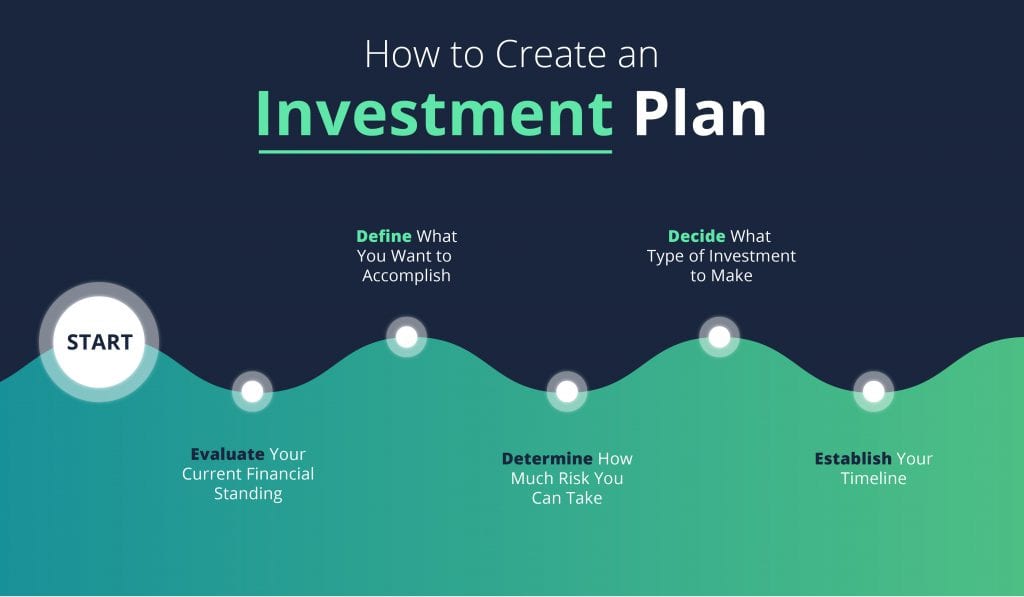
Step 1: Evaluate Your Current Financial Standing
First, assess your financial situation:
Your income and monthly expenses
Any outstanding debts
Your current savings
Your emergency fund
Practical tools like budgeting apps (Mint, YNAB) or spreadsheets can help simplify this.
Here is how I think about this step: Rule #1 is don't lose money. That rule does not start when you pick a stock. It starts right here. Invest before your financial foundation is solid, and you are already taking on risk before the market has anything to do with it. Get your house in order first. Then put your money to work.
When I started investing, my funds were limited, but even small amounts consistently invested can build significant wealth over time. Ideally, you should aim to invest a meaningful portion of your income after covering essential expenses and building a solid emergency fund.
How Much Should a Beginner Invest in the Stock Market?
Ideally, invest as much as possible throughout your life. Even if you can only begin with $500, this amount, invested annually at an average 10% return, can grow to approximately $90,472 in 30 years due to compounding interest.
Most stocks are priced below $500 per share, with many stocks being priced below $100 per share, and today, you can even buy parts of a share of a company's stock.
While the price of a share alone does not tell you how much of a bargain you are getting, the fact that most shares are priced affordably makes it easy for beginner investors to make small investments in the market when they are first starting out.
A few things that make it easier to get started:
Fractional investing through platforms like Fidelity, Robinhood, or Acorns lets you begin with very small amounts.
Most individual stocks are accessible at prices beginners can afford.
Starting small and staying consistent matters more than waiting until you have a large sum.
Commit to investing regularly, no matter the amount, and you'll steadily build wealth.
Step 2: Define What You Want to Accomplish
Clearly define your investment goals. Distinguish between short-term (saving for a home or vacation) and long-term goals (retirement or generational wealth). Consider using a worksheet or checklist to clarify and document these objectives.
Common mistakes include setting unrealistic goals or not accounting for inflation. Avoid these pitfalls by setting achievable, specific, and measurable targets.
Most investment plans never get specific enough to actually work. "Retirement" is a category, not a goal. A real investment goal sounds more like:
I want to stop depending on a paycheck by the time I'm 55
I want my portfolio to cover my mortgage
I want work to be a choice, not a requirement
Think about where you want to be in five years. Be honest about it. Not what sounds responsible on paper. What you actually want. The more specific that picture is, the more clearly you can build your investment plan around it.
Once you have a real goal in mind, the next question becomes: what kind of investing gets you there reliably? That is what the remaining steps in this investment planning guide are designed to help you figure out. And it is worth knowing that you do not need to hand this over to a financial advisor to get it right. With the right framework, you can build this plan yourself.
Step 3: Determine How Much Risk You Can Actually Handle
All investments involve risk. Your personal factors, including age, financial stability, health, and timeline, all shape how much risk makes sense for you.
If you want to earn money for retirement and retirement is 30 years away, you have a lot of time for your money to grow and recover from economic downturns, so you can afford to be more aggressive. However, if retirement is only a few years away, your approach will be focused on ensuring you will have enough money, and that you don't lose it.
How much risk you can tolerate is a personal decision, so give it some thought. It's not about how quickly you reach your goals but actually reaching them that's important.
As a general guide:
Younger investors with a long timeline can typically afford more aggressive growth strategies
Mid-career investors are usually balancing growth with increasing stability
Investors closer to retirement tend to prioritize preserving what they have built
But here is something worth adding to that picture. Most people think of risk as a stomach problem: how much market volatility can you handle without panicking? That is worth knowing. What most guides leave out is that real risk, the kind that permanently costs you money, is mostly a knowledge problem. The less you understand what you own, the more risk you carry, no matter how many different things you own.
That reframe matters for how you build your personalized investment strategy. Step 4 covers the framework that addresses it directly.
Step 4: Decide What to Invest In (This Is Where Most Plans Go Wrong)
Most investment guides give you a list at this step: stocks, bonds, funds, annuities. That list tells you what categories exist. It does not help you choose. The Rule #1 question is different: when you buy a stock, you are buying a piece of a real business. So the real question is whether that business is worth owning. The Four M's are the framework for answering that.
The Four M's: The Rule #1 Framework for Choosing What Belongs in Your Plan
The Four M's are the filter every investment has to pass before I put a dollar in:
Meaning: Invest only in businesses you understand and would be proud to own. If you cannot explain what the company does and how it makes money, it does not belong in your plan.
Moat: The business needs a durable competitive advantage that protects it from competitors, the way a moat protects a castle. A wide moat makes a business predictable. Predictability is what makes valuation possible.
Management: Look for honest, owner-oriented leaders who make decisions for the long term. Ask whether the people running this business act like they own it.
Margin of Safety: Even a wonderful business is only a good investment at the right price. The Sticker Price is what the business is worth. You want to buy meaningfully below that. The gap between price and value is your protection.
Learn how to apply the Four M's in depth
A Note on Stocks, Funds, and Other Investment Types
Your choice of investment comes down to what you understand. Here is how the most common investment types fit into a Rule #1 plan.
Stocks
Stocks let you own a piece of publicly traded companies. When you purchase an individual stock, you become a partial owner of the company whose stock you purchased. That means when the company makes money, so do you, and when the company grows in value, the value of your stocks grows as well.
From a Rule #1 perspective, this is the point. You are not watching a ticker. You are buying a business. The Four M's are your filter for deciding which businesses are worth owning and at what price. Avoid chasing trends or buying into businesses you do not understand.
Investment Funds
Professionally managed funds pool money across a range of stocks or bonds. Index funds and low-cost ETFs can be a reasonable starting point while you develop your investing skills. The long-term goal is to build the knowledge to evaluate and select businesses yourself.
Bonds
Bonds are loans you make to governments or corporations, offering moderate returns (2%-4%). Those returns aren’t great, especially if you’re getting close to retirement and don’t have 40 years to grow your money.
Annuities
Annuities provide guaranteed periodic payments, usually for retirement income. They are contracts between an investor and an insurance company where the investor pays a lump sum in exchange for periodic payments made by the insurer. They have disadvantages like high fees and limited flexibility, and usually aren’t suitable for beginners. They're generally beneficial only for investors who require guaranteed income.
401(k) and IRA Accounts
Many investors hold their stocks and funds inside tax-advantaged accounts like a 401(k) or IRA. Think of these as the container, not the strategy. The account gives you a tax benefit. What you put inside it determines whether your money actually grows. A self-directed IRA, where you control what you own, is the kind of account Rule #1 investing is designed to work inside.
Before committing to any investment, use the Rule #1 Toolbox Sticker Price Calculator to determine what a business is actually worth.
Step 5: Establish Your Timeline
Set clear, realistic timelines for your goals:
Short-term (1-3 years): Saving for a vacation or down payment.
Medium-term (5-10 years): Paying for college or expanding investments.
Long-term (15+ years): Retirement or generational wealth building.
For your long-term holdings, I apply a principle I call the 10-10 Rule: I won't own a business for 10 minutes unless I'm willing to own it for 10 years. If you would not hold it confidently through a market downturn, it does not belong in your long-term plan.
Rule #1 investors do not simply wait out the market. They wait for the right price. When you know a business's Sticker Price, what it is genuinely worth, you know exactly when Mr. Market is offering you a real deal. The Rule #1 Sticker Price Calculator helps you find that number for any business you are evaluating.
I encourage you to make a promise to yourself that you will accomplish that thing and make a plan to go after it. Write down the one action you can take today toward your end goal. A promise you commit to is worth more than any plan sitting in a drawer.
Step 6: Monitor Your Investments the Rule #1 Way
Most investors monitor their portfolio by watching prices move. Rule #1 investors monitor the business. Once you have done the initial research, keeping an eye on your holdings takes about 15 minutes a week. Here is what matters:
Is the moat still intact?
The Big Five Numbers (ROIC, sales growth, EPS growth, equity growth, and free cash flow growth) are your signal. If they are holding steady, the business is likely still wonderful.
Is the price still below the Sticker Price?
If the market has pushed it well above that number, reassess. Use the Rule #1 Sticker Price Calculator to check.
Has anything meaningful changed in the business?
New management, a shift in competitive position, or a moat that looks less durable than it did. These are reasons to act. A dropping stock price alone is not.
If the business remains wonderful and the price still makes sense, hold. Do not sell because the market dropped. Sell because something meaningful changed in the business.
That is the 10-10 Rule in practice. Every so often, ask yourself: would I buy this business today? If the answer is yes, stay the course.
The Rule #1 Toolbox is where you track the numbers that matter.
Bonus Step: Keep Learning (And Put What You Know Into Practice)
Successful investors continually educate themselves. Expand your knowledge through:
Podcasts (InvestED, The Investor's Podcast)
Books ("Rule #1" by Phil Town, "The Intelligent Investor" by Benjamin Graham)
Avoid common beginner pitfalls like over-analysis, impulsive strategy shifts, or investing in businesses you don't understand.
Knowing the steps is the beginning. The real learning happens when you apply them to actual businesses, with guidance.
The Rule #1 Virtual Investing Workshop is where that happens. You practice evaluating real companies alongside live Rule #1 mentors, hands-on, not theoretical.
If you want to get a feel for the approach first, the free introductory webinar is an 18-minute overview of Rule #1 Investing.
Take Action Today
Reading this guide is a start. Applying it to a real business is where the learning begins.
Write down one company you understand and would be proud to own. Run it through the Four M's. Find its Sticker Price. That first exercise will teach you more than any article can.
When you are ready to go further, the Rule #1 Virtual Investing Workshop is where I will work with you directly.

About Phil Town
Phil Town is an investment advisor, hedge fund manager, 3x NY Times Best-Selling Author, ex-Grand Canyon river guide, and former Lieutenant in the US Army Special Forces.
He and his wife, Melissa, share a passion for horses, polo, and eventing. Phil's goal is to help you learn how to invest and achieve financial independence.
Get Phil's Free Guide