










How to Invest During an Oil Shock: 3 Traits That Matter
 Phil Town
 In This Article
- The Short Answer: You Don't Need to Predict a Recession to Invest Well
- How Oil Prices and the Stock Market Are Connected: The Chain Reaction
- Why This Time Might Be Different, or Might Not Be
- Stop Trying to Predict the Market: Build a Brick House Instead
- The 3 Traits of Recession-Resistant Stocks
- This Is Bottom-Up Investing: The Buffett Way
- Why Recessions Are When Great Businesses Go on Sale
- How to Apply This Framework: Practical Next Steps
- Learn This Framework Live: Join Our Next Virtual Investing Workshop
- Focus on the Business and the Price, Not the Noise
20% of the world's oil flows through a waterway narrower than the drive you make to the grocery store. And right now, that waterway is a war zone.
Brent crude has ripped from the low 70s into triple digits. Ceasefires get announced, then shredded in a week. Tankers are seized. Blockades are reimposed. And every investor I talk to is asking the same question: is this the shock that finally tips the US into a recession?
I'll give you a clear answer. No hype, no doom. Then I'll show you the three traits that separate the companies an oil shock crushes from the ones that come out the other side stronger. That's how to invest during a recession without needing a crystal ball.

The Short Answer: You Don't Need to Predict a Recession to Invest Well
You can't reliably predict whether this oil shock tips into a recession. Neither can the Fed, Goldman Sachs, or Warren Buffett. The Rule #1 answer is simple: own wonderful businesses with fortress balance sheets, wide moats with pricing power, and trustworthy management. That's bottom-up investing.
How Oil Prices and the Stock Market Are Connected: The Chain Reaction
A war halfway around the world shouldn't touch your grocery bill, until oil gets involved. Then it touches everything.
Here's the sequence:
Oil spikes, and gasoline follows.
Shipping costs balloon, and every business that moves a physical product passes that cost straight to you.
You're paying more at the pump, more for eggs, more for plane tickets, but your paycheck hasn't moved. That's the consumer squeeze.
The Fed sees inflation reheating and shelves the rate cuts everybody was praying for. Rates stay higher for longer.
Mortgages stay expensive. Businesses delay hiring. Consumer spending wobbles.
Recession risk rises.
That's the chain: oil shock to inflation to sticky rates to slower growth to recession risk. And I've watched this movie play out three times already.
1973, OPEC embargo, deep recession. 1979, Iranian Revolution, another deep recession. 2008, oil at $147, economy rolls over.
Oil shocks don't always cause recessions. But they're often the match that lights the fuse at exactly the wrong time. So keep that in mind before you liquidate your portfolio and bury cash in the backyard.
Why This Time Might Be Different, or Might Not Be
There are four real reasons smart people think this one won't tip us over.
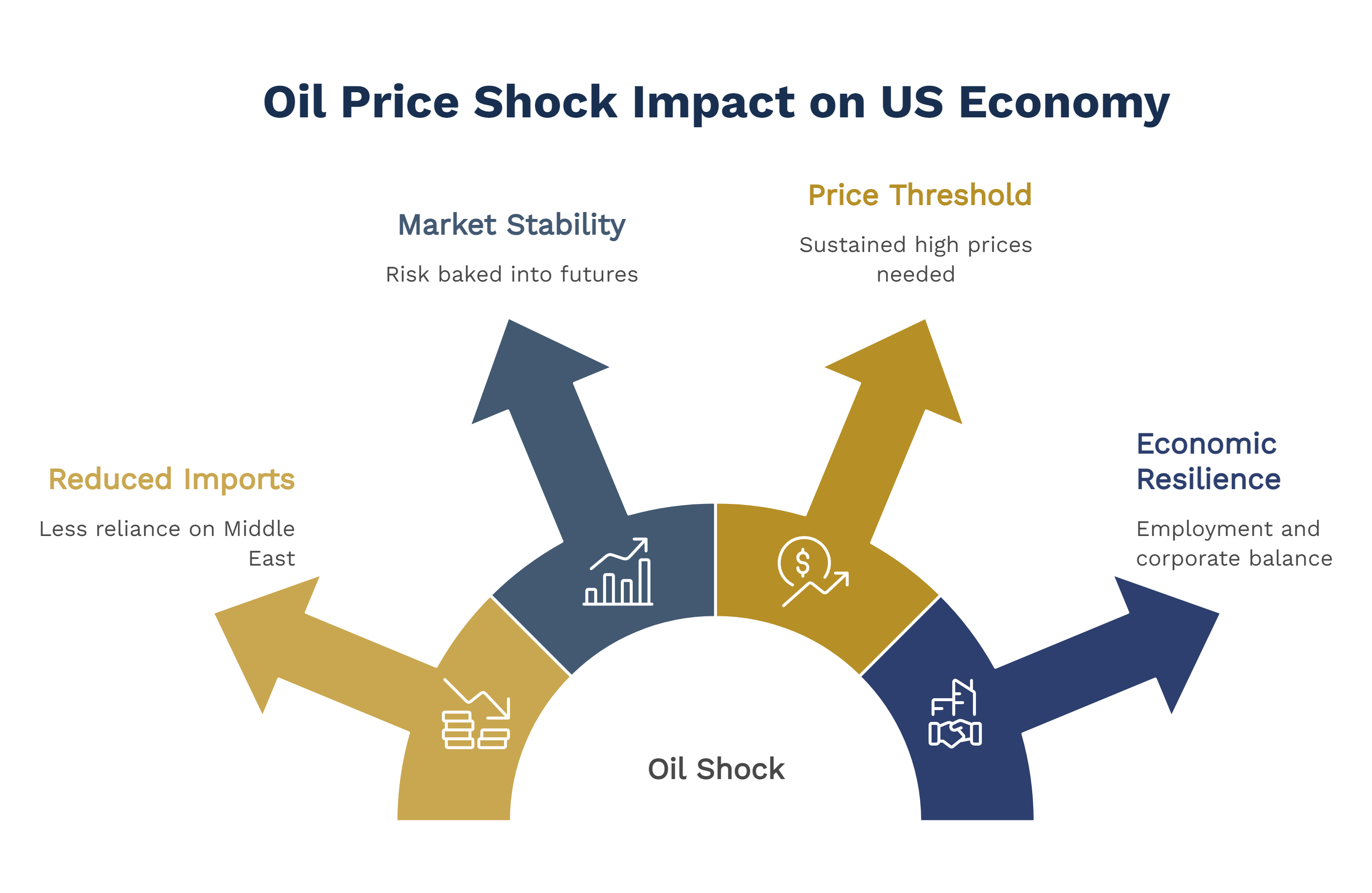
First: America isn't the America of 1973.
The US is now producing about 13.5 million barrels a day domestically, very near a record. It only needs to net import roughly 4 million barrels a day, and a lot of that can come from Canada. America isn't hostage to Middle East oil the way it used to be.
Second: Markets are forward-looking.
A lot of the risk is already baked into energy futures, bonds, and stocks. This shock isn't appearing out of nowhere. The geopolitical risk has been visible and priced in for a while.
Third: Oil probably has to park itself above roughly $140.
It has to stay there for a sustained stretch to truly break the economy. Volatility in oil prices is not the same thing as a broken economy. Price spikes that reverse don't necessarily destroy consumer spending.
Fourth: The underlying economy still has meat on the bone.
Employment's holding. Corporate balance sheets, at least for really good companies, are solid.
So, could this tip us into a recession? Sure. Or it could fizzle into another painful but survivable bout with uncertainty. Anyone telling you they know which one it's going to be is selling you something.
Stop Trying to Predict the Market: Build a Brick House Instead
Trying to predict whether oil hits $160 or $80 is a loser's game.
I have been doing this for 40 years and I cannot do it. And neither can you. Neither can Buffett.
There's a reason the best investors in the world aren't waiting for macro predictions to come true before they act. You can read more about why predicting a stock market crash is a strategy that doesn't work even for the legends.
As a Rule #1 investor, I play an entirely different game. I don't sit in a flimsy tent and try to predict the weather. I'm building a brick house that can handle any weather.
That means owning wonderful businesses I bought at attractive prices. A wonderful business is one you understand, that has a durable competitive advantage, and that's run by management you'd trust with your own money. In an environment like this one, "wonderful" has three very specific traits.
The 3 Traits of Recession-Resistant Stocks
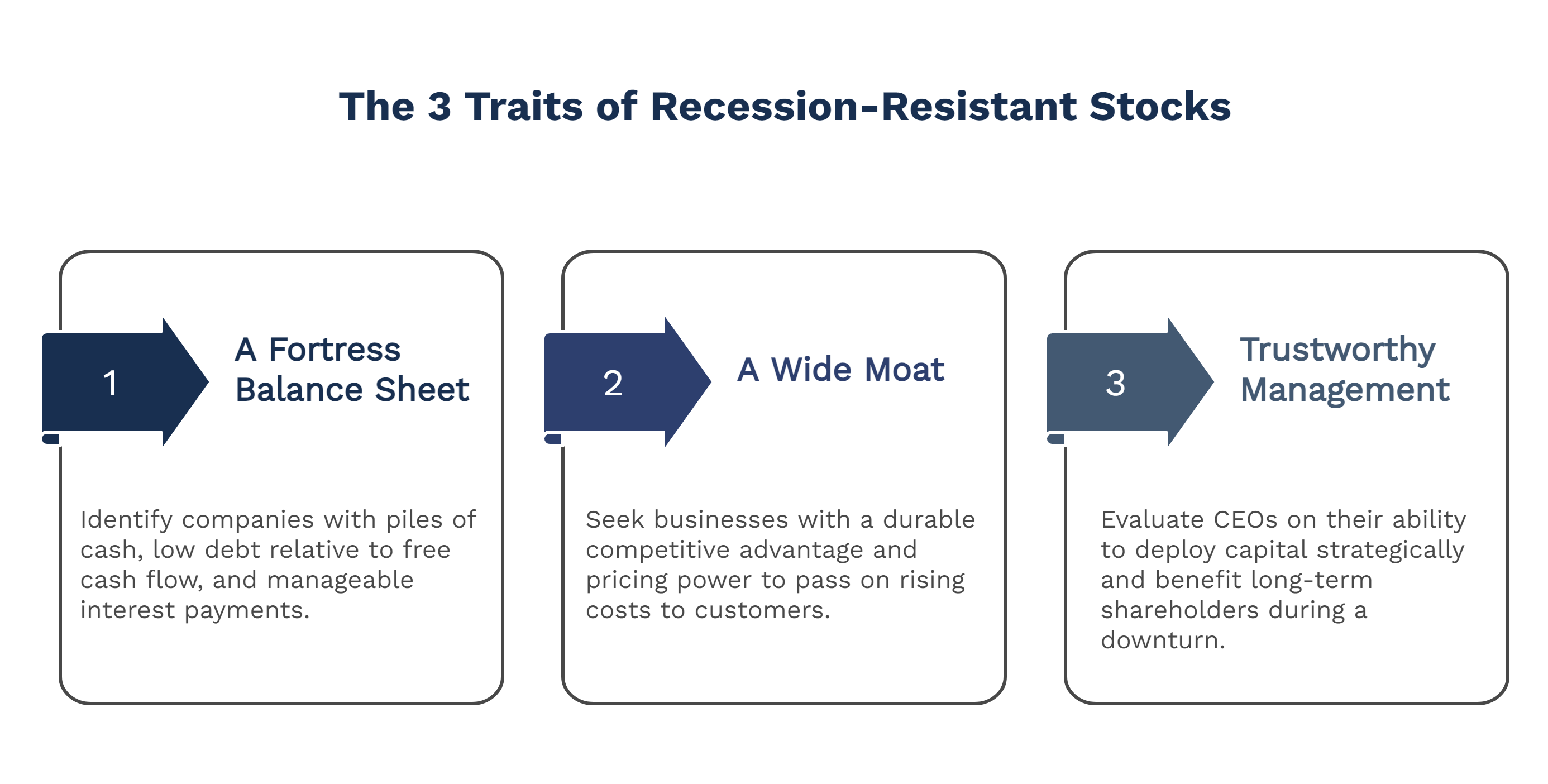
These three traits aren't specific to 2026. They're the timeless filter I use to identify recession-resistant stocks in any environment, from a Middle East oil shock to a credit crunch to a pandemic. Get these right and you don't need to predict anything.
Trait 1: A Fortress Balance Sheet
A fortress balance sheet means piles of cash, debt that's small relative to free cash flow, and interest payments that don't eat the profits alive.
In a slowdown, weak balance sheets get exposed the way a low tide exposes the rocks. Companies drowning in debt can't service it when cash flow dips. They start making desperate decisions: cutting staff, selling assets, diluting shareholders. That's exactly the kind of company you want to avoid.
The simple test I use: if this company's revenue drops 30% tomorrow, does it survive comfortably? Or is it on the phone with a bankruptcy lawyer?
Apple is the textbook example. Massive cash. Manageable debt. Massive free cash flow.
A recession won't threaten Apple's existence. It threatens Apple's competitors, the ones without that financial cushion. I'm using Apple as an illustration here, not a recommendation to buy.
Look for fortress balance sheet stocks before any downturn arrives. If you wait until the recession is confirmed, the best ones are already expensive or unavailable.
Trait 2: A Wide Moat with Pricing Power
A wide moat is a durable competitive advantage intrinsic to the business, not a temporary edge. It's the reason customers stay even when you raise prices.
Pricing power is the gold standard when you're figuring out how to invest during high inflation. If a company's input costs rise, a moat lets it pass those costs to customers without losing them.
Coca-Cola is the example I come back to every time. Sugar gets expensive, aluminum gets expensive, shipping gets expensive. They raise the price of the can by a dime and I still buy it. That's pricing power. I'm using Coca-Cola to illustrate, not as a recommendation to buy.
Contrast that with a no-moat commodity business. When their costs rise, they can't pass them on. Margins collapse. The stock gets cut in half. You don't want to own that in any environment like this one.
Stocks with pricing power don't just survive inflation. A wide moat stock can pull ahead while weaker rivals fall behind.
If you want to go deeper on building an inflation-resistant portfolio, the invest during inflation guide covers the mechanics in detail.
Trait 3: Management You Would Actually Trust with Your Money
In a crisis, capital allocation decisions are the whole ballgame.
A great CEO uses a downturn to buy back their stock super cheap, acquire weaker competitors for pennies on the dollar, and come out the other side with more market share than they went in with. They treat the chaos as a strategic opportunity.
A lousy CEO panics. They freeze, cut the wrong things, destroy value, and leave shareholders worse off than if they'd done nothing.
Trustworthy management isn't about whether you like the person on the earnings call. It's about how they deploy capital when times get hard. Look at what they did in the last downturn. Did they make moves that benefited long-term shareholders, or did they protect themselves?
This is the third M in the Rule #1 Four Ms framework, and it's the one most investors skip. Don't skip it.
This Is Bottom-Up Investing: The Buffett Way
This is a bottom-up investing strategy. You start with the individual business, its numbers, its moat, its leadership. Not the macro picture. Not the Fed. Not oil headlines. The business.
The question I ask is this: "Would I be happy owning this company for the next 10 years regardless of what oil does or what the Fed says or what Washington does or what the market does?"
If yes, and the price is attractive, you buy. If no, you wait.
Whether you're trying to figure out how to invest in a bear market or just don't want to watch your savings evaporate during a recession, this framework is the answer. You can run the numbers on any business yourself using the same approach I've taught thousands of investors.
Why Recessions Are When Great Businesses Go on Sale
A recession isn't just a threat. It's also an opportunity.
In a recession, great businesses go on sale even as they're getting stronger. Fear pushes prices down across the board, including for companies whose fundamentals haven't changed at all. The business keeps compounding. The stock price drops because everyone else is panicking.
The investor who has done the work, who knows the business and trusts its balance sheet and moat and management, can act with confidence while others are paralyzed. That's when you buy.
This is how the best investors in history have built wealth across every downturn. The history of the stock market shows it again and again: disciplined buyers during fearful markets may generate the best long-term returns. The price you pay matters enormously, and recessions make wonderful businesses available at attractive prices.
How to Apply This Framework: Practical Next Steps
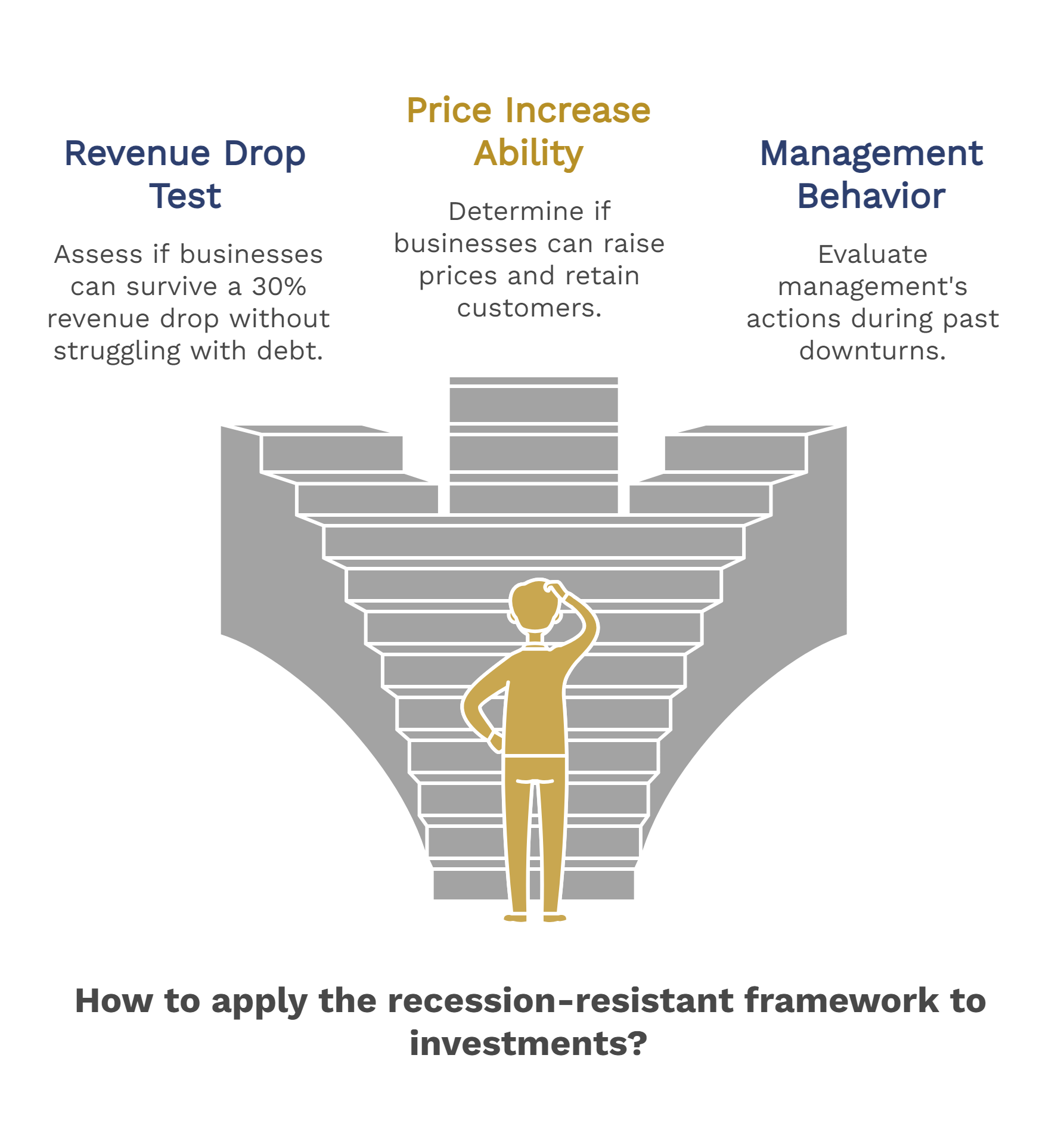
Here are three things you can do right now:
Run the 30% revenue-drop test on everything you own or are considering: if revenue fell that much tomorrow, would it survive comfortably or scramble to cover its debt?
Ask whether each business can raise prices and keep its customers, and look at whether it did over the last few years.
Check what management did in the last downturn, in 2020 or 2022. Did they strengthen the business and buy back shares cheap, or did they panic? Past behavior is the best predictor of future behavior.
If you want to know exactly what to pay for any of these businesses, start with the margin of safety calculator.
The filter is simple: start with the business, not the headlines.
Learn This Framework Live: Join Our Next Virtual Investing Workshop
If you're tired of letting oil prices and recession headlines dictate your stress level, I want to help you do something about it.
Real coaches. Real companies. Real numbers. My mentors and I have walked over 30,000 investors through this exact framework.
If you're ready to stop guessing and start knowing, the Rule #1 Virtual Investing Workshop is where you start.
Focus on the Business and the Price, Not the Noise
Three traits. That's the whole answer.
A fortress balance sheet means the business survives any weather. A wide moat with pricing power means it comes out stronger on the other side. Trustworthy management means someone smart is at the wheel when the road gets rough.
Oil will do what oil does. The Middle East will do what the Middle East does. The Fed will do what the Fed does. None of that is under your control.
What's under your control is the quality of the business you own and the price you paid for it. Focus on the business and the price, not the noise. Now get out there and go play.
This content is for educational purposes only and does not constitute investment advice. Rule #1 Investing is an education company. Nothing in this post should be construed as a recommendation to buy or sell any specific security. All investments involve risk, including the possible loss of principal. Past performance is not indicative of future results. Individual results will vary.

About Phil Town
Phil Town is an investment advisor, hedge fund manager, 3x NY Times Best-Selling Author, ex-Grand Canyon river guide, and former Lieutenant in the US Army Special Forces.
He and his wife, Melissa, share a passion for horses, polo, and eventing. Phil's goal is to help you learn how to invest and achieve financial independence.
Get Phil's Free Guide