











How to Invest and Retire Early Using the Rule #1 Strategy
 Phil Town
 In This Article
- Retirement Statistics in the US
- What Makes Rule #1 Investing Different?
- Stock Market Terms for Newbies
- How to Find a Great Business To Start Investing In
- 4 Things Rulers Do To Stay Rational
- Emotional Considerations for Early Retirement
- The FIRE Movement: Principles & Practical Steps
- Where Do I Start Investing? Pay Down Your Debt First
- Learn How to Invest by Opening Your First Trading Account
- Buy Your First Stock and Start Investing
- Conclusion
Why do you want to learn how to invest?
Most people want to start investing because they want to retire or retire early. Others want to be able to cover their medical bills, or pay for their children's college, travel, or have extra money later.
No matter what your reasons are or where you are in life, learning how to invest is the best way to secure your financial future. That is exactly what I'm going to show you in this post.
Let’s dive in and set you up for a year of financial clarity, confidence, and success.
Retirement Calculator
Discover how much you need to invest in order to retire comfortably
Retirement Statistics in the US
As of 2025, approximately 33% of Americans are not confident about their retirement prospects. Foremost among the challenges faced across generations — Baby Boomers, Gen X, Gen Z, and Millennials — is saving enough money for retirement while matching the pace of inflation. Meanwhile, 70% of retirees feel that their retirement savings are being consumed by their cost of living, and almost half express that Medicare does not cover as much as they hoped.
Many have the notion in their mind that the stock market is dangerous and risky. This could not be further from the truth. There is no other way for you to build retirement savings or achieve financial independence as effectively as through investing. A savings account may give you a .02% a year rate of return, a bond might give you 3% a year, and a mutual fund might get you 5% a year.
In the end, none of these will help you secure your retirement income or make you very much money. In fact, they will provide little protection from inflation, which has hovered around 3-4% for the last 20 years.
If you follow these methods of saving your income, you'll be lucky to double the money you have right now. That's not going to be enough to cover your annual expenses or set you up for a long retirement.
In 2025, nearly 50% of Americans aged 55–65, the typical retirement age, have less than $250,000 saved for retirement. Around 25% have less than $100,000. For many, that's not enough to maintain their lifestyle or keep up with inflation after leaving the workforce. This is especially concerning for those who want to retire early or reach their early retirement goal.
This is why learning how to invest and grow your taxable investments and tax-advantaged accounts wisely is more important than ever. Relying solely on social security or traditional retirement accounts simply won't cut it anymore. This is especially true if you want to have greater control over your future results.
In 20 years, I want you to be a millionaire. My mission is to teach you how to invest smarter. It's for you to learn how to develop an investment strategy that allows you to retire early and enjoy a secure retirement plan.
Investing doesn't have to be complicated. I can assure you that if I could do it and retire early and as a millionaire, you can too. It's that simple.
I started out just like you.

Me as a river rafting guide in the Grand Canyon.
I was a river rafting guide in the Grand Canyon, I rode a Harley, and I had a beard. I made 4,000 dollars a year. I was about as far from investing as you could get. In 1980, I took a group of investors out on the rapids. After a brush with death on one of the nastiest rapids of the Grand Canyon, one of the investors decided to teach me how to invest.
I borrowed $1,000. Five years later, I was bringing in over a million. By then, I had mastered the basics of Rule #1 investing, and at that time, I didn't even know that the Rule had been used by the best investors for the past 80 years.
I'm now a New York Times Bestselling Author; I run my own company and my own hedge fund.
I want to show you that you can do this too. You can learn to invest and make smart financial decisions, so you can live the life that you want to.
I want to get you started investing today. You may be like many people who just don't know where to start. I'm going to lay out an approach to get you started that should benefit new and seasoned investors alike.
Bottom Line: By the end of this article, I want to give you the confidence to invest.
What Makes Rule #1 Investing Different?
Rule #1 is different from any type of investing you've seen before. We simply follow how the best investors in the world invest. These are investors like Warren Buffett, Charlie Munger, David Einhorn, and Mohnish Pabrai. These guys have been crushing the market for years. These experts have been crushing the market for years and serve as trusted examples for anyone looking to retire early or achieve financial independence.
For years, all headlines, articles, and major websites have told us that the stock market is complicated. It's always subject to change, and therefore, you can't beat the market. You have to be an expert to manage your own money or develop a solid retirement plan at your current age.
They make it seem as though you need a financial advisor, tax professional, or registered investment adviser to give you investment advice or handle your taxable accounts and brokerage accounts.
All of these things couldn't be farther from the truth for the specific investor who wants greater control over their financial situation and future results.
Let me start by busting a few investing myths.
Myth #1: You Have to Be an Expert to Manage Money
The first myth I want to bust is that it takes a lot of time and expertise to manage your money or create an early retirement plan. It would if investing were hard to learn or if getting the information to make a decision took a lot of time.
It doesn't, even though the financial services industry wants us to believe it does. The industry stands to make billions from commissions and fees if it can keep you thinking you can't do it on your own. You don't always need advisory services for every decision.
In reality, with a disciplined savings rate and the right investment mix, you can take charge of your own path to early retirement and a secure retirement plan.
Myth #2: You Can't Beat The Market
Okay, it's true that 96% of all mutual fund managers have not been able to beat the market in the last 20 years. Past performance is not always indicative of future results. But you're not a fund manager, and you're not judged by whether you beat the market. Your financial skill is judged by whether you're living comfortably when you're 75 or the normal retirement age.
Myth #3: The Best Way to Minimize Risk Is to Diversify and Hold (for the Long Term)
If you know how to invest—meaning you understand Rule #1 and know how to find a wonderful company at an attractive price—then you do not diversify your money into 100 stocks or an index mutual fund. You focus on a few businesses that you understand. You buy when the big guys—the fund managers who control the market—are fearful, and you sell when they're greedy.
If you follow our Rule #1 philosophy (more on that coming), you don't have to worry about any of these things. You can beat the market without diversifying into 100 different stocks and without being an “expert”. You become the expert.
Stock Market Terms for Newbies
First, let's learn about some basic investing terms that will help you better understand the stock market and why investing is important.
What is a Stock?
A stock is a type of security that signifies ownership in a corporation and represents a claim to that company's assets and earnings. Basically, when you buy stocks in a company, you are buying a piece of that company. The best way to think about this is in terms of you owning the entire business. To be able to buy a stock in a company, you should be comfortable owning the entire company.
What is Compound Interest?
Albert Einstein said that compound interest is “The eighth wonder of the world.”
Compound interest is the game-changer here. It is the amount of interest you earn on your investments plus all of the interest earned on the interest over time.
The effects of compound interest become especially powerful over long time periods when the amount of interest you earn becomes larger and larger.
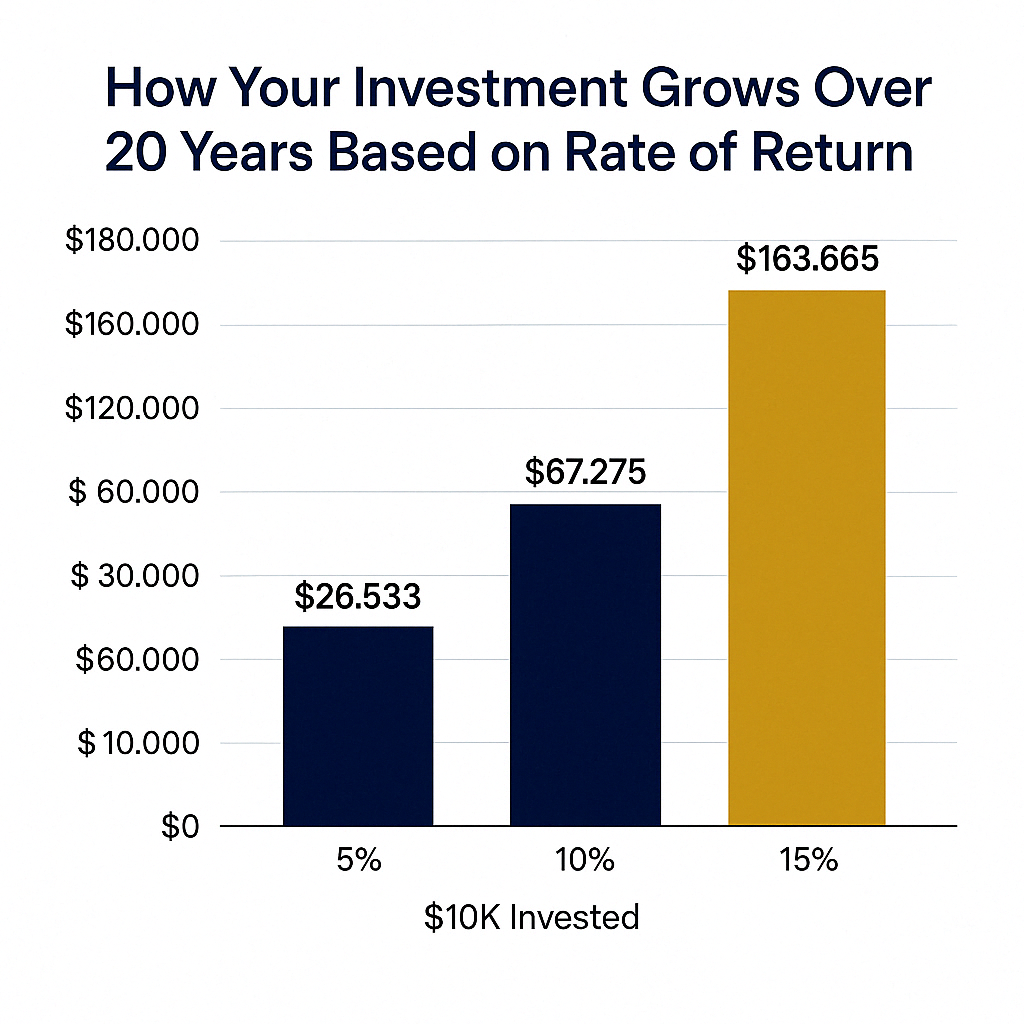
💡 Let's look at a real-world example of compound interest in action:
If you invest $10,000 and earn 15% per year (the Rule #1 target), you'll have $163,665 in 20 years.
If you only earn 5% per year, you'd only have $26,533.
That's the power of compounding at Rule #1 levels—an investment philosophy that aims for high returns by focusing on quality businesses at a discount.
What it means when people say “The Market”
When people talk about how “The Market” is doing, they are normally talking about the performance of an index. The two main indices are the Dow Jones Industrial Average and the Standard & Poor's 500.
The S&P 500 index reflects the performance of 500 companies in the stock market. If these companies rise in price, so does the index.
You can invest in an entire index fund. A lot of people recommend investing in index funds because you are instantly diversified. However, we want to find a few wonderful businesses to invest in. Great returns come from investing in wonderful companies that you understand, not in diversification.
Bottom line: Start saving earlier so you can take advantage of the effects of compound interest.
How to Find a Great Business To Start Investing In
There are what I like to call the 4M's when it comes to finding a great business. Since we model Warren Buffett-style investing, I'll use Warren Buffett's quotes about what he says about each ‘M.' The 4Ms are Meaning, Moat, Management, and Margin of Safety. Let's go through them below.
If you want to learn how to invest, this is exactly where you start:
1. Meaning - Understand the Business
"Buy into a company because you want to own it, not because you want the stock to go up." – Warren Buffett, in an interview with Forbes, 1974.
So where do you look for these mythical “great businesses?” Start with what you know and with what you love. If you don't understand a business as if you owned the company, stop and move on to the next company. This is the most important, and perhaps the easiest to overlook, part of Rule 1 investing.
When you think of buying stocks, think of it as purchasing the entire business. Once you find a business that you love, your next step is to research the company inside and out. Read their 10-K reports and any articles you can get your hands on.
Read everything you can on a company. Do your due diligence here, and it will pay off exponentially in the future.
2. Moat - Find a Business That Has a Competitive Advantage
“Time is the friend of the wonderful company, the enemy of the mediocre.” - Warren Buffett
A competitive advantage is what gives a company its lasting power. It is what ensures that the company will be around in 20 years. We call this a Moat. We compare a competitive advantage to a moat around a castle that prevents it from attack.
If the company is truly wonderful, it will be around in twenty years because it has a competitive advantage that no one can touch. A company without one will fall prey to other companies.
For more info on Moats, I've created a downloadable guide to the 5 types of competitive advantages your investments can have.
3. Management - A Business That Has Great Management
"I try to buy stock in businesses that are so wonderful that an idiot can run them. Because sooner or later, one will." – Warren Buffett
Find a business with a wonderful CEO. The CEO has control over what the company does with your money. Would you rather have them grow the company and pay you dividends or pay for a private jet and vacation? Would you want them to be honest with earnings and tell you exactly what they're doing with your money on a quarterly basis?
4. Margin of Safety - Buy It On Sale
"Whether we're talking about socks or stocks, I like buying quality merchandise when it is marked down." – Warren Buffett, 2008
If the company isn't on sale, we don't want to buy it. We are only interested in a company if it is on sale. This means finding the price that the stock is actually worth, and buying that for 50% off.
The Four M's For Successful Investing
How to invest with certainty in the right business at the right price
4 Things Rulers Do To Stay Rational
One of the most important things that investors can do when they start investing that fund managers can't do is to stay rational.
The ability to stay rational separates us from other investors. It allows us to stay calm in situations where others panic. It allows us to buy amazing companies that are on sale while others are running for the hills.
We think long-term, and we don't panic over short-term fluctuations in the market. We know we own a wonderful business. If we've truly done our research on a company, we're grateful because we can buy even more of it.
There are no shortcuts to getting rich, but there are ways to go about it that will make you rich in time that are guaranteed.
When making your first few investments, remember to keep these things in mind.
There are 4 really important things that you must do when you learn how to invest if you don't want to lose money.
1) Buy Stock in Businesses That You Love
As investors, we have a duty to buy businesses that match our values. Purchase a business in something that you spend your money on. That would be a company that you know. Over time, we can expect to be rewarded for doing this with dividends and great returns.
2) Rule #1 Investors Do Not Speculate
We are investors. We do not speculate. We only invest in a company that we fully understand. We spend hours making sure that we have read everything about the company. Remember that when you buy stocks, think of it as buying the entire company. Would you own a company that you hated or did illegal things? No, you wouldn't, so why would you want to support one by buying stocks in it?
3) Focus on Value
Try not to focus on the ups and downs of the stock market. We are investing for the long term. We don't need to worry about the market over the short term. When you buy a truly great company, you know that over time it is going to perform. It will also help you sleep better at night.
Buffett once said,
“The stock market is designed to transfer money from the active to the patient.”
Rule #1 investors remain patient, buying only when we're confident in the value—and ignoring short-term noise.
4) Buy to Hold
We buy companies with the intention of keeping them for the long term. But we don't hold blindly. Rule #1 investors monitor the company's performance over time to ensure it still meets the 4Ms. If the fundamentals change, we reassess. Holding for the long term only works when the business continues to be wonderful.
Investing Takes Time
Remember, that this is not going to happen overnight, although you may want it to. Rule 1 investors think long term because they want to work hard now and enjoy the fruits of their labor in retirement.
This means retiring a millionaire and doing whatever you want with that money. I've created an investing checklist that you can use to make sure that you're doing everything correctly and checking all of your boxes.
Bottom Line: Always stay rational. Keep your emotions in check when you invest.
The Pillars of Personal Finance
Learn Strategies for Debt Reduction, Insurance, Budget Management, and Investing!
Emotional Considerations for Early Retirement
Planning for early retirement involves more than just numbers—it’s also about preparing for a new lifestyle and mindset. For some early retirees, leaving work before the traditional retirement age can bring unexpected challenges. Some people experience an identity crisis if their career was a major source of purpose.
Others find that, once they stop working, feelings of boredom or lack of productivity can set in. That’s why it’s important to think about how you’ll find fulfillment and meaning beyond financial security. Pursuing hobbies, volunteering, or even starting a second career can help fill your days with purpose.
Early retirement offers greater control over your time. Many people discover new passions or revisit interests that were set aside during their working years. This freedom can reduce stress and lead to good health, both mentally and physically.
However, retiring early can also mean missing out on certain benefits, like employer match programs or maximizing Social Security benefits. It’s wise to talk to a financial professional or tax advisor about these factors as you plan for your next chapter.
The FIRE Movement: Principles & Practical Steps
The FIRE (Financial Independence, Retire Early) movement has inspired many people to rethink their approach to retirement. The main goal of FIRE is to achieve financial independence at a much younger age than the typical retirement age of 67. FIRE followers do this by aggressively saving and investing a large portion of their income—often between 30% and 60%—while keeping expenses low. This strategy allows them to reach their early retirement goal and enjoy more freedom in how they spend their time.
Core Principles of FIRE
Financial independence doesn’t always mean never working again. For some, it means having enough savings to leave a stressful job and pursue work they truly enjoy. It might also simply mean to have a more flexible schedule.
Successful FIRE followers are committed to living below their means. They make intentional choices to reduce expenses and maximize their savings rate.
The “rule of 25” is a popular guideline in the FIRE community. It suggests that you should aim to save at least 25 times your expected annual expenses before retiring. For example, if you plan to spend $40,000 per year in retirement, your target savings would be $1,000,000.
Planning for Early Retirement
Retiring before age 59½ requires extra planning. Early withdrawals from many retirement accounts can result in tax penalties. It’s important to consider strategies like using a taxable investment account for more flexibility.
Early retirement often means your savings need to last 30 years or more. A well-thought-out investment strategy and understanding your returns risk are essential for long-term success.
FIRE is not a one-size-fits-all plan. Each specific investor will have their own path, based on their financial situation, goals, and lifestyle preferences.
It's beneficial to understand both the emotional and practical sides of early retirement. As a result, you'll be better prepared to create a retirement plan that truly works for you.
Where Do I Start Investing? Pay Down Your Debt First
So, you want to start investing now, but you have debt. Both things require money, and you may be anxious to begin investing now, especially after reading this. Be wary of your debt and keep this in mind. It might also be helpful to know exactly how much you need to retire.
Eliminating high-interest debt, such as credit card debt, is crucial for improving cash flow before retirement. If you plan to retire in a shorter period or aim for a higher income in the future, pay off bad debt early. This can help you achieve a higher savings rate and avoid negative returns on your investments.

Good Debt vs. Bad Debt
The first barrier to success in investing is bad debt. Yes, there's good debt and bad debt. Good debt is money you borrow at a low rate of interest, with which you make a high rate of return and maximize your growth potential.
An obvious example is the money you borrow to buy an apartment complex. The debt is covered by the rental income, or it will be in a few years.
Bad debt, by contrast, is consumer debt. It's money you borrow at a high interest rate to buy things that don't produce income or grow in value. Things like cars, refrigerators, clothing, and trips to Europe.
All of us have done it, and all of us have paid the price.
The Price of Bad Debt
The price of bad debt is the impact of compounding rates of return working against you instead of for you. If you have credit cards or bank loans costing you 18 percent or more a year, that's 18 percent compounding against your retirement.
Since Rule #1 is all about not losing money, the first thing most of us must do to become successful Rule #1 investors is to pay off bad debt. Eliminating these obligations helps you pay expenses more easily and boosts your ability to invest for the long term.
First, Pay Off Debt
Think about it: If your target rate of return is 15% and we have credit card debt we're paying 18% on, essentially that means we're borrowing money at 18% and making only 15% on it.
Even though we're doing well as an investor, we're going backward at a rate of 3% compounded per year. That's a heck of a barrier to successful investing.
The only way you'll get rich is to hit the lottery.
Otherwise, you're going broke with great certainty.
But notice that if we turn that around and take the money we were going to invest and instead pay off the 18% interest rate debt, then instead of losing 3% a year, now, even if we don't have money left to invest, at least we're breaking even, and we're not violating Rule #1.
Utilizing catch-up contributions allows individuals aged 50 and older to contribute additional amounts to their retirement accounts, which many plans offer. If you want to retire before age 62, it is suggested to save 33 times your annual expenses for greater security.
Selling any asset that has gone up in value can result in a large tax bill and may impact your Medicare premiums. Therefore, consider your options carefully. Consult a professional if you need someone to provide legal or tax advice. Having a carefully constructed budget with the capacity to absorb increased out-of-pocket health care costs is crucial in early retirement planning.
Bottom Line: It's better to pay off debt before you invest.
Learn How to Invest by Opening Your First Trading Account
You're getting ready to find a proper account to open to begin saving. There are plenty of different types of accounts that will satisfy your savings needs for the future.
You have a few different options for savings accounts for your retirement savings. These accounts are set up solely for the purpose of retirement savings. Here are the two types of accounts we most commonly use:
IRA
An IRA or Individual Retirement Account allows individuals to direct pre-tax income toward investments. Individuals are allowed to contribute up to a year maximum dollar amount to these accounts. You'll pay income taxes on them when you withdraw money from these accounts.
ROTH IRA
A Roth IRA is similar to a traditional IRA; however, the money you put into a Roth IRA is taxed before it goes in. You won't pay taxes on the money you grow or when you take it out.
Both IRA accounts can give you more options in the types of investments that you can make.
Both types of accounts have different benefits, so do some research before deciding which one is right for you. The faster you can get one of these accounts set up, the faster you can get started investing.
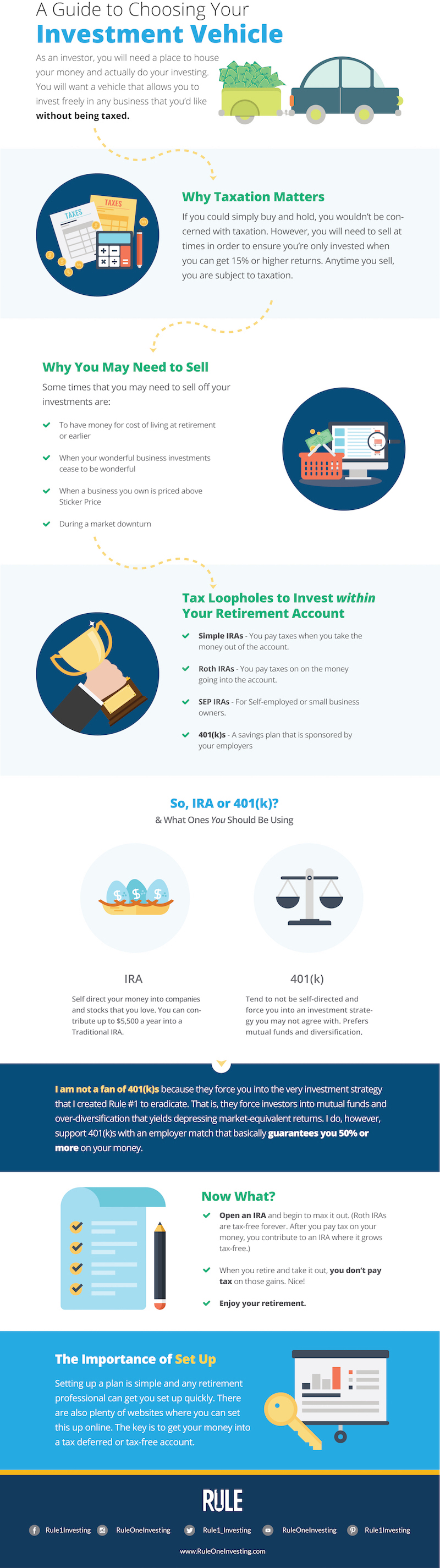
Here's an infographic on choosing the right investment vehicle for you.
Bottom Line: Do some research and find out what type of account is right for you.
Buy Your First Stock and Start Investing
So, you've paid off all of your debt and saved up some money for emergencies. Now you're ready to start investing.
You've opened up a fund account and done your research on a company that you think is an amazing buy.
Are you ready to go?
Let's do one more thing, just to be sure. Let's practice for a while.
There is something called “paper money” or “fantasy trading” where you can practice all of your newly discovered skills on a business.
Sites like this will let you trade in real time with fake money, so that you can practice a bit and “learn by doing before you get into the market.
💻 Top Paper Trading Tools for 2026: Consider using platforms like Think or Swim by Schwab, Interactive Brokers, or TradingView, which offer free paper trading features. These tools let you simulate investing decisions using Rule #1 principles in real time without risking real money.
Bottom Line: Open a free paper trading account before you start investing from a popular website and try it out.
How to Pick Rule #1 Stocks
5 simple steps to find, evaluate, and invest in wonderful companies.
Conclusion
Congratulations!
You've taken your first steps to learn how to invest, become a true Rule 1 investor, and become financially independent. With responsible living and saving, you are ready to take control of your finances and enjoy an early retirement.
I've given you some guidance on how to begin researching, shoring up your finances, and practicing. But the first step can still seem incredibly daunting, so I'm still here to help.
While you practice, you can further your knowledge of Rule #1 Investing by checking out my FREE Digital Course: Intro to Rule #1. If you want to learn exactly how to put your skills into action and start making real returns, don't miss out on this.
If you'd like another resource to help you retire sooner than you originally planned, check out my Retirement Calculator!
Attend a Rule #1 Workshop
Learn how to conduct research, choose the right companies for you, and determine the best time to buy.
**Editor's Note (Updated January 2026): This article was originally published in 2017 and has been significantly updated in 2026 to reflect current examples and Rule #1 investing insights.

About Phil Town
Phil Town is an investment advisor, hedge fund manager, 3x NY Times Best-Selling Author, ex-Grand Canyon river guide, and former Lieutenant in the US Army Special Forces.
He and his wife, Melissa, share a passion for horses, polo, and eventing. Phil's goal is to help you learn how to invest and achieve financial independence.
Get Phil's Free Guide