








How I’d Invest $1,000 in 2026 (And Why You Should Too)
 Phil Town
 In This Article
- Two Roads, One Destination: Building Wealth
- The Passive Path: Easy to Do, But Is It Enough?
- The Rule #1 Way: Active, Intentional, and Rational
- Ways to Invest $1,000
- Savings and Investment Strategies for Beginners
- The Apple Example (And Why It Matters)
- So What Should You Do With $1,000?
- Final Thoughts: Small Start, Big Future
There's something powerful about that first thousand dollars you decide to invest. It might not seem like much on the surface, but it's not about the amount. It's about the mindset.
If you're in your 20s or 30s, just starting out, and you've managed to set aside your first $1,000, well, first of all, congrats. That alone sets you apart. Now comes the bigger question: what should you do with it?
The beginning of the year is always weird and noisy to begin investing. The headlines are packed with drama—rising interest rates, budget cuts, geopolitical turmoil, inflation, you name it. There's fear swirling in the media, but behind the curtain, trillions of dollars are being funneled into the U.S. economy.
So what does that mean? It means this market is ripe with opportunity. And if you know how to look for it, that $1,000 could become your first real stepping stone toward building long-term wealth.
Let’s dive in and turn your first $1,000 into the start of something bigger.

Two Roads, One Destination: Building Wealth
There are really just two paths you can take with that first $1,000.
One is passive. The other is active.
Now, before you start wondering which one's “better,” the truth is they both have value. It just depends on what kind of investor you want to be. Are you someone who wants to set it and forget it, letting the market slowly build your portfolio over time? Or are you ready to roll up your sleeves and learn to do what I do? To invest with intention, in companies you understand and believe in, with the potential to seriously compound your wealth?
If you're leaning toward the first option, you're not alone. That's the approach a lot of people take, and it's served them reasonably well over the years. It's called passive investing.
The Passive Path: Easy to Do, But Is It Enough?
Passive investing is as simple as it gets. You buy into a broad index fund, like the S&P 500, using anETF such as SPY. Then, you keep putting money in, no matter what the market is doing. This approach is known as dollar-cost averaging. You buy regularly, on a schedule, regardless of whether prices are up or down.
Historically, this method has delivered around 10% annual returns over the long run. And for folks who don't want to dig into financial statements or learn how to value businesses, that's a pretty solid return.
Warren Buffett himself has even recommended this strategy to people like LeBron James. It's not flashy, but it works, especially when you give it time.
But here's where I want to level with you: if you're starting with just $1,000, passive investing might not move the needle in your life the way you hope it will.
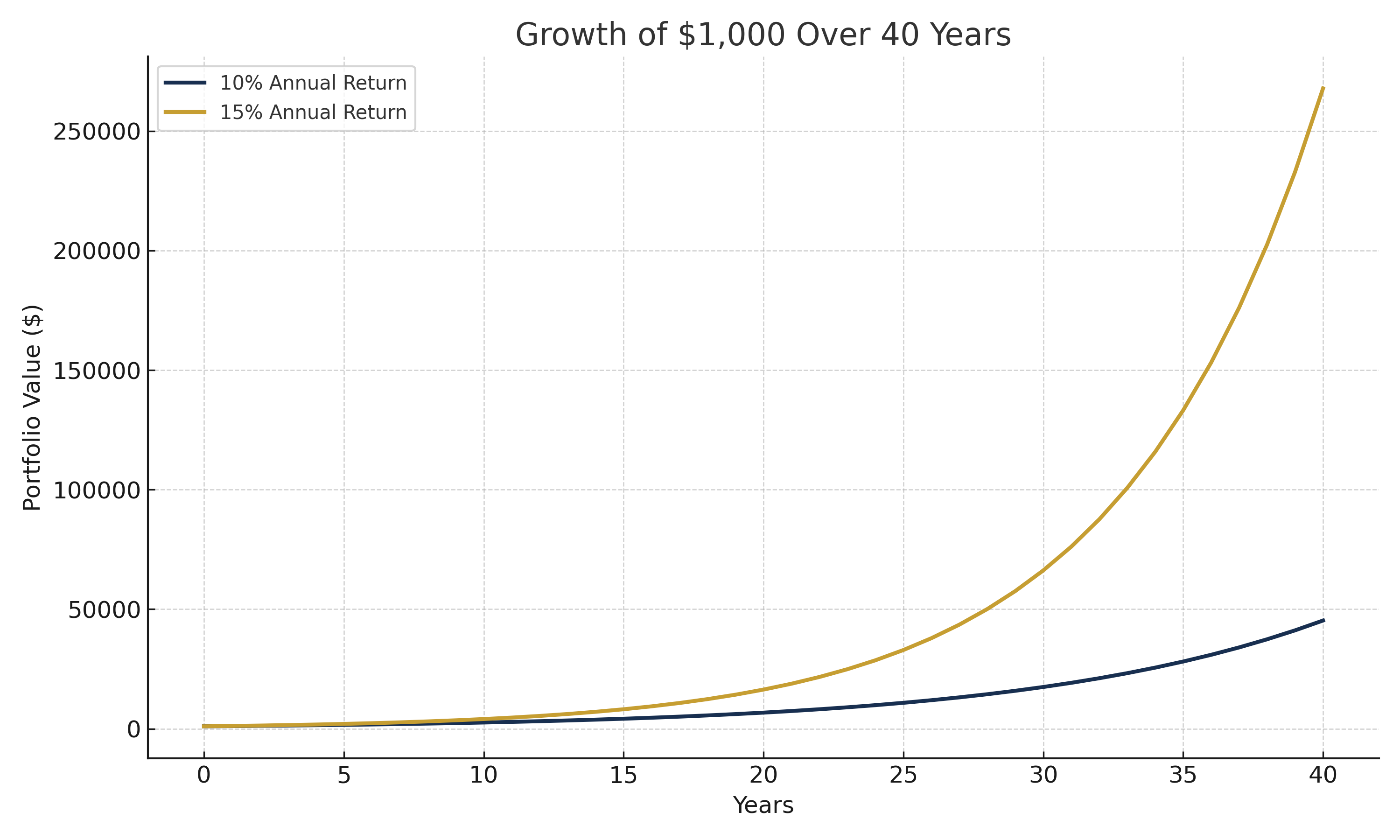
Even at 10% annual growth, your $1,000 turns into about $2,594 after 10 years. Over 40 years, it could grow to $45,000. Not bad, but not life-changing.
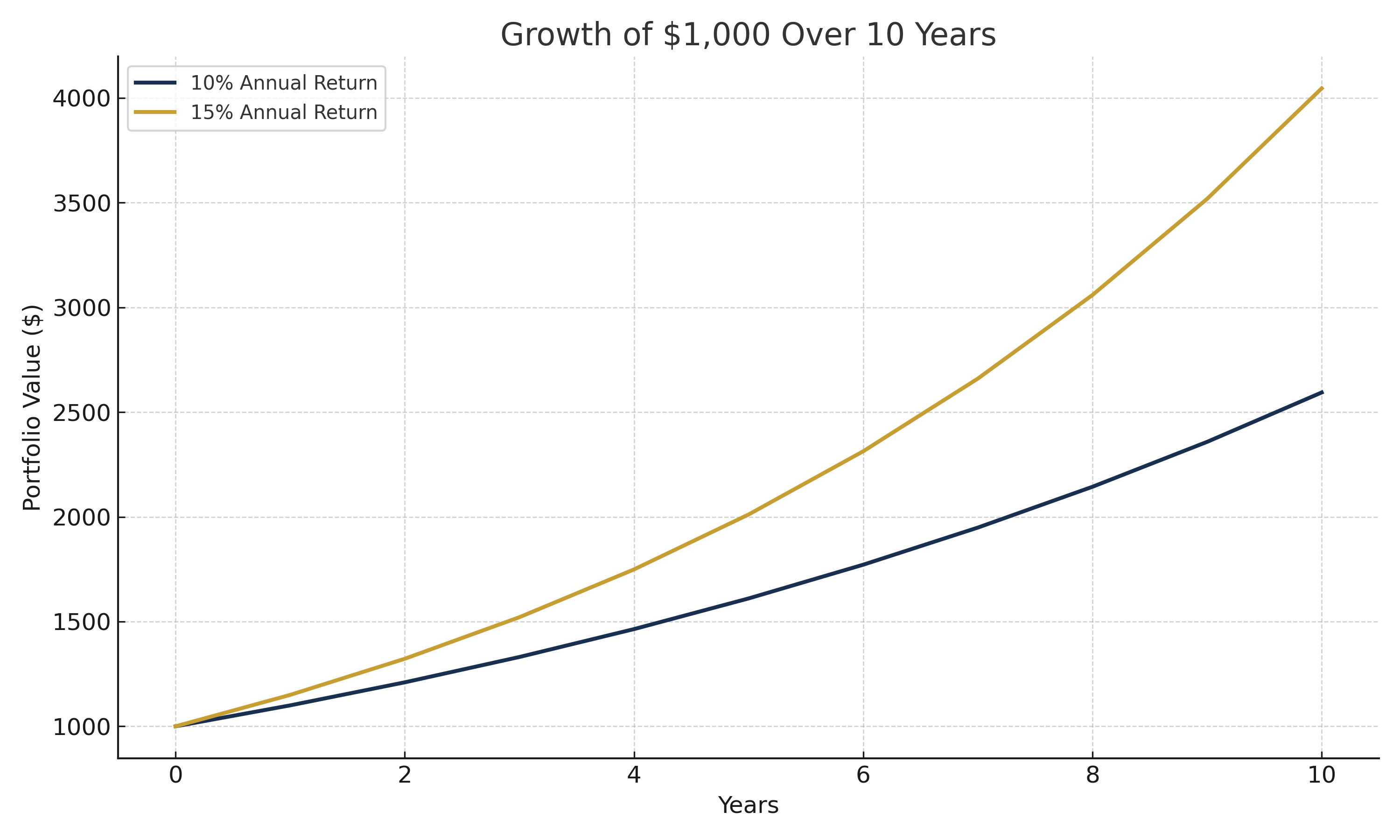
On the other hand, what if you could bump that return to 15% per year? That same $1,000 would grow to more than $4,000 in 10 years. Over 40 years? You're looking at over $260,000. And if you could hit even higher returns, like the investors I study and admire—Buffett, Mohnish Pabrai, Charlie Munger—you'd be in an entirely different financial universe.
That brings us to the second path.
The Rule #1 Way: Active, Intentional, and Rational
This is the path I've taken. And it's what I teach.
Rule #1 Investing is about doing what the greats do. It's not about gambling on trends or buying stocks because someone on YouTube said it was the next big thing. It's about approaching investing the way a business owner would approach buying a business.
When I talk about Rule #1 Investing, I'm talking about finding great companies—companies that are simple to understand, have a durable competitive advantage, are led by trustworthy management, and are priced well below what they're actually worth.
That's our holy grail: buying a dollar's worth of value for fifty cents. That margin of safety is what separates a smart investor from a speculator. And it's what protects you when the market gets bumpy—which, as you've probably noticed, it often does.
Starting with just $1,000 is actually an advantage here. When you're small, you can afford to learn. You can take your time, practice analyzing businesses, make a few mistakes, and get better without risking your financial future. If something goes wrong, it's not the end of the world—you can save again. But what you're gaining is priceless: experience, insight, and confidence.
Ways to Invest $1,000
If you’re ready to invest 1,000 dollars, there are more ways to invest than ever before. For new investors, understanding your investment options is the first step toward achieving your financial goals.
Below are some of the most accessible and effective ways to invest $1,000. Each of them has its own benefits and considerations.
Individual Stocks
Investing in individual stocks means you own a piece of a company. With many brokerage accounts now offering fractional shares, you don’t need a lot of money to get started.
This approach can offer strong growth potential. However, it also requires careful research and a clear investment strategy to manage risk tolerance.
Consider starting with companies you understand and believe in. Focus on building a diversified portfolio over time.
Mutual Funds
A mutual fund pools money from many investors to invest in a mix of stocks, bonds, or other assets. Mutual funds are generally considered a solid choice for those who want to invest money with professional management and less hands-on involvement.
They allow you to diversify your investments. Meaning, they can help lower risk and smooth out potential losses in your portfolio.
Bonds
Bonds are debt securities issued by companies or governments. When you invest in bonds, you are essentially lending money in exchange for interest payments.
Government bonds or Treasury Bills are among the safest investment options. Their interest is often exempt from state and local taxes.
Bonds can provide steady income and are a good choice for investors seeking lower risk and stability in their investments.
ETFs & Index Funds
Exchange-traded funds (ETFs) and index funds are popular ways to start investing, especially for new investors. These funds pool money to invest in hundreds of stocks or bonds, giving you instant diversification across multiple asset classes.
For example, an S&P 500 index fund or ETF provides exposure to 500 of the largest U.S. companies. This helps to lower the risk of potential losses from any single company.
ETFs offer trading flexibility, lower fees, and potential tax efficiency. Index funds are known for ease of management and low entry costs.
Both are great for building a diversified portfolio with moderate risk. They make it easy to start investing with less money.
You can also even find specialized options, such as a dividend ETF for those interested in passive income.
Other Ways to Invest $1,000
Certificates of Deposit (CDs): CDs usually offer fixed interest rates higher than traditional savings accounts. These are often around 4.10% APY. They’re a safe way to earn interest, but your money is locked in for a set period.
Target Date Funds: Target date funds automatically adjust your investment mix as you approach a specific goal, like retirement or a child’s education. They are a simple, hands-off solution for investors with a longer investment horizon.
Bond ETF: A bond ETF allows you to invest in a diversified group of bonds. They combine the stability of bonds with the trading flexibility of ETFs.
Robo Advisor: If you want help with your investment strategy, a robo advisor powered by artificial intelligence can help you build a portfolio tailored to your goals and risk profile.
No matter which option you choose, always align your investment goals, time horizon, and risk tolerance. If you’re unsure, consulting a financial advisor can help you make informed decisions and grow wealth over time.
Savings and Investment Strategies for Beginners
Before you invest, it’s important to build a strong foundation in personal finance. Smart savings strategies protect you from unexpected expenses and set you up for long-term success.
Here’s how to make the most of your first $1,000:
Emergency Fund
An emergency fund is your financial safety net. It helps you cover unexpected expenses, like medical bills or car repairs, without derailing your investment goals.
Most experts recommend saving three to six months’ worth of living expenses in an emergency fund. Even if you start small, automating deposits can help you consistently save money and reach your target.
Consider using a high-yield savings account (HYSA) for your emergency fund. HYSAs offer higher interest rates than traditional savings accounts, so your extra money can earn interest while remaining accessible.
As of late last year, about 33% of Americans say they don't have an emergency fund. If you have $1000 dollars to invest, this is a great first step before you start investing in the stock market or other securities.
Paying Down Debt
Paying down debt, especially high-interest credit cards, is one of the smartest moves you can make. The interest you save by paying off debt is a guaranteed, risk-free return.
Prioritizing high-interest debt frees up more money for future investments and helps you avoid unnecessary interest payments. Every dollar you pay toward debt now is money you keep for yourself in the future.
Retirement Accounts
Investing in a retirement account is a powerful way to grow your retirement savings. Accounts like a 401(k), traditional IRA, orRoth IRA allow your money to grow tax-free or tax-deferred, depending on the type.
Contributions to a traditional IRA are generally tax-deductible. On the other hand, Roth IRA contributions are made with after-tax dollars and can be withdrawn tax-free in retirement.
If your employer offers a 401(k) with matching contributions, take full advantage. It’s essentially free money added to your retirement savings.
Even a small amount, like $1,000, can benefit from historical performance and compounding over a longer investment horizon. Retirement accounts are also a great option if you’re saving for a child’s education or other long-term goals.
The Apple Example (And Why It Matters)
Let me give you a real-world example.
Back in 2016, Warren Buffett made a move that surprised a lot of people: he invested heavily in Apple. At the time, Apple was trading at a big discount to its intrinsic value. But Buffett saw what most didn't: a massive moat in brand loyalty, smart management, and a balance sheet that was rock solid.
From 2016 to 2026, Apple delivered a 24.5% annual return. During that same period, the S&P 500—a benchmark for the market—averaged about 17.5%.
That's the kind of upside you can uncover when you invest like a Rule #1 investor.
And you don't need billions to start doing what Buffett did. You just need to understand the process, learn the tools, and have the discipline to follow through.
So What Should You Do With $1,000?
If you just want to park your money and let it ride, passive investing might suit you just fine.
But if you're hungry to learn how to actively build wealth—if you want to know how the best investors in the world consistently beat the market—you owe it to yourself to learn Rule #1 Investing.
The best way to do that? Join me for my 3-day online workshop. It's packed with everything you need to get started. We'll walk through:
How to find wonderful businesses
How to calculate their true value
How to know when the price is right
And how to build a portfolio you can be proud of—starting with just $1,000
I'll even show you what I'd do, step by step, in today's market environment.
Final Thoughts: Small Start, Big Future
You don't need to have millions to build financial freedom. You need to start with what you have—and do it right.
$1,000 won't change your life overnight. But invested the Rule #1 way, it might be the start of a journey that absolutely does.
Every great investing journey starts with a small step. This could be yours.
Attend a Rule #1 Workshop
Learn how to conduct research, choose the right companies for you, and determine the best time to buy.
**Editor's Note (Updated 2026): This article was originally published in 2025 and has been significantly updated in 2026 to reflect current examples and Rule #1 investing insights.

About Phil Town
Phil Town is an investment advisor, hedge fund manager, 3x NY Times Best-Selling Author, ex-Grand Canyon river guide, and former Lieutenant in the US Army Special Forces.
He and his wife, Melissa, share a passion for horses, polo, and eventing. Phil's goal is to help you learn how to invest and achieve financial independence.
Get Phil's Free Guide