












Best Ways to Save Money And Improve Your Financial Standing
 Phil Town
 In This Article
- 1. Set Attainable Financial Goals
- 2. Get Rid of High-Interest Debt
- 3. Track Your Spending and Monthly Expenses
- 4. Budget Your Money
- 5. Checking and Savings Accounts
- 6. Set Up Automatic Savings
- 7. Build Your Emergency Fund
- 8. Make Smart Investments
- 9. Watch Your Money Grow Year Over Year
- Savings Strategy: What Is the Best Way to Save Money for Your Future?
Saving money can be difficult to commit to, but if you start now, you can set yourself up for the future you've always hoped for.
For many people, financial struggles are a direct result of not bringing in enough money or having to manage monthly payments that seem to grow over time.
However, financial troubles can stem from not spending money wisely or not having a strong savings habit in place.
But, I'm going to help ensure that this isn't your path.
If you abide by these saving strategies now, you may maintain a healthy cash flow. You'll begin to build a solid financial foundation that will carry you through retirement.
Let's take a look at some of the nine best ways to save money today so you can begin to invest and establish wealth tomorrow.
1. Set Attainable Financial Goals
It's easy to get caught up in the “go big or go home” mentality when looking at the best ways to save money. While saving upfront may seem more effective, it's important to remember that saving is a sprint and not a marathon.
Being an effective saver is all about consistency over quantity.
It is establishing consistency beginning with setting reasonable savings goals you are confident you can meet.

Is it a long-term or short-term savings goal? How much will you put aside every month to achieve your goal within a certain timeframe? Consider your fixed monthly expenses when mapping out your plan.
As you begin to build out a thorough savings strategy, you may want to consider creating SMART goals. These goals provide you with more clarity, as it is:
Specific
Measurable
Achievable
Relevant, and;
Time-bound
Setting such criteria that need to be met helps you actually reach your goal.
When you assess your specific savings goals, a few common ones may come to mind. Take a look at the standard savings goals below to determine how you can minimize your spending in specific areas so you can effectively set aside money to achieve major milestones.
Save Money for a Home
Though investing in the stock market tends to be more profitable, buying a home can be a smart investment if the home is selling at only half of its actual value or in a neighborhood that has a proven track record for increasing property value. Read this post to understand the difference between saving and investing.
If you're looking to buy, the best way to save money for a house is to take a magnifying glass to your budget.
Try asking questions like:
Are you able to limit unnecessary spending for a period of time?
Can you find an outlet for earning supplemental income to support this dream?
Is it possible to downsize now in order to save more for later?
These are all critical questions that must be addressed to begin saving for a home.
How to Pick Rule #1 Stocks
5 simple steps to find, evaluate, and invest in wonderful companies.
For example, let's say you want to buy a house for $500,000 within the next two years.
SMART goal: check.
Let's go even deeper. You'll want to ensure that you can make at least a 10% down payment on your dream home. For a $500,000 house, this equates to $50,000.
If you've already set aside $25,000, your goal becomes even more achievable. Saving a little over $1,000 every month for 2 years will allow you to meet your goal on time.
You don't want to fall into the trap of putting all of your hard-earned cash into your savings fund for a house because having an emergency fund is also critical. Making adjustments to your goal in order to have more financial flexibility is okay.
If you are able to contribute more to this savings account every month, fantastic! The more money you set aside now, the more flexibility you’ll have down the road.
You'll be well on your way to closing on your home within your desired timeframe. However, if you need to extend your timeline there's absolutely no shame in doing so.
Go at your own pace. Life is better enjoyed than lived as a race.
I'm also not suggesting you throw $50,000 into your savings account and wait to use it until you're ready to buy, but more on that later. Consider how your account earns interest and whether your savings are in a liquid account for easy access.
First, let's look at a couple of other types of savings goals.
Save Money for Your Children
Generational wealth is attainable for everyone. You have the tools to help you and your family maintain and grow wealth for generations to come. You just need to put them into action.
The best way to save money for kids is to create accounts and contribute to them based on need. An investment account or mutual funds can also be a smart way to grow savings for your children over time.
For example, you could open a children's savings account or set aside money in a trust fund. In addition, many parents take advantage of 529 College Savings or Prepaid Tuition Plans in order to put their kids through school when the time comes.
In order to come up with a saving goal for your kids, try asking questions like:
What is the minimum amount I am able and willing to contribute to my child's savings account?
How much do I want to save and put toward my child's education? How much of my monthly income am I able to set aside every month in order to reach my goal by the time they begin college?
Taking a closer look at this second question, we can begin to map out a reasonable savings strategy to send your children to a reasonably priced college.
What's your Investing IQ?
See how you stack up against other investors.A recent report done by the College Board for 2024-2025 estimates that the average tuition price for an in-state student to attend a four-year public university was $11,610. That price rises to $30,780 for out-of-state students and $43,350 for students attending private universities.
There are a lot of factors at play here, like student loan payments. However, at minimum, let's use the in-state option for the purposes of this exercise.
Rounding up, if you were to send your child to a four-year public university, it would cost you roughly $12,000 per year or $48,000 in total.
This is a daunting number, but it doesn't need to be. If you start saving to send your child to college when they are born, this is easily achievable.
Say you want to have this money set aside by the time your child is eligible to attend a university. This is typically around the age of 18. If you have 18 years to save $48,000, that amounts to $3,000 a year, or $250 a month.
Piece of cake.
You also by no means need to have the entire cost of tuition, room, and board saved by the time your child begins school.
To reduce stress and allow yourself more time, you could give yourself an additional 3 years (while they're in school) to save up more slowly and contribute that money to their college fund as they begin taking classes.
Save Money for Retirement
It’s easy to put off saving for retirement, especially if it feels far away. But the earlier you start, the more your money can grow thanks to compound interest.
You are the only one with the power to turn your retirement dreams into realities, so it is best to start investing in your retirement plan at an early age.
When you think about the best way to save money for retirement, ask yourself:
What lifestyle do I want to live when I retire?
How much will that lifestyle cost?
What is currently happening to my money?
What spending habits or debt do I need to eliminate to put myself in the best position to be successful?
Based on the answers to the above questions, you can begin to establish a retirement savings plan to fit your lifestyle.
Many formulas suggest that you should save an amount equal to your annual salary by age 30. For instance, if you make $60,000 per year, you should have $60,000 saved by your 30th birthday.
This number increases with every decade that goes by—by age 40, you should have saved two times your annual salary. By 50, you should have saved four times your annual salary, etc.
What's your Investing IQ?
See how you stack up against other investors.However, it's also important to keep in mind that life gets in the way sometimes. Home repairs need to be done, credit cards must be paid off, car payments must be met, groceries need to be bought, etc.
What I'm getting at here is that sometimes you'll be able to save more and sometimes you won't. That's okay. Just remember to continually set aside time to check your progress to see if you're still on track. Reviewing your bank statements and monitoring your monthly budget may help.
Consider opening a Roth IRA or contributing to your employer’s 401 k. This can be a good place to start in order to build a foundation for retirement savings. This will help quell any worries you may have about being financially prepared for retirement and will ensure you are regularly contributing to this account on a monthly basis. Many retirement accounts are tax-free or offer a tax break, which can give your savings a boost.
If you’re eligible, don’t miss out on an employer match. It’s like getting free money for your retirement plan. And remember, social security may not be enough to cover all your expenses in the future.
2. Get Rid of High-Interest Debt
Financial freedom lies on the other side of eliminating bad debt. But, before we go any further, let me explain what bad debt entails.
Any money you borrow at a high-interest rate that is not an investment falls into the category of bad debt. Think about cars, appliances, excess clothing, extravagant vacations, and so on -- these are all purchases that lose value over time.
As if that wasn't enough, bad debt typically comes with a huge interest rate. This means paying off the bad debt prior to investing will yield a 12-24% return because you aren't paying that in interest anymore.
This is why it is crucial to pay off debt before saving and investing. Prioritize your debt payments, especially on credit cards, to reduce your financial burden.
Bottom line: learning how to eliminate bad debt will yield immediate results. Trust me.

3. Track Your Spending and Monthly Expenses
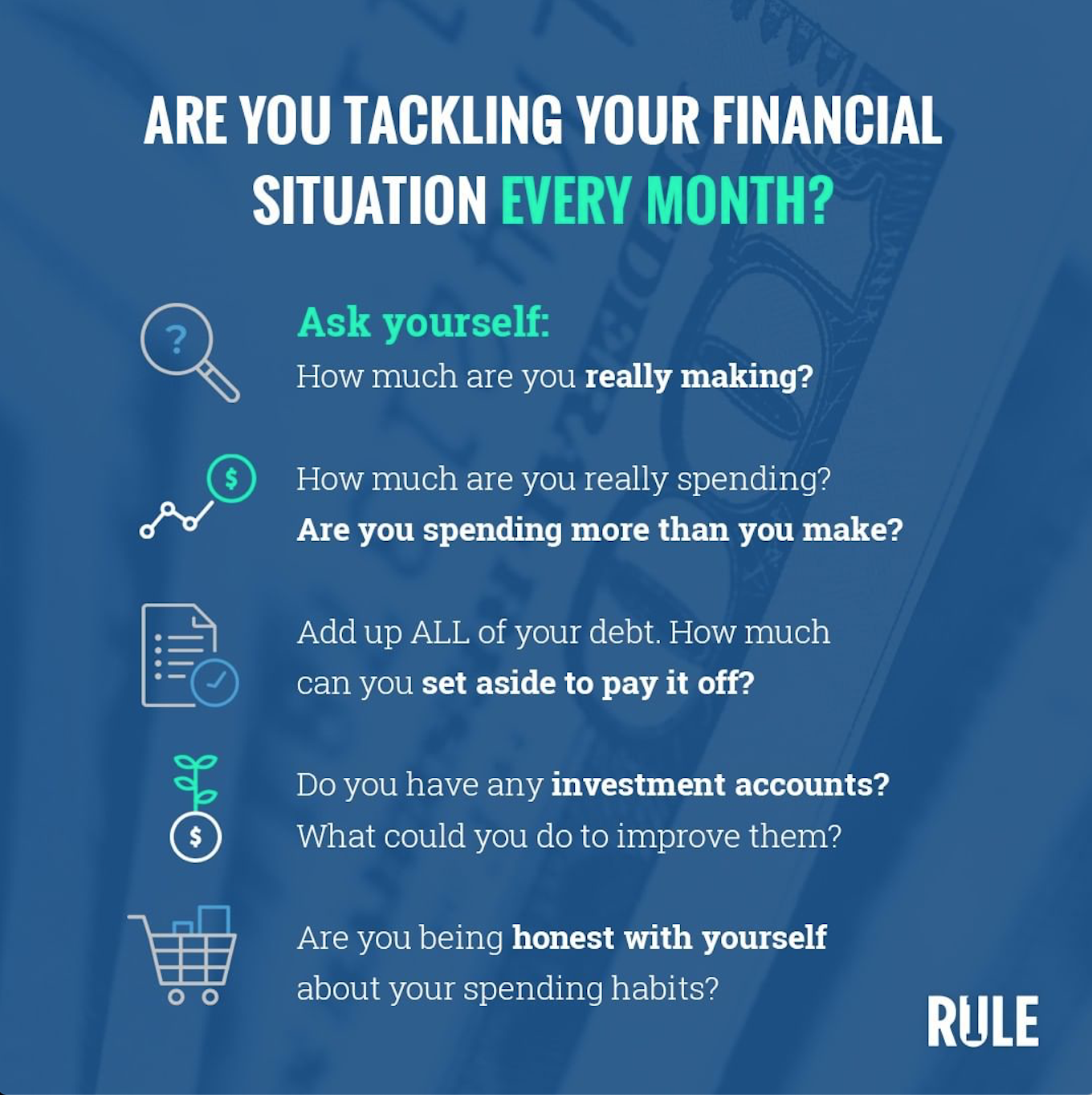
Before you figure out how to spend your money wisely, you first have to understand where it's being spent. To eliminate any guesswork, make a budget sheet and track your income and expenses. Include utility bills, cell phone plan, and other obligations.
Once you know where your money is going, you can begin to seek out opportunities and determine where it could be better spent. Keeping an eye on your current spending will help you identify areas for improvement.
4. Budget Your Money
After you've discovered where your money is being spent, you can reallocate it to different spending categories if necessary.
For example: if you know that you consistently spend $300 per month buying groceries but are only budgeting for $200, it might be time to allocate another $100 to that spending category instead of using that money for nonessential purchase.
Got streaming service you barely watch or cable package rarely used? Canceling subscriptions can free up extra cash each month.
Spending too much time on shopping apps or ordering restaurant meals more often? Regulating can help you save money fast.

Creating and sticking to a budget is one of the best ways to save money and spend wisely to avoid throwing away more than you make.
5. Checking and Savings Accounts
First things first: if you don’t already have a checking account and a savings account, now’s the time to open them. Your checking account is your financial hub—where your pay lands, bills get paid, and everyday spending happens. Your savings account, on the other hand, is your safe zone for setting aside money for emergencies, big goals, or just a rainy day.
Tip: Consider using a bank or credit union that offers competitive interest rates and low fees. Some even provide budgeting apps or tools to help you track your spending and savings goals. And if you’re aiming to make your money grow a bit faster, a money market fund can be a great option for short-term savings.
6. Set Up Automatic Savings
Remove choice from the equation by automatically designating a certain amount of your paycheck into your savings account every month. Setting up direct deposit or automatic transfers makes it easy to save money automatically.
This method ensures that you will be less tempted to spend your money on indulgences and more committed to meeting your savings goals.
7. Build Your Emergency Fund
We’ve all heard the advice: “Save for a rainy day.” But what does that actually mean? An emergency savings fund is money you set aside specifically for unexpected expenses—think medical bills, car repairs, or a sudden job loss. Having emergency savings can protect you from financial emergencies that could otherwise derail your progress.
How much should you save? Financial planners often recommend having three to six months’ worth of living expenses in your emergency fund. I know, that can sound like a lot, especially if you’re on a tight budget. But don’t let that discourage you!
Start small—maybe just $25 or $50 a month—and build from there. The important thing is to start saving.
8. Make Smart Investments
Once you get into a routine of saving money, you can begin to use these savings for smart investments. Investing in mutual funds or opening an investment account can help you grow your wealth for the near future.

Don't let your money sit in a savings account that provides you with less than 1% interest. You won't even be able to beat inflation, meaning your money won't grow at all! What's the point of that?
If you learn how to invest now, you can see your money double or even triple over time. This is where compound interest comes into play.
Double your money using the Rule of 72 and invest in the companies you love. The more you make with your investments now, the greater the opportunity you will have to save for your future.
9. Watch Your Money Grow Year Over Year
What if I told you that you could incorporate smart habits into your everyday life to grow your wealth year over year? Would you do it? I hope so!
While some strategies require time and effort, others are quite passive and easy to implement. Start by making a promise to yourself that you will save a certain amount of money by the end of each calendar year. This could be for holiday gifts, a vacation, or even just to build up your emergency fund.
Then take actionable steps every month to ensure you achieve your goal. Having milestone numbers to hit will allow you to hold yourself accountable no matter what.

Savings Strategy: What Is the Best Way to Save Money for Your Future?
If you take a closer look at your spending habits and become more disciplined with your money, you'll be pleasantly surprised by how much you can save immediately.
More importantly, though, the money you are saving can be invested to help you secure your financial future.
Putting money into quality companies that will grow in value over time is always a wise use of your income.
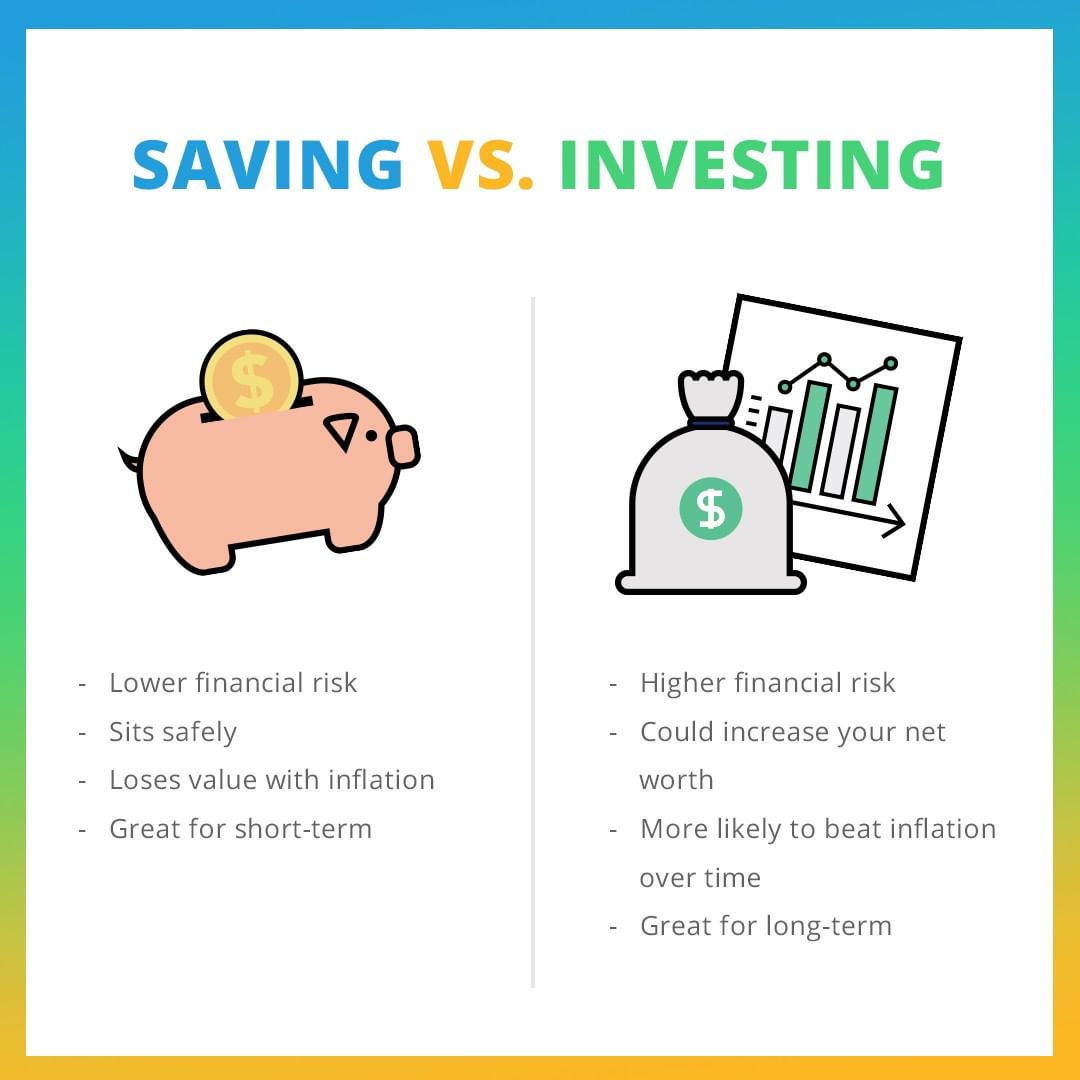
Even if you have nothing beyond a current watchlist at this time, the best way to save money for future plans is to develop a cushion of savings that you can use to invest in companies at great prices should the market crash in the future.
Take Your First Step in Learning How to Invest
Stop just saving, and start growing your wealth.
Set the stage for learning the Rule #1 approach with easy-to-follow lessons that will get you on your way to investing with certainty in no time.
Enroll now in our online course on How to Invest the Rule #1 way, and have a clear plan in place to simply do it.
How to Pick Rule #1 Stocks
5 simple steps to find, evaluate, and invest in wonderful companies.

About Phil Town
Phil Town is an investment advisor, hedge fund manager, 3x NY Times Best-Selling Author, ex-Grand Canyon river guide, and former Lieutenant in the US Army Special Forces.
He and his wife, Melissa, share a passion for horses, polo, and eventing. Phil's goal is to help you learn how to invest and achieve financial independence.
Get Phil's Free Guide